Showing posts with label palace. Show all posts

Saturday, September 13, 2014

a day in Phnom Penh

Travel Truth #4: If you skimp on research, you will pay for it later. 

My only day in Phnom Penh began with a major letdown. My first priority was to visit Kingdom Breweries, Cambodia's premier craft brewery, founded by Leopard Capital and headed up by a German brewmaster. The legend printed on every bottle will happily inform drinkers that every Kingdom brew "blends Europe's finest ingredients with purified water from Cambodia's largest lake to create a traditional yet unmatched flavor."

Yeah, whatever. I just wanted to be able to say that I'd toured the brewery, chatted with the brewmaster, and had a couple of Cambodia's premier craft beers direct from the source. 

I was foiled in that ambition. The date was Sunday, July 20. The brewery was closed on Sundays. 

Rats. 

So I went to the National Palace instead. 


The Silver Pagoda, so called because its floor is one solid sheet of the stuff. You can't see it, though. The curators covered it up with a carpet, the bastards. Apparently it's so tarnished these days that you can't tell what kind of metal it is anyway. 


And then I went to the Foreign Correspondent's Club on the banks of the TonlĂ© Sap River for some chicken and beef satay, prawn shooters with sweet chili aioli and salsa, and some Kingdom pilsener. Even if the brewery was closed, a lot of watering holes along the riverfront still served its products. 


Then I saw the National Museum. I had to buy postcards somewhere, you know. 


Selfies with Siddhartha is going to be the title of my autobiography. 

I rode a tuk-tuk back to Amber House, filled out said postcards, rode another tuk-tuk to the post office, mailed 'em, and then managed to scoot my butt back to FCC for some beef lok-lak and a Hemingway Special for dinner before the evening monsoons broke. 


Phnom Penh accomplished. 

Monday, June 23, 2014

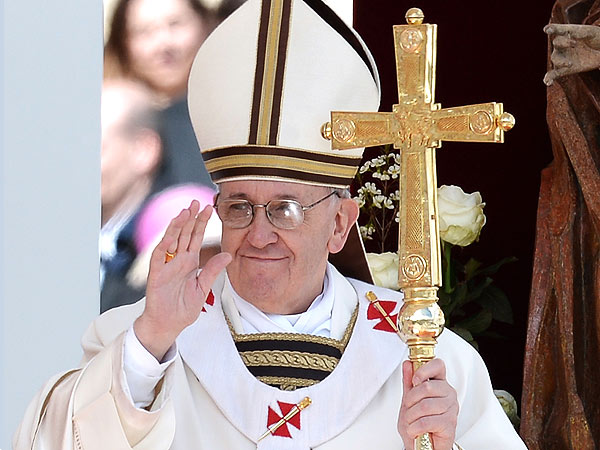
the Pope is coming

I noticed something interesting on the subway TV screens last week: images of Pope Francis interspersed with Korean churches and cathedrals. I didn't think much of it at the time, but a quick Internet check confirmed my suspicions.

The Pope is coming to South Korea. 

People.com

Between August 14 and 16, His Holiness, in his big heavy robes, will flit about this hot, steamy peninsula succoring the victims of the Sewol disaster, conducting Mass at various Korean cathedrals, presiding over the beatification of 124 Korean martyrs, and just generally doing papal things. There will be a parade near Gwanghwamun and (if the article I linked to above is to be believed) over 100 million people will be in attendance. 

I find that a little difficult to believe. This city's population is just over 10 million. I don't see how it could swell by 1000% and not explode. I don't think that many people could physically fit into this town, not even if they flung a bunch of pontoons into the Han River and turned it into a peanut gallery. 

Anyway, Miss H and I return from Hong Kong on the 7th of August, so we'll be here in time to see Francis. If we feel up to battling our way through the teeming throngs, we may try to get a glimpse of the fellow. It'd be cool to say we saw the first New World pope on an official mission of mercy. 

Thursday, April 3, 2014

Park, Lee, and Kim...oh my!

Have you ever wondered why such a staggeringly large slice of the Korean population is named Park, Lee, or Kim? 

So have I. In fact, it used to be the most burning question I had about this peninsula, right behind what "Seoul" means. 

But not anymore. I found the answer. 

First, let me introduce you to a building:

                                                                                                               from Wikimedia Commons

It's called Gyeongbokgung ("Palace Greatly Blessed By Heaven") and it stands in central Seoul, near the intersection of Lines 3 and 5. Up the hill behind it is a famous Buddhist temple and the Blue House, the official residence of the Korean president. Gyeongbokgung was the largest and grandest of the Five Grand Palaces built by the Joseon Dynasty. Originally constructed in 1395, right after Joseon's foundation, and then later burned and abandoned for three centuries, it was reconstructed in 1867. 

Now here's where things start to get controversial. 


The official word is that Gyeongbokgung was burned to the ground by Imperial Japan shortly after their annexation of Korea in the early 20th century. But various reports and accounts I've heard tell a different story. Let me back up and do some more explaining.

Korea's surnames, like Scotland's, were all clan-based in antiquity. The Kims were a clan unto themselves back in the day, and a very powerful one. So were the Parks (or Bak, as I prefer to romanize it). The Lees, too. But there were hundreds of others: Choi, Bae, Woo, Lim, Jang, Jeong, Bang, Go, Min, Hong, Seo, Gang, Yoo, Heo, Yoon, Gwak, Gwon, Yang, Hwang, Myeong, Dong, Ryu, Noh, Na, and Pyo come readily to mind.

Here's the thing, though. Korea used to have a caste system. The Kims, Lees and Parks got so powerful that they became the rulers of some of the peninsula's mightiest kingdoms: Baekje, Silla, Goguryeo, and Joseon. Everybody else got the shaft. The Gangs and Yoos and Yangs remained commoners. Granted, any commoner could sit for the gwageo (civil service examination) and become a yangban (civil servant), entitled to an estate and aristocratic privileges...but hey, noble names were still noble names, and common ones common.


When the Japanese annexed Korea in 1910, one of the first things they did was abolish the caste system. Suddenly a Kim was no better than a Choi, and Park no worthier than a Jang. But the names themselves still retained some time-honored clout. It was a mark of prestige to be a Kim or a Park, even if the Japanese had barged in and said it didn't count for beans anymore. 

So, according to what I've heard, Gyeongbokgung wasn't burned down by the Japanese. It was burned down by the Koreans. See, Gyeongbokgung was where the Hall of Records was. Everybody's birth certificates and genealogies were in there. With those reduced to ashes, a lowly Pyo or Hong could waltz right into the nearest Japanese registrar's office and say "Hello there. I'm Mr. Kim." Or "Howdy doody, ilbon saram! I'm Mr. Lee!" 

I don't know if that's true or not, but I have to admit it's a compelling theory. Korea suffers from a deplorable excess of Kims, Lees and Parks because their granddads all wanted to put on airs and had no qualms about committing arson to do it. This is why I secretly rejoice whenever I see an extremely rare surname (such as Gwak, Yang or Pyo) because I know that that person's ancestors had enough pride in their roots not to torch the royal palace and then fake their names during the next census.

And now you know the rest of the story.


P.S. Can you think of anybody else who might be using the name "Kim" to give themselves some street cred...?

Saturday, October 5, 2013

the Forbidden City

...or not.

Look: I'm a Californian. There are certain rules Californians abide by. One of them is to never end a sentence with a preposition.

I'm joking. I just broke that rule. Rule-breaking is what we do in California. Drug laws are optional, speed limits are just conservative suggestions, and contravening societal norms is the official state pastime.

But seriously: all kidding aside, the first rule of being a sane Californian is this: avoid crowds.

Crowds are everywhere in California, and much like hurricanes, they are capricious and pervasive during certain times of the year, but can be anticipated and predicted with a degree of scientific accuracy. So over the decades, we've developed certain strategies for avoiding the other 38 million ass-hats that live in our lovely state and circumventing crowd-related calamities.

For example:

  1. Purchasing a year-long pass to Disneyland so you can take a day off and go there on Wednesday instead of having to fight your way through the weekend throngs and ticket lines.
  2. Getting the hell out of Dodge (i.e., the L.A. Basin) before 3:30 p.m. on a weekday, or else you'll be stuck in bumper to bumper traffic on Interstate 15 as the commuters head home to the High Desert. On weekends, you get out even sooner (or don't go at all), as everybody and their mother with a boat or a hole in their pocket will be leaving at noon for Lake Mead or Las Vegas.
  3. Making a reservation at Cheesecake Factory or Joe's Crab Shack or Red Lobster or even the goddamn hot dog stand on the corner, 'cause you're SOL if you don't, buster. (Or rather, SIL—standing in line, something the average Californian has about 20,000 hours of experience doing.)
  4. Picking the tiniest, dumpiest, lousiest backwater on the map and going to that town's DMV office, 'cause you'll have to camp out overnight in front of the one in your town and wait in a line around the building otherwise.

Get the picture?

Unfortunately, there's no escaping some crowds. If you're planning on a day in Santa Monica, Malibu, Venice, Long Beach, or any of the other coastal suburbs (or their fabulous beaches), you're going to get stuck in traffic. Just accept it. You'll have to fight your way in and fight your way out.

If you're anywhere near Grauman's Chinese Theatre on a premiere night, you'll be weaving through packs of sozzled socialites and dodging homicidal Lamborghinis. Might as well get used to the idea. 

And unfortunately for me, there seems to be no getting around the crowd (literally) anywhere in the vicinity of Tiananamen Square on a holiday weekend, rain or no rain. The place was packed with tourists, both Chinese and foreign. Miss H, Miss J and I had elbowed our way through the square and taken a breather in Zhongshan Garden, but now it was time for the main event: the Forbidden City.

The Forbidden City. It's on everyone's Beijing bucket list. It was the residence of the Chinese emperor from the Ming Dynasty to the end of the Qing Dynasty, a period of nearly 500 years. It consists of 980 buildings and covers 720 square kilometers
—making it larger than that imaginary sky-citadel I drew with blue and red crayons in my 3rd-grade art class. (TouchĂ©, China, touchĂ©.)

Did I want to see it? Yes.

Did I see it? Sort of.

Miss H, Miss J and I joined the inchoate mass of people funneling into the palace at the main gate. I marveled at the great honking picture of Mao Zedong which adorned this structure. It seems that the Chinese people can't get enough of the Great Architect. His mug's everywhere: on the Forbidden City gates, in private homes and businesses, on postcards and stamps and posters, and on every single bill of every denomination of the yuan. (Yikes.) This one, however, took the cake: tall as a house and glowering over Tiananmen Square as though still ticked off at those student protesters from 1989.


We passed under the enormous, intimidating archway and found ourselves in a broad courtyard flooded with human beings:


I was annoyed and dismayed by the crowd. My imagination wanted to run away with me, but the roiling stew of people foiled it at every turn. I marveled that I stood on a patch of ground which Chinese peasants had been forbidden to look upon for five centuries. I wondered what kind of defensive fire the palace guards could call down upon the invaders or rebels who somehow surmounted the main gate and entered this vast yard. But the people shouldering me aside and tripping over my feet rather distracted me from these delicious ideas.

We passed the next great archway (whose doors were studded with great metal knobs, presumably for defense) and found ourselves in...um, another courtyard. Rather similar to the first, I might add.


We were rapidly tiring of this game. The only difference between this yard and the last one was that this new one had a ticket office in it. In the mist-shrouded distance lay the most impressive gate yet. It possessed great, majestic wings which branched out from the central structure as though to lock visitors in its mighty embrace.


...and which were also coated with ugly scaffolding.

The whole thing was being restored and renovated, it looked like. Just our luck. Tokyo Tower was being renovated when I was there in August; Mao's Mausoleum had scaffolding all over it; and now this. It was just about enough for the three of us. The crowds, the drizzle, the long walk, and the castrated look of the palace under construction combined to dampen our enthusiasm. With scarcely a word between us, we three turned about and walked away from the Forbidden City. We neither penetrated its unknown depths nor paid a single yuan in admission fees. We were tired, footsore, cranky, and ready for a nap. So we returned to the Novotel Xin Qiao and had one, a sinfully good one.

When we awoke in the middle of the afternoon, we were ready for our final conquest: THE TEMPLE OF HEAVEN.

But that's a story for another day.

Friday, May 15, 2009

Gyeongju: temples and tourism

I awoke on the morning of the second day (the first full day) in Gyeongju, the "museum without walls"...or perhaps it is more appropriate to say that I came to myself. Sleep is a liberal word for what I did in that room. It was so hot and stuffy in there that I hardly got any rest at all. I had to kick the covers off and just sleep on the bare mattress. I did snatch a little rest, however. I got up, re-dressed (I'd slept in the previous day's clothes), arrayed myself with water and camera once again, and advanced boldly to the nearest bus station.

It was my plan to see Bulguksa, the famous Buddhist temple some 16 kilometers east of Gyeongju, and Seokguram Grotto, an even more well-known monument, an enormous Buddha presiding over the eastern face of the mountains behind the aforementioned temple. I expected it to take all day. If I had any time left over, however, I figured I'd just go the rest of the way to the East Sea (the Sea of Japan) and view the sea-tomb of King Munmu, said to be the only underwater tomb in the world.

It was at the bus stop where one of those fateful international travel meetings occurred. I bumped into a fellow foreigner. Actually, he struck up a conversation with me...not in my usual mold at all. I'm usually the more amiable one who starts talking first, but he just sauntered up and said hello. His name was Jerry. He was taller than I was, fair-skinned, with curly, almost frizzy brown hair and a few freckles. His accent was difficult to place. It definitely sounded as though it originated in the U.K. somewhere, but there was something off-kilter about it. It was the same sort of confusion I'd experienced in trying to place Adam and Elaine's accents upon first meeting them. But Jerry wasn't a Geordie. He revealed himself to be German-Irish (born in Germany, raised in Ireland, bilingual...no wonder I'd been having trouble). He was a friendly fellow. He was on vacation from a teaching job in Japan, and had picked Korea as the cheapest destination. We were both headed to Bulguksa and Seokguram Grotto, so naturally we decided to stick together and go venturing as a duo. That was a happy decision; the day was made so much more fun and memorable for it.

After a twenty-minute bus ride we were in the main parking lot before the temple, in the foothills of the mountains. The day, partly cloudy in Gyeongju proper, had degenerated into a sort of sullen overcast. The ground was soggy and muddy, but at least the sun wasn't beating down as we climbed the wide causeway up the hill to the entrance of the temple. There were some beautiful ponds, ringed with pines and weeping willows, into which quiet waterfalls were trickling with a cheery sound. We passed the gate, and the four imposing temple guardians which guarded it with massive weapons and snarling visages, and entered the temple proper.
Inside the temple it was a zoo. It seemed the traffic I had endured on the bus ride to Gyeongju hadn't passed this place up. It was, as I mentioned before, a double-holiday weekend. Indeed, the monks had strung the entire temple complex up with multicolored paper lanterns in recognition of Buddha's Birthday, an amazing feat, as the temple was of no small size. And so Jerry and I began to wander; up this hill, down that staircase, across the other courtyard.
It was an impressive place, and bigger than Bongeunsa in Seoul, if I was any judge of size. I peeked inside the temple buildings (I didn't take any photos out of deference to the monks' wishes), and though the architecture was not as grand nor complex as Bongeunsa's had been, it still invoked awe and reverence. In the central courtyard were the two pagodas whose replicas I had seen at the National Museum the previous day: Dabotap and Seokgatap. Dabotap was swathed in a scaffolding, wreathed with opaque sheets of burlap; there was some kind of renovation or restoration going on, I guessed. But Seokgatap, the plainer of the two obelisks but nonetheless impressive, was revealed in all its glory.

We wandered on, out of the crowd, and passed through the remainder of the temple. There was something odd I hadn't been able to put my finger on at first, but it was just about then, as we were exiting the central courtyard, that I realized it. I hadn't seen a single monk. They were nowhere in sight. Only the uniformed exhibit guards, clothed like the priests but not shaved bald and obviously not part of the doctrine, were present in the temple that day, it seemed. Jerry and I tossed around various explanations for this, the most convincing and least insulting of which held that the monks went under hatches on big tour days like this and came out again to clean up the mess afterwards and get on with the monking business.

We passed some intriguing and, I'm ashamed to admit, inexplicable sights. I always have wondered how journalists and writers manage to divine the purpose for or origin of the strange customs and phenomena they witness during their peregrinations. I suppose the obvious answer is that they ask. I am neither sufficiently fluent in Korean nor resilient enough against the half-imagined potential for ridicule to ask that kind of question aloud, so I either resort to inane guesswork or merely present facts as I see them for the reader to interpret. I'll do better next time, I promise. One of the inexplicable sights Jerry and I witnessed was this:

People had collected bunches of loose, oblong, amorphous rocks in this one place and had stacked them up into intricate little piles. I've seen these tiny, precarious cairns in several other places around Korea since then (all of them outdoors) and can only assume they have something to do with good luck or good health. And then we were on our way out.
I couldn't just leave one of the most famous Buddhist temples in Korea without some kind of proof, and if that proof could also serve as a good-luck charm for whatever harrowing circumstances or imbroglios I might find myself entangled in years down the road, so much the better. To that end, I stopped in at the gift shop and purchased, for two thousand won, this little number.
It's a yeomju, a Buddhist wish-maker and protection-giver. It saves you from evil, and you can also make wishes on it, if I'm not mistaken. The larger varieties can fit around the gearshift of your car, for the stimulation of beneficent vehicular fortune. We had bigger fish to fry.

After departing Bulguksa, we made a quick stop by the tourist information booth to obtain the route up the mountain to Seokguram Grotto, a UNESCO World Heritage site and home of an enormous carved stone Buddha, seated in an artificially buried temple facing east from the mountain face to the Sea of Japan (sorry, the East Sea, as the Koreans call it). We got the route, but missed it. Somehow or other we wound up walking up the road. Fortunately we realized our mistake and turned back after a kilometer or two; otherwise we'd have been walking uphill for five hours.

We retraced our steps, went a little ways back toward the temple, and finally found the correct trail. On our way up (it was not hot, but the trail was steep, and we got quite sweaty) we discovered this!
It's a spring, a spring of fresh mountain water trickling down the mountainside. We both drank of it. It was largely tasteless, but fresh. Seeing as how I couldn't drink the tap water back in Gohyeon, drinking from a source of water welling up out of the ground was quite novel to me at that point. I know what you're thinking. The whole effect is rather tarnished by the rubber hose sticking out the dragon's mouth and the cell phone advertisement on the sign board. But what are you going to do? This is Korea.

Not long after this (thank goodness) we were at the top. Not quite the summit, mind you, but the top. From here it was an easy walk along the ridge line to the grotto. Or at least, it would have been, if it weren't for the line. I'm speaking of the humongous line of people waiting to get in to see the grotto.

By some cosmic twist of fate, there was a troublesomely large number of people trying to see this Gyeongju attraction as well. I am, of course, being extremely sarcastic. Of course there were a lot of people here. It was a holiday weekend, and this was another scenic wonder of Gyeongju (and Korean National Treasure No. 24), for Pete's sake. I don't know much about who built it or why, but it was truly astounding close-up. Recessed into the grotto, barely swimming up out of the shadows and dim electric light, loomed the enormous figure of the Enlightened One, his head geometrically aligned with the lotus flower or sun thingy or whatever it was on the grotto wall behind him, presiding silently over the assembled company (and indeed, the entire countryside) as he had been for some time, and might conceivably continue doing for eternity. This was one of the few times during my trip to Gyeongju that I, desensitized to temporal displacement by fiction and literature, felt properly awed by the weight of ages.
I remained respectful to the wishes of the curators and took no pictures. Perhaps it's best to let my memory stand on that count. A brief glimpse, the thrill of rarity and antiquity, an achievement after a long trial (we did climb the mountain by ourselves, when there was bus up the mountainside we could've taken)...and then we passed on.
Predictably, as we made our way down the trail back to the parking lot at the trailhead, the line had disappeared. Figures. Due to our dwindling amount of time that day, Jerry and I elected to take the bus back down the hill. After a 20-minute wait, we accomplished this; after another 20-minute wait, we got the bus back to Gyeongju. We immediately resolved to set out for the Sea Tomb of King Munmu, as we'd previously discussed; but it was already dinnertime, and the sun was getting low in the sky; Bus 150 wasn't showing itself. We had just barely missed it as we got off in Gyeongju. We wouldn't have time to get 20 kilometers back east to the ocean in time to see the tomb in the glory of sunset, so we decided to skip it, and returned to Tumuli Park instead.

Well, I returned...Jerry hadn't seen it yet. I'm ever so glad he came up with the idea of touring it by evening. My first look at it (visible in some of the pictures I've posted), under the leaden gray skies, was not encouraging. Now, lit by the glorious brilliance of the evening sun, it was a far cheerier and more satisfying sight indeed.

We toured the whole park, strolling around in the warm, still evening air, the park itself filled with families and field trips and tour groups and even some other foreigners. I took loads more pictures; I had to recapture everything I'd photographed in the previous day's drabness. As an added bonus, the line to get into Cheonmachong (the Heavenly Horse Tomb, remember?) wasn't so prohibitively long that evening, so after we'd finished with the rest of the park we got in line and managed to get inside in what could reasonably called, by Korean standards, a jiffy.

It was impressive inside. Once again, I took no photographs as per regulations, but I think I can muster up a decently florid description. They'd scooped out the inside of one of the tumuli, cross-sectioning half of it so that the king (whoever he was) and his tomb, remains and all, would be visible, as well as the striations of dirt and gravel used in the construction of the mound. They'd put in hard cement flooring, added a ventilation system and stainless steel gates, and in the inner walls of the mound (opposite the king's wooden burial chamber), they'd placed display cases with artifacts recovered from the tomb. There was drinking ware, and personal trinkets, and equestrian equipment, very well preserved. The Heavenly Horse Tomb, in fact, was named for the insignia found emblazoned on some of the saddles and saddle blankets found in the tomb.
Standing there in that tomb, the dark vault of the mound's interior arching over my head, the almost religious half-light of the displays playing over my face, the very casket of the royal family within arm's reach, the weight of ages pressing down upon my shoulders...I could hear the voice of the king.
"Hey, what's the big idea?! I was sleeping peacefully in here until you bozos came along, scooped out my mound, stuck in some tasteful mood lighting and dropped a glass partition through my casket! Who the heck d'you think you are? God, as if subduing the entire Korean peninsula wasn't enough, now I have to donate twelve hours of my precious afterlife every day so moon-eyed tourists can waddle through my resting place and gawk at my treasures? At my very remains?! Whose brilliant idea was that? How did my tomb get picked for this kind of sacrilege anyway?"
Indeed, it was hard for me to reconcile the two extremes: a Korea that claims to care deeply about and take pride in its long and time-honored history, and a Korea that turns its tombs into tourist traps. Don't get me wrong: there's nothing vitriolic in my musings. I lay blame on no one; I am not attempting to lambaste the commercial world we live in. I am merely speculating, and I invite you to do so as well. After this we headed north briefly (passing through Noseodong once again)... ...and wound up in the central downtown area of Gyeongju, whence began the bars and restaurants. After a little reconnoitering we finally decided on Pyeongyang, a restaurant whose name bears a vague resemblance to the North Korean capital. Any similarities to Communism ended there, however. The food was good (we had beef marinated in soy sauce, grilled over a bed of coals at our table, Korean style), the place was cozy, and even though we didn't have beer or soju, it was still a unique enough experience to indoctrinate Jerry with. He was used, as he admitted, to Japanese cuisine, which is somewhat bland compared to Korean food, I understand. Korean food is spicy. All of it. Pretty darn spicy, too, by most people's standards. I supposed I'd gotten used to it, or else my upbringing, fraught as it was with spicy food (my dad's a fiend for Mexican, particularly red chili sauce) has dulled my sensitivity.
Things only improved from there, if that were possible. Retracing my route from the previous day almost to the letter (with the exception of the Gyeongju National Museum), Jerry and I proceeded to tour Wolseong Park and Anapji Pond...after dark. Nocturne, Korean style. It was transcendently beautiful. Some clever electrician had rigged up the whole of the Wolseong tumuli and the fringe of trees lining the old fortress walls with floodlights. Not only that, but they'd gone on and done it to Anapji Pond, too. The restored pagodas were lit up like skyscrapers on a holiday, and the pleasant little woodland surrounding the pond was splashed with luminescence of the most lurid and astounding kind. Even the little well, the washing-pond I'd noticed earlier in the day (and that I begged you to take note of) was brightened up with a series of submarine lights that changed colors every half-minute or so: first vivid red, then deepest blue, now warmly purple and green.

And that was just about the end of our little adventure together, Jerry and I. We stopped in for a beer at the London Pub...

...and in deference to his hostel's curfew we split just before 11:00 p.m. We returned on sore legs and aching feet to our respective accommodations: he at the Hanjin, and myself right across the road at the forty-grand-per-night yeokwon I'd selected. We said our goodbyes, promised to meet up on Facebook, and departed as friends.

The day was infinitely better for his company.