Billed as a chance to score some one-on-one time with the rare, elusive Indochinese tiger, the reality turned out to be neither one-on-one nor much time at all. We strode across half a kilometer of dusty temple grounds, strewn with indolent, wandering water buffalo and skittish deer, to the nexus of the action, a spot fancifully called "Tiger Canyon." It was a gully naturally carved out of the pale rock and ochre dust, leaving a natural shady grotto with an artificial waterfall built by some thoughtful, wealthy, and guilt-wracked Thai millionaire. We eager guests traversed the the gravel and hard-packed dust to the bottom of the gully, where a stout fence and double lines of gawkers heralded our arrival at the tiger paddock. Beyond this fence, tigers—some dozen of them—sprawled everywhere near the rock pool at the base of the waterfall, spreading themselves out like the viscous liquid which all somnolent cats resemble. Tanned, dreadlocked foreign volunteers sorted us into two lines: the camera-bearers and the camera-less. I was shunted into the former. When I got to the head of the line, a curt Thai volunteer grasped my wrist and hustled me from one tiger to the next, shoving me into a crouch, snatching my camera away, snapping a picture or two, yanking me to my feet, and packing me off to the next recumbent feline form. The whole affair was run with the efficiency of an assembly line and the quickness of a soccer substitution. I didn't get to savor the fact that I was sitting next to, or petting, a goddamn tiger. It was rather anticlimactic.
Showing posts with label Bangkok. Show all posts
Friday, September 26, 2014
Wat Pha Luang Ta Bua (Tiger Temple)
A scant 30 minutes from the River Kwai bridge was the golden horn of this little seventy-dollar tour I'd taken out of Bangkok on Saturday, July 26: Wat Pha Luang Ta Bua. The Tiger Temple.
Billed as a chance to score some one-on-one time with the rare, elusive Indochinese tiger, the reality turned out to be neither one-on-one nor much time at all. We strode across half a kilometer of dusty temple grounds, strewn with indolent, wandering water buffalo and skittish deer, to the nexus of the action, a spot fancifully called "Tiger Canyon." It was a gully naturally carved out of the pale rock and ochre dust, leaving a natural shady grotto with an artificial waterfall built by some thoughtful, wealthy, and guilt-wracked Thai millionaire. We eager guests traversed the the gravel and hard-packed dust to the bottom of the gully, where a stout fence and double lines of gawkers heralded our arrival at the tiger paddock. Beyond this fence, tigers—some dozen of them—sprawled everywhere near the rock pool at the base of the waterfall, spreading themselves out like the viscous liquid which all somnolent cats resemble. Tanned, dreadlocked foreign volunteers sorted us into two lines: the camera-bearers and the camera-less. I was shunted into the former. When I got to the head of the line, a curt Thai volunteer grasped my wrist and hustled me from one tiger to the next, shoving me into a crouch, snatching my camera away, snapping a picture or two, yanking me to my feet, and packing me off to the next recumbent feline form. The whole affair was run with the efficiency of an assembly line and the quickness of a soccer substitution. I didn't get to savor the fact that I was sitting next to, or petting, a goddamn tiger. It was rather anticlimactic.
I wasn't in the sweetest of moods after the three-and-a-half-hour trip back to Bangkok. Imagine my surprise and delight when I reentered my cubicle at Boxpackers and discovered a lovely handwritten note from Emilia, my Kentish dorm-mate. Sadly, our paths had parted. After I'd left for my tour at 6:30, she had checked out at noon, bound by train for Chiang Mai. I had considered leaving her a note, but hadn't wished to appear forward and creepy; so I'd desisted. She was more earnest. In her missive she wrote that it had been nice to meet me, and she wished me well on the rest of my journey. It's not often you meet such genuineness out on the road. I do hope she and I meet again someday.
Billed as a chance to score some one-on-one time with the rare, elusive Indochinese tiger, the reality turned out to be neither one-on-one nor much time at all. We strode across half a kilometer of dusty temple grounds, strewn with indolent, wandering water buffalo and skittish deer, to the nexus of the action, a spot fancifully called "Tiger Canyon." It was a gully naturally carved out of the pale rock and ochre dust, leaving a natural shady grotto with an artificial waterfall built by some thoughtful, wealthy, and guilt-wracked Thai millionaire. We eager guests traversed the the gravel and hard-packed dust to the bottom of the gully, where a stout fence and double lines of gawkers heralded our arrival at the tiger paddock. Beyond this fence, tigers—some dozen of them—sprawled everywhere near the rock pool at the base of the waterfall, spreading themselves out like the viscous liquid which all somnolent cats resemble. Tanned, dreadlocked foreign volunteers sorted us into two lines: the camera-bearers and the camera-less. I was shunted into the former. When I got to the head of the line, a curt Thai volunteer grasped my wrist and hustled me from one tiger to the next, shoving me into a crouch, snatching my camera away, snapping a picture or two, yanking me to my feet, and packing me off to the next recumbent feline form. The whole affair was run with the efficiency of an assembly line and the quickness of a soccer substitution. I didn't get to savor the fact that I was sitting next to, or petting, a goddamn tiger. It was rather anticlimactic.
Labels:
animals,
Bangkok,
Buddhist temples,
friends,
girls,
Kanchanaburi,
Southeast Asia,
Thailand,
tigers
Wednesday, September 24, 2014
the floating markets of Kanchanaburi
It was rather like a field trip, only we didn't stop by school first. The bus came right to my house. At the crack of dawn I was up and ready, but the tour company beat me to the punch. I was still throwing things into my satchel when a bleary-eyed young night clerk came up to tell me a car was parked downstairs for me. I dashed down and leaped into a full-size van, and off we went. There were already two bony, exhausted-looking young Italian girls inside, and on our way out of Bangkok we stopped to pick up three burly Indian fellows and two elderly, grinning Australian women.
The driver was a tall, gaunt man with longish hair and a Heineken baseball cap who barely spoke two words and spent our rest stops sitting in the driver's seat and smoking a listless cigarette. The guide was a shorter, bug-eyed, toad-mouthed fellow with close-cropped graying hair. He introduced himself thus: "My name Cham Long. You call me Long Cham." He grinned a lot and had a wicked sense of humor. He kept patting my pudgy stomach and asking me when my due date was, and he hinted incessantly that one of the three Indian fellows was a ladyboy.
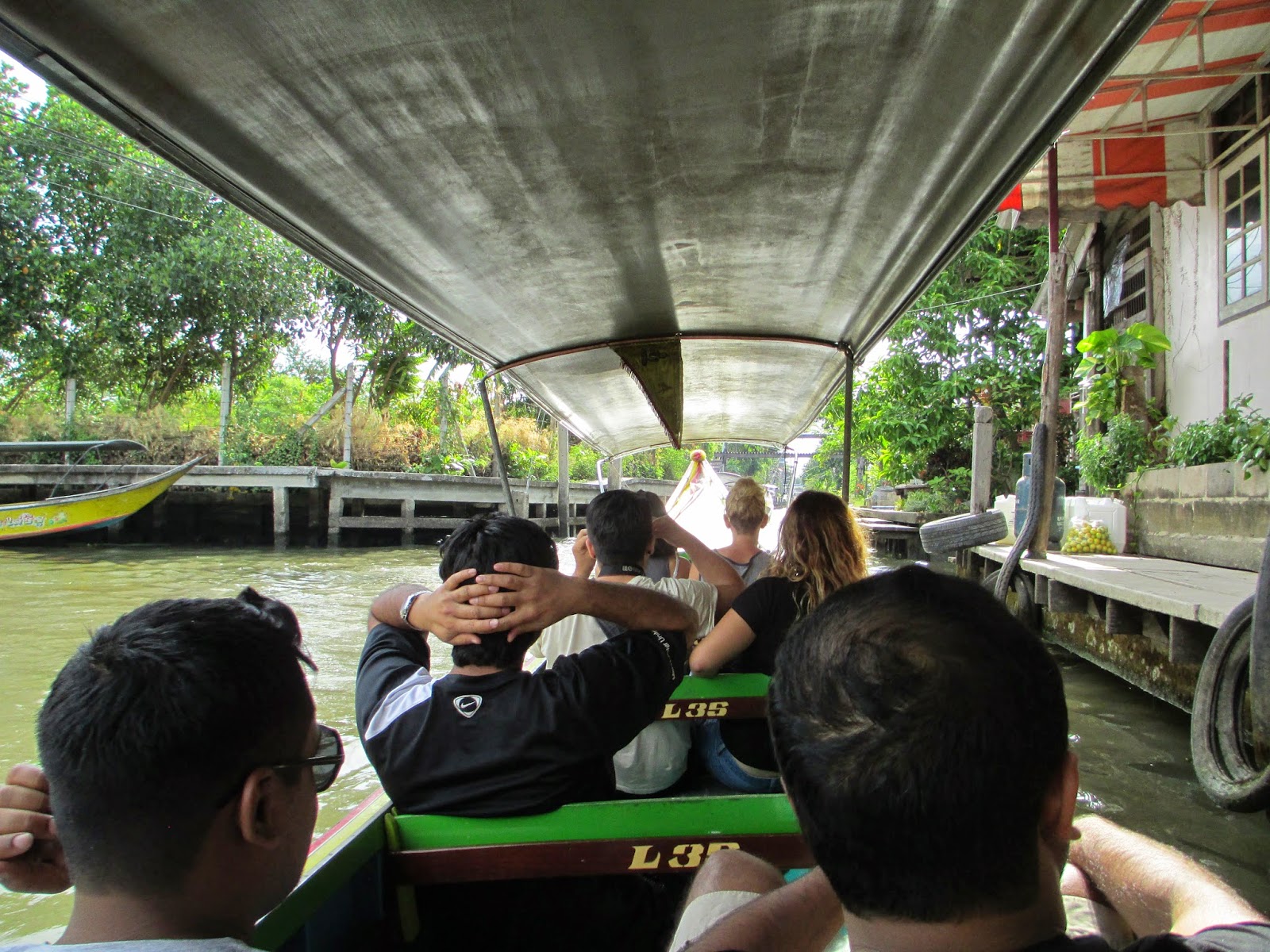
The tour was good, but it was so...rushed. We had only an hour at the floating markets (after a two-hour drive to get there!) which was just enough time for a quick paddle around—for 200 baht—and a sip of coconut juice.
After we finished with the markets, Long Cham rounded us up and we were whisked off to lunch, an assortment of spicy, savory Thai dishes laid out buffet-style at a roadhouse. We were all too hungry to make much conversation, and people pretty much stuck to their own cliques. I was the only solo traveler, but that's fine; I was never much for conversation anyway.
After another long drive, we found ourselves at...
Labels:
adventure,
Bangkok,
coconut,
food,
Kanchanaburi,
Southeast Asia,
Thailand
Tuesday, September 23, 2014
Bangkok, day two: Chinatown
So much for my promise about walking everywhere today (Friday, July 25, 2014). I was feeling so drained after my grueling trek through riverside Bangkok (and so at peace with the world after my lengthy rest in Wat Suthat) that I hired a tuk-tuk to take me to Chinatown for dinner.
Here's where things really started to go south. I rode the Skytrain (Line 2) from Hua Lamphong to the transfer station at Sukhumvit/Asok, but the rush-hour crowds there were beyond imagining. I would have had to wait in line for an hour just to get a ticket, let alone actually board the Line 1 train. So I said "Screw it" and decided to hunt up a beer bar I'd heard about, BREW Beers & Ciders. I knew it was on Sukhumvit 55, and I was on Sukhumvit Road anyway, so I strolled about ten or twelve blocks south, from Asok to Thong Lo, and turned left (east) on Sukhumvit 55 as darkness fell. I walked a good kilometer along the gum-pocked sidewalk, dodging scooter drivers and ladyboy hookers and drunken salarymen and horny foreigners looking for a fix and a quick fuck. I finally reached the alley where BREW allegedly was, but I couldn't find it. I walked up and down, past other trendy and upscale bars, coffeehouses, and Thai-Chinese fusion restaurants, but I never located it. I later learned that I had walked right by it. It lay at the mouth of the alley, but it was hidden from me by some stupid outdoor seafood restaurant that took up half a block and hid the bar from my view.
I was hot, sweaty, footsore, and felt like I'd hiked 80 miles. I hiked back to Thong Lo and caught the Skytrain home. The crowds had thinned out by this time. I showered, checked in with my Kentish cubicle-neighbor Emilia, updated my journals, and hit the sack.
Tomorrow: my package tour of Kanchanaburi, northwest of Bangkok, begins with the floating markets.
| Innovative solution... |
![]() |
| Fortunately the food was pretty dang good, and so was the beer, or there would have been trouble. |
![]() |
| Coconut curried crab. Since I was breaking rules today, why not break my no-food-selfie rule, too? |
| As you can see from the signs, I could have had shark fin or bird's nest soup, but I thought I'd keep things simple. And humane. |
I was rather disappointed in the place. It had all the authenticity of a corny Japanese theme park, all the priciness of a Sino-Korean neighborhood, and all the dirt and slime and grunge of a Vietnamese metropolis. I ate quickly at Lek & Rut Seafood, paid 500 baht(!!!), and caught a tuk-tuk back to Hua Lamphong Station.
Here's where things really started to go south. I rode the Skytrain (Line 2) from Hua Lamphong to the transfer station at Sukhumvit/Asok, but the rush-hour crowds there were beyond imagining. I would have had to wait in line for an hour just to get a ticket, let alone actually board the Line 1 train. So I said "Screw it" and decided to hunt up a beer bar I'd heard about, BREW Beers & Ciders. I knew it was on Sukhumvit 55, and I was on Sukhumvit Road anyway, so I strolled about ten or twelve blocks south, from Asok to Thong Lo, and turned left (east) on Sukhumvit 55 as darkness fell. I walked a good kilometer along the gum-pocked sidewalk, dodging scooter drivers and ladyboy hookers and drunken salarymen and horny foreigners looking for a fix and a quick fuck. I finally reached the alley where BREW allegedly was, but I couldn't find it. I walked up and down, past other trendy and upscale bars, coffeehouses, and Thai-Chinese fusion restaurants, but I never located it. I later learned that I had walked right by it. It lay at the mouth of the alley, but it was hidden from me by some stupid outdoor seafood restaurant that took up half a block and hid the bar from my view.
I was hot, sweaty, footsore, and felt like I'd hiked 80 miles. I hiked back to Thong Lo and caught the Skytrain home. The crowds had thinned out by this time. I showered, checked in with my Kentish cubicle-neighbor Emilia, updated my journals, and hit the sack.
Tomorrow: my package tour of Kanchanaburi, northwest of Bangkok, begins with the floating markets.
Labels:
Bangkok,
beer,
China,
failure,
food,
frustration,
problems,
Southeast Asia,
Thailand,
trains
Monday, September 22, 2014
Bangkok, day two: Wat Suthat and the Giant Swing
After I left Wat Phony I walked all the way around the National Museum, the royal palace and Wat Phra Kaew. Seemed to take hours, though it was barely one. No tuk-tuks today, remember? I'd promised myself.
I'd originally intended to tour the palace and Wat Phra Kaew, but I changed my mind when I came around the corner of the palace wall and saw the pulsating throng crowding the main gate. White tourists buses kept rolling up and disgorging clamoring heaps of pudgy, fatuous, ridiculously-dressed Asian and European tourists, and I "couldn't get no show" as Mark Twain would say. I walked on, past the museum, fighting my way through the stagnant afternoon heat, trailing a japing pack of young Thai army cadets on a long and completely unnecessary detour around Saranrom Park. I probably should've stopped and strolled through this park, but didn't because another pack of army cadets was doing drills in it and I didn't want to have anything to do with the military while I was here.
On the east side of the park I was accosted by a plain-clothed policeman of Chinese descent with a bristly, pencil-thin mustache and a whiny, nasally voice who wanted me to walk (or rather, hire a tuk-tuk) to take me to the giant standing Buddha at Wat Intharawihan. I nodded, said I'd consider it, and walked north to Wat Suthat (and the Giant Swing, which isn't really a swing at all).
It was quiet. It was peaceful. It was airy and breezy and cool. There were hardly any phonies. The ceiling was high and vaulted and had all the quiet reverential quality of a church. The pillars and walls were coated in scenes depicting the life and trials of the prince Siddhartha, fantastically intact after all this time. There were a few worshipers—old men, mostly—quietly meditating and bowing. Electric fans hummed soothingly away in the background. I sat on the temple grounds for 40 minutes and inside the temple proper for 15, just soaking up the atmosphere (and drying off after my long walk).
I'd originally intended to tour the palace and Wat Phra Kaew, but I changed my mind when I came around the corner of the palace wall and saw the pulsating throng crowding the main gate. White tourists buses kept rolling up and disgorging clamoring heaps of pudgy, fatuous, ridiculously-dressed Asian and European tourists, and I "couldn't get no show" as Mark Twain would say. I walked on, past the museum, fighting my way through the stagnant afternoon heat, trailing a japing pack of young Thai army cadets on a long and completely unnecessary detour around Saranrom Park. I probably should've stopped and strolled through this park, but didn't because another pack of army cadets was doing drills in it and I didn't want to have anything to do with the military while I was here.
On the east side of the park I was accosted by a plain-clothed policeman of Chinese descent with a bristly, pencil-thin mustache and a whiny, nasally voice who wanted me to walk (or rather, hire a tuk-tuk) to take me to the giant standing Buddha at Wat Intharawihan. I nodded, said I'd consider it, and walked north to Wat Suthat (and the Giant Swing, which isn't really a swing at all).
In this temple, I found Nirvana—or the closest thing to it on such a hot, miserable, swampy day. I sat down on the red velvet floor and gazed contemplatively over the enormous sitting Buddha, with his long earlobes and his languorous hooded eyes and his lips tinged with that old Angkor smile. I liked Wat Suthat better than any other temple I'd been in, and I've been to temples in six Asian countries. I've been to temples with Buddha statues of solid emerald and floors of pure silver, temples with heaps of glittering gold artifacts sitting at the Enlightened One's feet, temples saturated with the smell of incense and washed with the rays of the sun and the spray of the sea. To blazes with them all; I liked Wat Suthat.
It was quiet. It was peaceful. It was airy and breezy and cool. There were hardly any phonies. The ceiling was high and vaulted and had all the quiet reverential quality of a church. The pillars and walls were coated in scenes depicting the life and trials of the prince Siddhartha, fantastically intact after all this time. There were a few worshipers—old men, mostly—quietly meditating and bowing. Electric fans hummed soothingly away in the background. I sat on the temple grounds for 40 minutes and inside the temple proper for 15, just soaking up the atmosphere (and drying off after my long walk).
Labels:
Bangkok,
Buddhist temples,
parks,
philosophy,
religion,
Southeast Asia,
Thailand,
walking
Sunday, September 21, 2014
Bangkok, day two: Wat Pho
No descriptions this time—I'm just going to let the great Reclining Buddha speak for itself. It was so massive I couldn't even fit all of it into one photograph:
The only thing you need to know about Wat Pho apart from that is that it's usually full of phonies—hipster kids in their doofy narrow-brimmed straw fedoras and couples my age in those ridiculous elephant pants that somehow make them look even more like tourists. They were everywhere. Should've been called Wat Phony...
Labels:
Bangkok,
Buddhist temples,
Southeast Asia,
Thailand,
walking
Saturday, September 20, 2014
Bangkok, day two: the Chao Phraya River cruise
I woke up on the morning of Friday, July 25, "had a good gap and a stretch" as Mark Twain would say, ate breakfast, and chatted with my cubicle neighbor, a lovely 20-year-old woman from Kent whom I shall call Emilia. I'd never met anybody from Kent before. Then I lazed around in bed until noon reading Dune, and when I got hungry I went out for some lunch. Whom should bump into but Emilia, returning from her sweaty morning forays into Bangkok?
We went for lunch together at the same little Thai-Sri Lankan greasy spoon off Phetchaburi Road that I'd been eating at every day, and had us a good long chinwag. She was fascinating to talk to: she was about to start university in the fall (studying journalism, no less!), and had worked as a waitress in a pub. She knew all about pulling pints. We talked a fair bit about journalism's slow but steady transition from print to Internet and how that would affect our respective careers. ("Career" is a pretty loose term to use about the lazy, indolent stuff I've been doing since I graduated in 2007, and I said as much.) Even though I was nearly eight years her senior, I did my level best not to be patronizing or offer unwanted advice; I remembered how I'd felt as a twenty-year-old green buck and I used to hate it when people tried to counsel me. Just let me do my own thing, will you, you old codgers?
Then I took the BTS Skytrain south and west to the Chao Phraya River (the Saphan Taksin stop on the Silom line), strode a few hundred meters to the Sathorn waterbus stop, bought a ticket for 40 baht, and boarded a boat heading upriver.

It was a delightful ride. This is one of the best ways to get around in Bangkok, as a lot of the sights and activities are clustered along the eastern bank of the river. Here's a printable route map of the particular waterbus line that I used, and here's an itemized list of the stops.
During the voyage I spoke to an elderly, rotund, balding Oregonian man who'd been stationed in Thailand in 1967 and was now visiting with his freckly, frizzy-haired granddaughter. He said he was most impressed with the high-rise hotels: Bangkok had become a "very modern city" since he'd seen it last. They hadn't a building over three or four stories in '67. He'd been stationed somewhere in the north of Thailand to monitor Communist air traffic in Laos, I believe, but he and his comrades would sneak south into Bangkok whenever they could and have a bit of fun. I can only imagine what a rough-and-tumble place the city was back then, before it was civilized, digitized, modernized, and gentrified. Saddens me I never saw it, and I told the Oregonian so.
I got off at the No. 8 stop, Tha Tien. I weaved through the dockside throng, ignored all the souvenir sellers and noodle joints clinging perilously to stilts along the waterfront, and dove headfirst into Wat Pho, the Temple of the Reclining Buddha. But I'll show you that in the next post.
We went for lunch together at the same little Thai-Sri Lankan greasy spoon off Phetchaburi Road that I'd been eating at every day, and had us a good long chinwag. She was fascinating to talk to: she was about to start university in the fall (studying journalism, no less!), and had worked as a waitress in a pub. She knew all about pulling pints. We talked a fair bit about journalism's slow but steady transition from print to Internet and how that would affect our respective careers. ("Career" is a pretty loose term to use about the lazy, indolent stuff I've been doing since I graduated in 2007, and I said as much.) Even though I was nearly eight years her senior, I did my level best not to be patronizing or offer unwanted advice; I remembered how I'd felt as a twenty-year-old green buck and I used to hate it when people tried to counsel me. Just let me do my own thing, will you, you old codgers?
Then I took the BTS Skytrain south and west to the Chao Phraya River (the Saphan Taksin stop on the Silom line), strode a few hundred meters to the Sathorn waterbus stop, bought a ticket for 40 baht, and boarded a boat heading upriver.
| Wat Arun, the Temple of Dawn, on the western bank of the Chao Phraya. |
During the voyage I spoke to an elderly, rotund, balding Oregonian man who'd been stationed in Thailand in 1967 and was now visiting with his freckly, frizzy-haired granddaughter. He said he was most impressed with the high-rise hotels: Bangkok had become a "very modern city" since he'd seen it last. They hadn't a building over three or four stories in '67. He'd been stationed somewhere in the north of Thailand to monitor Communist air traffic in Laos, I believe, but he and his comrades would sneak south into Bangkok whenever they could and have a bit of fun. I can only imagine what a rough-and-tumble place the city was back then, before it was civilized, digitized, modernized, and gentrified. Saddens me I never saw it, and I told the Oregonian so.
I got off at the No. 8 stop, Tha Tien. I weaved through the dockside throng, ignored all the souvenir sellers and noodle joints clinging perilously to stilts along the waterfront, and dove headfirst into Wat Pho, the Temple of the Reclining Buddha. But I'll show you that in the next post.
Labels:
Bangkok,
bars,
bartending,
Buddhist temples,
ferries,
friends,
journalism,
people,
Southeast Asia,
Thailand,
travel,
vacation
Subscribe to:
Posts (Atom)