Showing posts with label bartending. Show all posts

Saturday, September 20, 2014

Bangkok, day two: the Chao Phraya River cruise

I woke up on the morning of Friday, July 25, "had a good gap and a stretch" as Mark Twain would say, ate breakfast, and chatted with my cubicle neighbor, a lovely 20-year-old woman from Kent whom I shall call Emilia. I'd never met anybody from Kent before. Then I lazed around in bed until noon reading Dune, and when I got hungry I went out for some lunch. Whom should bump into but Emilia, returning from her sweaty morning forays into Bangkok? 

We went for lunch together at the same little Thai-Sri Lankan greasy spoon off Phetchaburi Road that I'd been eating at every day, and had us a good long chinwag. She was fascinating to talk to: she was about to start university in the fall (studying journalism, no less!), and had worked as a waitress in a pub. She knew all about pulling pints. We talked a fair bit about journalism's slow but steady transition from print to Internet and how that would affect our respective careers. ("Career" is a pretty loose term to use about the lazy, indolent stuff I've been doing since I graduated in 2007, and I said as much.) Even though I was nearly eight years her senior, I did my level best not to be patronizing or offer unwanted advice; I remembered how I'd felt as a twenty-year-old green buck and I used to hate it when people tried to counsel me. Just let me do my own thing, will you, you old codgers? 

Then I took the BTS Skytrain south and west to the Chao Phraya River (the Saphan Taksin stop on the Silom line), strode a few hundred meters to the Sathorn waterbus stop, bought a ticket for 40 baht, and boarded a boat heading upriver. 


Wat Arun, the Temple of Dawn, on the western bank of the Chao Phraya.


It was a delightful ride. This is one of the best ways to get around in Bangkok, as a lot of the sights and activities are clustered along the eastern bank of the river. Here's a printable route map of the particular waterbus line that I used, and here's an itemized list of the stops. 

During the voyage I spoke to an elderly, rotund, balding Oregonian man who'd been stationed in Thailand in 1967 and was now visiting with his freckly, frizzy-haired granddaughter. He said he was most impressed with the high-rise hotels: Bangkok had become a "very modern city" since he'd seen it last. They hadn't a building over three or four stories in '67. He'd been stationed somewhere in the north of Thailand to monitor Communist air traffic in Laos, I believe, but he and his comrades would sneak south into Bangkok whenever they could and have a bit of fun. I can only imagine what a rough-and-tumble place the city was back then, before it was civilized, digitized, modernized, and gentrified. Saddens me I never saw it, and I told the Oregonian so. 

I got off at the No. 8 stop, Tha Tien. I weaved through the dockside throng, ignored all the souvenir sellers and noodle joints clinging perilously to stilts along the waterfront, and dove headfirst into Wat Pho,  the Temple of the Reclining Buddha. But I'll show you that in the next post. 

Thursday, February 13, 2014

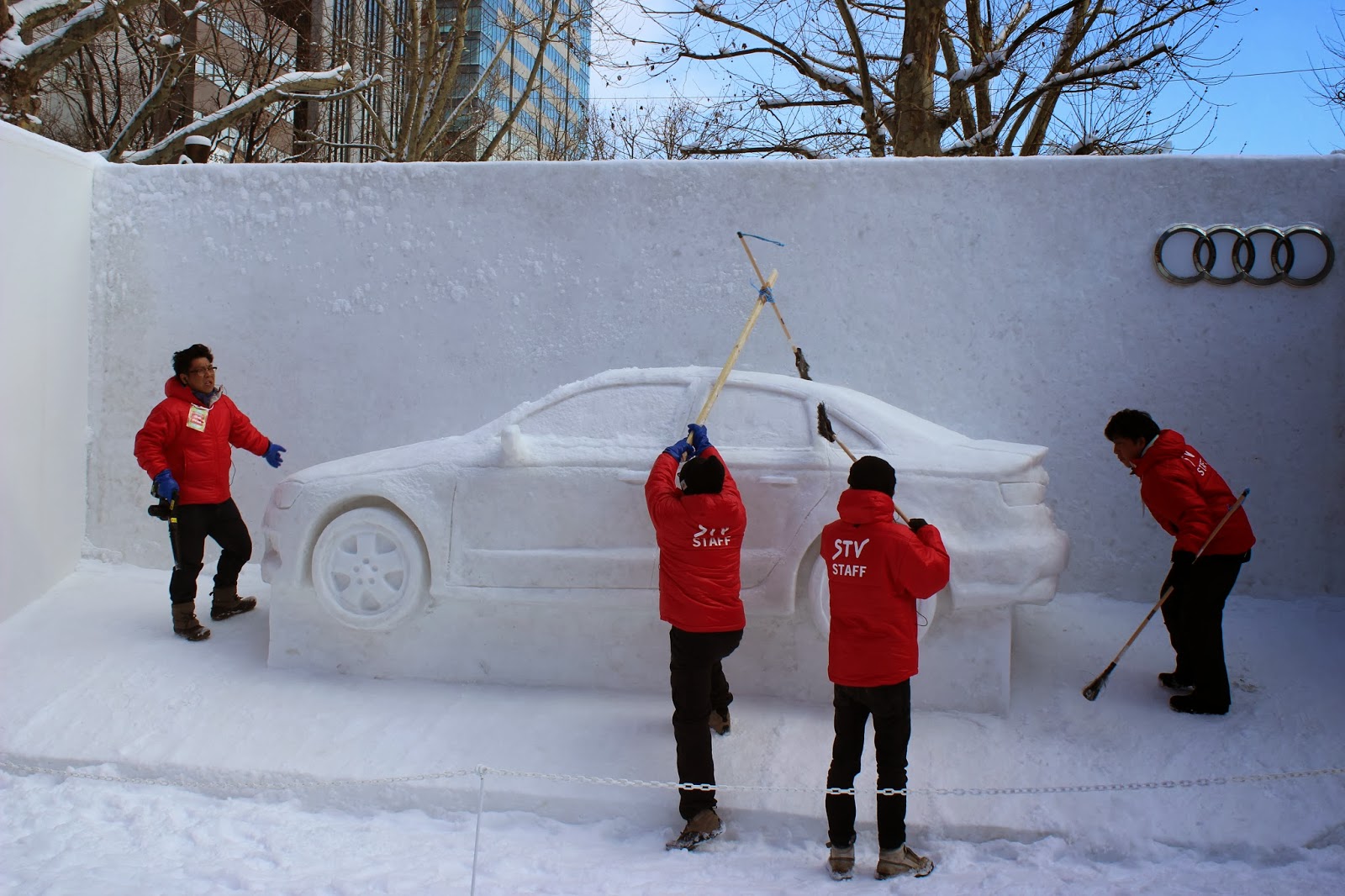
Hokkaido diary: the 65th Sapporo Snow Festival

In one of the many cut-rate sci-fi adventure stories I read as a youth and continue to read to this day (this one was On Earth As It Is In Hell, an officially-licensed Hellboy novel by Brian Hodge), a defeated villain defiantly tells the hero: "Do you know why you'll always lose, in the end? Because what you consider victories are such small things."

Going to the Sapporo Snow Festival reminded me of that quip, for some reason. It just impressed me how something that started so small—a pack of enterprising Hokkaido University students building modest snow sculptures in Odori Park in central Sapporo—blossomed into an annual world-famous festival that attracts over two million foreign tourists per year.

This year I was one of them. Here's my diary entry for that day: 


2/5:

10:32 a.m. Nice long sleep-in. At Kita-12 jo waiting for the train. Hardly anybody here. Is it because I'm used to Seoul, which is always a zoo, or because of the festival? The 65th Sapporo Snow Festival starts today, and I am heading first to Odori Park and then to Susukino to take in two-thirds of it (the other third is up in Tsudome, near Asaba, way up north, but I'm prioritizing). 

It's STILL snowing. Must have snowed all night. Light snow, heavy snow, light snow again. The only time it hasn't snowed was the bright sunny first morning. Wow. Not sure how easy it'll be trying to wrangle an umbrella AND a camera in this weather, but I'll try.


1:07 p.m. What I was praying for happened. At 11 or so, 30 minutes after I arrived at Odori Park, the sky cleared. The snow stopped.


Hokkaido scallop, ¥500. Good deal. 


Crab soup, also five hundred yen. Three kinds of crab!


I got some great pics and then strolled south to Susukino to see the ice sculptures.


That there may be no speculation...those are real fish.


Now they're just making me hungry...

Now I'm standing outside of Sushizanmai (which looks packed to the gills) and memorizing the menu. I want the Uruoi Sushimori Special, which has herring roe, boiled prawn, salmon roe, red tuna, white stuff that could be squid or flounder, red snapper, and six other things besides. Great place—the waitresses bustle and flit about in blue blouses, white aprons, black stockings and buckled shoes, while the chefs flay away at the fish, egg, and seaweed with their long, thin knives, shouting hearty hellos, goodbyes and thank-yous to the patrons coming and going. The tea is hot and the atmosphere warm in more ways than one.


You could immediately tell the difference between this and any other cut-rate sushi joint—fresh, tender ginger, moist rice and succulent seaweed. Eating the herring roe was an interesting experience—it had the color and texture of an orange slice. The miso soup with prawn heads was a lovely counterpoint. The sea urchin roe had the consistency of apple butter. There was also sardine, sea eel, and albacore tuna, plus shellfish. One of the red fish—either mackerel or red tuna—simply melted in my mouth. A feast

3:00 p.m. Sitting in the Hokkaido University Museum. Made a brief but futile stop at the gift shop for souvenirs. Pole Town (an underground mall between Odori and Susukino Stations) was a bust, too. Speaking of busts, I'm going to go see William Clark's now.
"Boys, be ambitious!" 

3:41 p.m. Just sent off the postcard to my folks at Sapporo's big blocky grey post office, east of the station. I'm lucky everything is so close together in this town. I think I'll hit the station on the way back to the hotel in one last-ditch effort to find souvenirs. 

5:32 p.m. Darkness has fallen. My last day in Sapporo is over. I'm ready to be gone, but I am a bit sad. I found no souvenirs—not in the station, nor Tokyu Department Store, nor anywhere else. All that's left is to get some chicken kebabs (yakitori) and beer for dinner, pack my bags and go to bed early. 

7:28 p.m. ADDENDUM. I had a peek in the yakitori place and discovered it was actually an izakaya—and the prices weren't nice. So I stumped a bit further south and found something that wasn't crowded, noisy, or overpriced—Beer & Coffee Venison. The name isn't poetic license—they serve deer meat. So I went on in. The light was low, coming from a line of glass globes over the wooden bar, every other one of which had the names of various Scotch whiskies written on it in multicolored marker. Lots of dark wood and white stucco-like walls, interspersed with tables and chairs with cross-shaped holes in the back (plus fully-antlered deer skulls on the walls and old coffee grinders and tea tins on the shelves) completed the rustic ambience [sic]. Behind the bar were two men: one elderly and thin, severe in demeanor, wearing a tie and black waistcoat and apron, with a beige wool-knit cap which clung to his bald pate like a yarmulke. The other man was likewise in a dark suit (with a fleece jacket flung over it) but was young, handsome, and energetic. He drummed his fingers on the bar in time to the jazz playing on the stereo (Colin Stranahan and Lloyd Miller), and buzzed about snipping labels or sterilizing glasses. The place had a bewildering collection of empty beer bottles in the window and quite a few in the fridge, Negra Modelo, Old Tom, Stone IPA and Löwenbräu among them. The Scotch selection, though extensive, tended to favor Islay and Highlands single malts, I noted. 


I sat down and ordered some venison sausage and a ¥500 glass of Heartland (a European pale lager made by Kirin, with a fine flavor and a delicious creamy head). I nibbled on Hokkaido potato salad and sliced pickles (and later the sausage and some fresh fruit) while the younger barkeep and I attempted a conversation. His name was Kei, and he loved jazz. It was he who manned the Toshiba laptop above the bar and chose tune after syncopated tune. I sensed rather than knew—for he spoke as little English as I did Japanese—that he was a student at Hokkaido University and that this was his part-time job, and that he longed to escape from pulling pints and pouring whiskey and escape to Tokyo (or perhaps even New York) and found a jazz trio. We talked as much as we were able. I sipped beer. The old proprietor washed up or stared into space. I felt the weight of my impending departure weigh heavily upon me. It was an introspective moment—the old man in his wool cap behind the bar, arms folded, staring at the empty room; Kei drumming his fingers, nodding his head and gazing at the computer screen; and me with a cleaned plate and a sweating beer glass in front of me, eyeing the collection of whiskey bottles in their glass cabinets, thinking about getting up at 4 a.m. tomorrow and feeling simultaneously warm and content yet lonely and restless. 

I got up, paid, snapped some photos of the bar and its stewards, bowed low, and left. I bought a crap-ton of food at the convenience store for tomorrow's 18-hour journey—onigiri, bento, salad, coffee, beer, apples, and even something which looked suspiciously like kimchi. All I have to do now is pack my bags and await the dawn. 

Thursday, August 15, 2013

cocktail review no. 70 - Madras

It's hot outside and I have a crap-ton of vodka, so from here on out you'll get an earful about vodka highballs that keep you cool. Capische?

This is a classic drink, and apparently quite popular at the moment. I was one of the simple ones included in the curriculum at National Bartenders, the bartendin' school I attended in Riverside, California. I still vividly remember when our teacher, Joe, taught it to us. (You could tell Joe was raised on the street, 'cause he said "whoop cream" instead of "whipped cream" and "coney-ack" instead of "cognac." I loved him for it.) Joe grabbed the vodka, poured a shot into a rocks glass filled with ice cubes, and then grabbed a bottle of orange juice in one hand and cranberry in the other and filled the glass the rest of the way up. It didn't take him more than five seconds, I swear. We were impressed. He looked so cool doing it.

I pretty much just gave you the recipe, but there's a protocol we have to follow, dang it. So here you go.


  • 1½ ounces vodka
  • 2 ounces cranberry juice
  • 2 ounces orange juice

Pour all of the ingredients into a highball glass almost filled with ice cubes. Stir well.

Now, as with most highballs, there's all sorts of variations. Some call for increased proportions of cranberry juice; some call for more orange juice. Some say to add the vodka and cranberry juice together and then pour the orange juice over the top after stirring. As I mentioned in my review of the Presbyterian, that's the great thing about highballs: they can be customized. It's up to you. I gave you the base recipe here, the one that's in The Bartender's Bible, my most trusted resource. You can play around with it as much as you like. In any event, this will be a smooth, tasty, tangy, cooling-off sort of drink for you. I'm not going to describe the flavor 'cause you already know that vodka takes on the flavors of whatever it's mixed with (I've said that millions of times). And if you're 21 or older and don't know what orange or cranberry juice tastes like, I pity you.

One more thing: I know where the name of this drink came from. The city of Chennai is the capital of the Indian state of Tamil Nadu, on the Bay of Bengal in southern India...but that wasn't always its name. It used to be called "Madras." This picture down here is one of its beaches.


Now drink up! ê±´ë°°!

Friday, July 19, 2013

cocktail review no. 67 - Leprechaun

Honestly, I'm not running out of ideas. Okay, maybe I am. But that's not the reason why these cocktail posts keep happening so infrequently. I'm not sure what the reason is, exactly, but I'm quite certain that that's not it.

Regardless, I'm going to keep going with these cocktail reviews. You hear that? I mean it. They won't lapse like my random travel destinations column did. I'll consider it a mark of highest shame if I don't crack an even hundred reviews. There are at least that many drinks I've tasted. Perhaps I should review more shots. I'm worried that would make this blog too popular, though. If you'll look over there on the right (and down a bit) you'll notice that cocktail reviews comprise half of this blog's "most popular posts" list. I'm not sure what to attribute that to. A sizable cross-section of the people trawling the blogsphere must be thirsty, I guess.

Or leprechauns.

Anyway, enough chit-chat. Let's get to the point!

I branched out a bit from The Bartender's Bible for this one. (That book is currently 6,000 miles away from me on my bookshelf in Seoul, anyway.)

You like gin-and-tonics, right? Well, so do I. But I've had 'em a lot lately and I wanted something new. New, but simple. Either I'm getting lazy in my old age or I'm coming around to my Dad's golden rule. I just can't be bothered to make really complex cocktails lately. Or even anything that involves a shaker. Highballs are where it's at for me. Glass, ice, three ingredients, and boom: cocktail deliciousness.  

So this here's the leprechaun! A take on the gin-and-tonic or the whiskey and tonic, using Irish whiskey:

  • 2 ounces Irish whiskey
  • tonic water
  • lemon twist for garnish
Pour the whiskey into a highball glass half-filled with ice cubes. Top with the tonic water and garnish with a lemon twist.

And there you have it, folks! Two seconds and you've got a zesty, powerful, refreshing drink that'll still put some fire in your belly. Gin's good, don't get me wrong, but it can sure chill you down. Whiskey always puts the heat into my innards. This is a good, strong kick of a drink. As always, I invite you to try it for yourselves.

More reviews to follow. Stay tuned every Thursday. My research department has become much more assiduous now that I'm home in the States and not grading deadhead students' papers. Get ready to sit back and join me for a drink once again. We're breakin' a hundred, got it?

Thursday, January 10, 2013

an immoveable feast

Goodness, ten days into 2013 and I haven't posted yet? Let's rectify this, shall we?

I'd like to say a few more words about my last post before we begin. I declared my intention to eschew any further references to airplanes, booze or literature in my blog and focus solely on travel, but due to popular outcry I am hereby rescinding that declaration. Thanks to you and your wonderful comments, I've decided to keep on writing about the things that interest me (alcohol, flying, good books and travel being the most prominent). If people would like to get more specialized information, they can click on the lower right of this main page, among the swarm of yellow keywords with which I've seeded my posts, and narrow the topics down that way. So there. The Vaunter abides. Thank you for your support, y'all.

Speaking of support, I have only 80 official followers but my page views are skyrocketing. I cracked 100,000 in late 2012 and am already well on my way to 150,000. I've noticed, thanks to the crisp and clear statistical analysis which Blogger provides, that some of my posts appear to have been backlinked. I'm writing like I have a clue what "backlinked" means, but in reality I don't. I think it means that somebody posted links to my blog in high-traffic areas of the web, and they're getting clicked on a lot, thus driving up my page view count. Also, I have taken advantage of the "post-tagging" function that Blogger offers, and have made my posts highly searchable. (I believe the cyber-gods call this SEO, or "search engine optimization.") So there ya go. Hopefully someone in power will notice me and start paying me to write this blithe and mellifluous blog.

Anyway, on to the heart of the matter: Ernest Hemingway.

I don't think I ever truly realized in high school exactly what Hemingway's books were about. The Old Man and the Sea was thankfully self-explanatory, but For Whom the Bell Tolls sounded like it was about somebody's funeral and A Farewell to Arms made me think of a wood-chipper. A Moveable Feast was no different. I thought it was a buffet on wheels.

Then, on a whim, I looked the book up. To my surprise, it was a kind of memoir, posthumously compiled from Hemingway's notes and manuscripts, recording his time as a young writer in Paris in the 1920s, and his encounters with other famous expatriates. The story behind it was quite charming, really: during his time in the French capital (working as a foreign correspondent for the Toronto Star), and beginning to spread his novelist wings, Hemingway bumped into a lot of luminaries: Aleister Crowley, Ezra Pound, F. Scott Fitzgerald, James Joyce and Gertrude Stein, among others. He took copious notes about his time in Paris, the things he saw and did, and the places where he and the other expats habitually hung out: restaurants, bars, seedy cafés and whatnot. In 1928 he stashed these notes in two small trunks in the basement of the Ritz Hotel. He retrieved them again in 1956, had them transcribed and was in the process of collating them into a memoir when, well...

Yeah. You know what happened. The dude offed himself. The editing process was finished by his fourth wife, Mary Hemingway, and published by Scribner's.

This information has seized my imagination with incandescent fingers. I now have yet another book I need to read, another chance to expand my Hemingway collection. It also made me see that I have something in common with Ernest, as well as Mark Twain, Sinclair Lewis, Stephen Crane and Willa Cather: I worked as a journalist before becoming a writer.

(Okay, I didn't work as a journalist very long, and I'm not a published writer yet; but I will be, dang it. I have some exciting news to tell you on the journalism front, so hang tight for that this weekend.)

But apart from the superficial facts, there's another thing that I realized. All the notes I've made about Korea—all my thoughts on this nation's complexities, dualities, dichotomies and idiosyncrasies—are digital. They're floating around in cyberspace, either on this blog or in various e-zines. I've got a few tiny Mead composition books filled with bus fares, random scribblings in Hangeul, the translated names of exotic dishes, half-finished itineraries and disjointed snatches of poetic prose, but that's it. It's hardly enough to fill a pair of steamer trunks.

This saddens me somewhat.

Part of me feels like walking down to Homeplus (similar to Tesco, and owned by them) and buying up every spiral notebook and composition pad in sight. I'll spend the rest of this year (and the next, if I choose to stay in Korea longer) filling them with every conceivable thought that comes into my head. The loud drone of cicadas in summer. The autumn trees' fireworks display. The children squealing as they escape their last hagwon of the day and sprint for the buses, or the old housewives chattering as they maneuver through the aisles of the supermarket. That annoying little whine that only young Korean women are capable of infusing into the final syllable of their sentences. The Koreans' dislike of China and absolute hatred of Japan. The wailing invasion sirens, tested every six months. Typhoons, cloudbursts and fog-banks. The Han River, lazy and green in summer and frozen solid in winter. The sandy beaches of Busan, the humid heat of the midlands, the fading grandeur at Gyeongju, the tropical paradise of Jeju Island. Kimchi, squid-rice, bulgogi soup and fried sweet potatoes. The cloud factory behind my apartment.


Yeah. That sounds like a plan. Something for future generations to mull over. In print. This URL might not last forever, you know. But maybe a manuscript hidden in a chest in the attic for 200 years will.

Even if I don't go through with it, and those notebooks are never bought and filled with exciting scribbles, I am going to make a determined effort to write more on this blog about Korea. In addition to my travel writing (which I need to do some more of), and in addition to being more assiduous in my reporting (bus fares, travel times, ports of call), I shall simply give you more info about my bailiwick, and paint a more vivid picture of my life in East Asia.

Sound like a deal?

Sunday, November 18, 2012

cocktail review no. 66 - Caipirinha

I never thought I'd get the chance to try this one! The ingredients are kinda out there, so this one requires a didactic preamble. Bear with me.

The caipirinha comes to us from Brazil. It was virtually unknown outside that country a few years ago, but it's gaining popularity around the globe. The word caipirinha is a derivative of the word caipira, which is roughly analogous to the English word "hillbilly."

The primary component of the cocktail is cachaça, which is a type of Brazilian rum. The main difference between cachaça and traditional rums is that it's distilled from sugar cane juice (as opposed to molasses) and then aged in oak barrels. The reason the caipirinha cocktail has been gaining ground outside Brazil lately is the increased availability of quality cachaça.

Case in point, Gecko's Restaurant & Bar in Itaewon, in the Yongsan borough of Seoul, South Korea. I was sitting at the bar last night for a coworker's birthday party and I happened to notice a poster on a nearby pillar, advertising the caipirinha. Remembering the odd name and the eldritch ingredients from The Bartender's Bible, and realizing that this was a golden opportunity (the ₩8,000 price tag notwithstanding), I ordered one.

Enough background for ya? Okay, here's the recipe:

  • 1 lime, quartered
  • 2 teaspoons fine sugar
  • 2 ounces cachaça

Place the lime wedges and sugar into an old-fashioned glass. Muddle well. Fill the glass with ice cubes. Pour in the cachaça and stir well.


This is exactly how I observed the bartender doing it last night at Gecko's. Lime wedges and chunky sugar, muddled well, and then the cachaça poured in over the top. It was delicious, sweeter than I'd expected. I didn't realize sugar was such a large or vital component to the drink, and I didn't recall the ingredient list before I got home and checked online. Nevertheless, the taste was as limey as I had anticipated, and that was a welcome complement to the sugar. The cachaça was milder and more mellow than a lot of light rums I've tasted, and was only just discernible underneath the sugar and lime; whether this was the fault of the bartender's light hand or the cachaça's inherent properties was a mystery to me. Nevertheless I heartily enjoyed the drink and found it soothing, pleasant, summery and delicious.

Yes, it's a drink for a hot day and not a winter's night, but in that warm, smoky gallery at Gecko's in Itaewon, it was just what the doctor ordered. Try it and see for yourself.

Tuesday, February 28, 2012

to-do list for March

Here's what I've got so far:

  • go visit my Korean friend down on Geoje Island
  • get a wastebasket and a reading lamp
  • compile some simple Korean recipes and start actually cooking for myself
  • venture forth to Itaewon and find What the Book?, the English-language bookstore I mail-ordered from when I was here before
  • buy some booze and get the bar running again

No doubt other items will make their appearance in due time.

My friend down on Geoje-do is Charles, the liaison I worked with at Reading Town. He's got his own hagwon now and I'd love to stop by and see how he's doing. He took good care of me when I was here before.

I made some delicious bulgogi for myself the other night, and I want to get all the necessaries for bibimbap (one of my favorites) and cook up a batch.

What the Book? seriously saved my bacon when I was languishing with homesickness. I ordered a stack of books and started going through them like they were cocaine and I was Kobe Bryant. I spent a lot of money, sure, but the bookstore's rates are very reasonable and they do free shipping on orders over a certain amount. But now I'm close enough to just ride the subway there and buy books directly from the store! Hot diggity dog!

And the last one's self-explanatory. I need to get the cocktail bar back in business. I called it the Hole in the Wall when I was down in Geoje, and now that I'm here in Bucheon I see [cough] no reason to change things.

Friends, furniture, food, books, and booze...I'm quite the epicurean, aren't I?

Thursday, December 15, 2011

e-hiatus, day 2

The results are encouraging: I finished reading Transgalactic and got started on a book that Miss H's mum lent me, Race to the South Pole by Roald Amundsen. This will be interesting. I've read Sir Ranulph Fiennes's Race to the Pole, which details Robert Scott's Antarctic foray, and thereby learned about the English perception of their Norwegian competitors; this new book will be the other side of the coin (from the man who actually won the race). 

I didn't touch my phone. I watched the second half of For a Few Dollars More (I watched the first half yesterday to reward myself for knocking 20 pages of my novel out). I checked Facebook, but didn't do anything, except reply to a message from a dear friend whom I don't want to keep waiting for a month. I made a few calls and took a few (one from Helen, our recruiter at ESL Park, who told us that we still don't have all the paperwork we need for a Korean job, and that furthermore no positions will be opening until late February or March). Miss H and I have been in communication via e-mail (due to the ban on texting), and it's strangely exciting: suddenly, instead of microscopic blurbs of information, we can put down our entire thought process and convey a complete message, with salutations and loving farewells attached. It's almost like we're separated by some incalculable distance and are keeping contact through love letters. I never thought e-mail would strike me as a charming way to connect, but due to my submersion in texts, I couldn't gain perspective. This hiatus is already yielding startling and unforeseen revelations.

The only bummer about today is that I had to fork over a good portion of my life savings to the bank. I hate bills. Things are becoming desperate. I'm fine for next month, but the month after that might be troublesome. I applied for a bartender's position with the parks & rec district in the next town over, but I've had no word from them yet. All I can do is lounge around in my bathrobe and wait for a miracle.

I busted through two more chapters of the damn novel, trimming, cleaning, snipping, and making general improvements as well as a few major edits. The thing is streamlining nicely. I also cracked open a new book: Get Published, a volume I've owned for some time but never perused at length. Should help me jump-start my writing career, I hope. I can see now that I haven't started yet. I could be submitting articles to High Desert Magazine or the Daily Press (despite my sordid history with that latter organ). I don't have to wait for a book deal. I could get started on this crap now. I think I will tomorrow.

But for now, Clint Eastwood, Lee van Cleef and hot buttered rum shall sustain me.

Monday, November 7, 2011

perspective and soda

Alright, I'm working on two Gibsons and one whiskey and soda, so we'll see how coherent this blog post turns out. Coldplay's "Paradise" isn't helping, either (and yet, somehow, it's helping oh so much).

There are many recurring archetypes in fiction. One of the most overdone is that of the "invincible young dude." You know 'em, you love 'em: slick, loud, brash, overconfident. Unafraid of death or misfortune. They're on top of the world, and they're hot stuff, and nobody can tell them different. They're practically begging to be taken down a peg.

And sure enough, it inevitably takes a calamity (a buddy's death, a close encounter with the bad guys, a near-death experience, or some-such) to wake them up, bring them down to earth, and make them realize the truth: they are not invincible, and never were. They're just as human as the next man. They're privy to all the ills which flesh is heir to: pain, suffering, displacement, impotence, deprivation, loss, failure, death, injury, disability. And whenever a cocky young buck gets his comeuppance, there's a painful interlude in which they reappraise their outlook and readjust it—allowing for failure. It's a heartrending thing to watch, but it's a necessary growing experience. Ultimately the brash youth will be more mature the next time a catastrophe comes around.

Never have I identified more with this trope than I do now.

I have received my wake-up call.

For many years, I thought I was immune to life's downturns. Pukey economy? Ha! Job slump? Not even on my mind. Housing crash? Fuhgeddaboutit!

As Emperor Palpatine would say, my overconfidence was my weakness.

Keyword: "was."

Everything has finally caught up with me.

A niggling fear has been dogging me for the last few months, a fear I had never acknowledged or suspected before. I never dreamed that I would suffer at its hands, not in a million years.

The fear of mediocrity.

It feels, lately, that everything I ever planned, hoped for, strove for, dreamed, daydreamed, or wanted is slipping slowly away from me. All chance of worth, accomplishment, notoriety, fame, or happiness turns increasingly dim. These days it seems like the best I can manage is shadows and dust: a half-life, a skulking, underdone fugue of broken dreams, wants unanswered, hope turned hollow. Insecurity and doubt plague my every step. In the face of adversity, crippling economic disadvantage, the humiliation of dependency, and the general pervading listlessness, it seems as though all my personal demons have crawled out of the woodwork to torment me. Suddenly, my novel's prospects fall miserably short of expectation; at best it will manifest as a paperback on the bottom shelf of the science fiction/fantasy section in Barnes & Noble. Suddenly, my lofty pilot's ambitions fall to rubble before my eyes; I feel I will live out my days as a peon copilot for some regional airline in the Midwest, ferrying disagreeable passengers between Springfield and Chicago or Des Moines and Minneapolis. Suddenly, I realize that I will never work as a drink-slinging bartender in a high-class establishment in Las Vegas or Edinburgh or Santiago; the best I will manage will be half-assed Manhattans in my basement.

A painful process this has indeed been.

Yet hope springs eternal. I've got quite a few more novel ideas floating around my skull, and I think I know how to fix my current manuscript. I'm working on the perfect Gibson; pretty soon I'll turn my hand to Manhattans and polish them until they're perfect. And as for flying...well, I don't want to say anything too committal here, but I believe I have a deal worked out. I'm placing an important call tomorrow, the outcome of which will determine my fate. Further bulletins as events warrant.

In the meantime, I'll dream of Paradise.

Thursday, October 27, 2011

cocktail review no. 63 - Planter's Punch

Tropical drinks are a rum do.

A wealth of visual imagery and context and light and sound and feeling and fury lie bound up in those two words.

Most people immediately think of tiki bars, and rum bars, and tropical bars, and beach bars, and barbecues and summer nights and sambas and limbos and rumbas and tangos and lambadas when you say "tropical drink."

They think of tattooed women caked with makeup, drinking way too much and wearing way too little, easy prey. "Oh, I can't taste the alcohol, it's fair game for me!"

They think of paper umbrellas, and friends staggering on the street, and loud clubs, and garnishes almost too gaudy to be edible, pineapples and cherries and pomegranates and God knows what else. "For Christ's sake, where's the booze? This tastes like fruit juice!"

They think of outlandish names, monikers fit for the Sheriff of Nottingham, Vlad the Impaler, Robespierre, CeauÅŸescu, Shiro Ishii: the Zombie, the Scorpion, the Tidal Wave, the Green-Tailed Dragon of the Maroon Morning.

Maybe that last one's a stretch, but it's imposing regardless.

There are a few hardy folks, however, who don't subscribe to the trendy, hip, club-going, bar-hopping, street-puking, alley-humping "in-crowd." Some of us out here in the ether still dream of seaplanes, hammocks, palm fronds, zebra stripes, native girls, ukeleles, volcanoes, howdahs, bungalows and sprawling plantations while we sip tropical drinks.

I do, anyway.

And this drink, Planter's Punch, made every daydream I'd ever had about a voyage to the South Seas or a passage to India or a beach house in Cuba come galloping to the forefront.

  • 1 ounce dark rum
  • 1 ounce light rum
  • ½ ounce orange Curaçao 
  • 2 ounces fresh orange juice
  • 2 ounces pineapple juice
  • ¼ ounce fresh lime juice
  • ½ ounce simple syrup
  • dash of grenadine
  • dash of Angostura bitters

Shake all ingredients well with ice and strain into a glass. Garnish with an orange slice and a cherry. Top with club soda.

I need to tell you about a little book I found at Anthropologie.

The book, the acquisition of which cost me fifty-three U.S. dollars, is the jewel of my bartender's collection.

It's called Vintage Cocktails.

Part of Assouline's line on travel and culture and fine dining, the book features photography by Laziz Hamani, who is better known for his pictures of Louis Vuitton handbags than alcoholic drinks.

That should give you some idea about how lush the photography is.

As Brian Van Flandern explains in the introduction:
"The word vintage often implies antique, a relic from the past that has come back into vogue. Not to be confused with the classic cocktail, the vintage cocktail conjures images of specific places in time when a particular cocktail gained global popularity. Many of the recipes featured in [Vintage Cocktails] survived the devastating years of Prohibition (1920-1933) while others, like the Brandy Crusta (created in New Orleans in 1852), boast legacies of over a century."
What we have in this book is a collection of cocktails that are very old, mostly unheard of these days, known to only a few old-fashioned drink-meisters, mentioned frequently in black-and-white films, sometimes seen on those giant prints that Red Robin loves to put up on its walls. Nobody drinks this stuff anymore, but once you taste it, you may never go back to your Scooby Snacks and Blow Jobs. These names conjure up images of dimly-lit mahogany bars, and brightly lit ballrooms, and yachts, and verandas, and red carpet and movie stars and black-tie affairs.

The Sidecar.

The Brandy Flip.

The Gin Mule.

The Dry Martini.

The French 75.

The Sazerac.

The Irish Coffee.

The Stinger.

The Sloe Gin Fizz.

The Pousse-Café.

The Hemingway Daiquiri.

The White Russian.

Between the Sheets.

Pimm's Cup.

And all the rest of it. You can just see a bunch of Hollywood's greats lounging around in tuxedos, sipping on these masterpieces. (And indeed, there is a picture in the front pages of Vintage Cocktails showing Clark Gable, Van Heflin, Gary Cooper and James Stewart, tuxedo-clad, enjoying a "drink and a joke" at a New Year's Eve party in Beverly Hills.

Wowzer.

So these drinks (with a few exceptions) have a long, epic history, steeped in tradition and class, endowed with unimpeachable reputations, crafted from the finest ingredients, and savored by some rather legendary human beings.

One of these is—you guessed it—Planter's Punch.

And it has earned its place on the list of vintage (and classic) cocktails.

I've had tropical drinks before. Lots. I like 'em. Makes me feel a little closer to my idols (Ernest Hemingway and Bartholomew Roberts come to mind). But I've never had one like Planter's Punch. It is a doozy. For once, the pineapple juice does not overpower or undermine. It smoothly backs up the orange juice and complements the sour kick of the lime, while its best qualities are brought out by the simple syrup. The simple mix of light and dark rum creates both a smoky undertone and a sweetly alcoholic finish which entrances nostrils and taste buds alike. (Some recipes for Planter's Punch include three or four kinds of rum; this is, I believe, an unnecessary and wasteful practice.) The bitters balance out what would otherwise be overwhelming sweetness. The grenadine provides both a textural solidarity and a slight cherry undertone that creates, in my opinion, the perfect tropical flavor. Many tropical drinks taste foully or overwhelmingly of pineapple; some are sickly sweet; others dilute the booze to fantastic degrees. The Planter's Punch does none of this. The addition of orange juice and orange Curaçao provides just the right amount of orange overtone (supplemented by the lime) without submitting to or adulterating the other sensations.

Sorry, I'm gushing.

Putting it bluntly, I think I've found my favorite tropical cocktail.

But, as always, don't take my word for it.