Showing posts with label newspapers. Show all posts

Monday, February 10, 2014

Hokkaido diary: Tokyo Skytree and craft beer

As before, I'm trying the Paul Theroux approach to travel writing: no bloviating, no florid soliloquizing, no fluff. Just straight-up description. As Mary Chesnut wrote in her Civil War diary, "My subjective days are over."

I'm going to do something a little different this time around. Instead of just telling you blandly about my week-long trip to Hokkaido in the past tense, I'm going to include snippets from the journal I kept. Present tense is always more vibrant and visceral. 


So. Day 1.

Hokkaido diary
2/2 - 2/7

2/2:

  • was almost late for my flight, but made it. Miss H saw me off. I sure do love that girl.
  • nice sandwiches on board, though thin strips—Japanese style
  • next time I'm taking the limited express to from Narita to Tokyo (¥1000, or $10) instead of the Skyliner to Ueno (¥2400, or $24)
  • Looking at Chiba Prefecture for the first time in six months—still as gray in the sky, but browner in the grass. And not stinking hot and humid
  • Checked into Capsule Value Inn Kanda. Met a very nice Finn named Manu (?)—talked about mandatory Swedish in Helsinki schools, idiosyncracies [sic] of the Japanese culture; his dad was a farmer, but he lusted for knowledge at a library 16 km away
  • tried to go to Tokyo Skytree; cost ¥2000 to get in. I said "screw that noise, I've been up Tokyo Tower." Checked out the Minolta Planetarium, but cost ¥1000-¥1300 to get in. 
  • went back to Kanda and ate maguroichibadon (sushi over rice) for ¥700
  • found a craft micropub called Devil Craft nearby—tried microbrews with Mel, a foreign reporter for the Japan Times (and occasionally the Korea Herald)
  • Sacked out in my capsule, reading Paul Theroux, hearing Finnish snores and Japanese farts
I'm getting to be an old pro at hopping back and forth between Japan. Getting to Incheon Airport was a breeze. I made it onto my flight with just five minutes to spare because I underestimated how much time it takes to get there and check in. The gate agent even scolded me, his face flat and impassive. But I made it, and that's the important thing. 

I did the same thing as I did last time: I cleared customs and immigration at Narita, exchanged my Korean won for Japanese yen, and then forked over ¥2400 of that precious wad ($23.42) to ride the blue Skyliner to Ueno Station in northeast Tokyo. Then it was a couple of stops down the Ginza subway line to Kanda Station, where, after a bit of poking through back alleys and some help from a good Samaritan (a shortish middle-aged Japanese fellow with his hair cropped close to his skull and a bellicose demeanor), I found my capsule hotel, the Capsule Value Inn:


I checked in and stashed my stuff in the lockers, retrieving only my camera. Then I went back downstairs. Passing the front counter, I bumped into Manu, a Finnish fellow with the look of a mean drill sergeant: buzz-cut hair, blade-like nose, his face all angles and hollows, hardly an ounce of fat on his body. His eyes were piercing gray-blue and his English was flawless. He'd never stayed in a capsule hotel before, and as he was leaving Tokyo the next day (like me) he thought he'd give one a shot. We chatted for half an hour on the hotel's front stoop before I headed off to see Tokyo Skytree. 

Part of my Tao of Travel (again, I'm ripping off terminology from Paul Theroux, but the man's traveled farther than most and he's got some good tips) is this: once I get to a city, at the soonest possible juncture, I find a high place and take a look down at the city from there. Get the lay of the land, so to speak. In August, on my way through western Japan, I did it with Tokyo Tower, Mt. Arashiyama in Kyoto, and Kumamoto Castle. I've done it several times in Seoul: Namsan Tower, the 63 Building, and Dobongsan. I've looked down on L.A. from the Mount Griffith Observatory, the Rim of the World Highway, and several others. I think it's nice to get a bit of an overview before you dive into something, you know? Like looking at a menu at a restaurant or reading the abstract of a scientific study.

But here's the thing: I'd already looked down at Tokyo in August. And I'd done it in the bright daytime, when the air was clear. A moist, slimy fog was stuck to Tokyo's back this night, and I doubted whether, even from the Skytree's Tembo observation deck a redoubtable 450 meters off the ground, I could have seen much of the city. Moreover, even though this was the tallest tower in the world and the tallest structure of any kind after the Burj Khalifa in Dubai, I wasn't up for paying 
¥2000 ($20) to get in. The lines were humongous, the night was chill and foggy, and I was content just to stumble around at the tower's base with my head craned back, looking at the clouds swirling around the tower's 634-meter spire.


Then I headed back to Kanda. I was in the mood to just sit and have a beer and reflect on the long, exciting journey ahead of me tomorrow. By some cosmic stroke of luck, there was a brewpub just around the corner from my capsule hotel. It was called Devil Craft, one of only two in Tokyo, run by a trio of American expatriates, crewed this night by two handsome and bantering Japanese fellows and filled with foreigners. I fell into conversation with one of them, an Englishman named Mel, who looked almost exactly like Richard Attenborough in The Great Escape and wrote for the Japan Times. I sipped the Miyama Blonde (by Shiga Kogen Beer), Rogue Brewery's Yellow Snow IPA, and Left Hand's Fade to Black, a rye ale. All were supremely delicious. Mel and I chatted away as we drank. He asked me about living in Korea, I asked him about working for a newspaper in Japan. The man had quite a long list of interesting things he believed: he'd interviewed Paul McCartney for 20 minutes and said he hated him; he disliked the Irish and thought the Potato Famine had been faked (just another example of Irish self-victimization); he felt the whole Dokdo/Takeshima possession dispute was bollocks; he avoided films and had no idea who Sir Ian McKellen was. He'd served as a parachutist in the RAF during the Iraq War and had broken both his legs, being sent to Australia to recover.  Japan was a stopover on the way back to Britain, but Mel had liked it so much he'd stayed. He'd married a local and gotten into newspapers, and would be interviewing Lionel Richie on that musician's Japan tour in a few weeks. Right now he was collecting man-on-the-street interviews about the upcoming Tokyo mayoral election and whether the Fukushima incident should factor into it. He wanted to interview me, but I demurred; I wasn't sure how much my job would be worth if Sejong University learned that one of its junior professors had shown up in the Japan Times yapping about Tokyo elections and nuclear meltdowns. No matter; Mel had plenty of bites. He'd already interviewed one of Devil Craft's waitresses and, shortly before I arrived, had become engaged with a foreign-born Japanese man and his Russian wife. Lots of fish in the sea. Mel and I parted as friends, though I did not share his views on the Irish.

Then, my head reeling, I wobbled back to the Capsule Value Inn and spent an hour reading the rest of the 
Tokyo Andagarundo chapter in Theroux's book. I set an alarm, turned out the light, and waited to see what fortunes the next day would bring me.

Get ready for Day 2: Tokyo to Sapporo. 

Thursday, May 16, 2013

peninsular news

What I'm about to tell you is two weeks old already, because the newspapers I'm using were a week old when I picked them up, and it's been a week since I picked them up. So there. Yeah.

But anyway, the news was so interesting and so genuinely Korean that I had to share it with you. Y'might get a better idea of what goes on over here on this peninsula after reading these stories:

From an issue of the Joong-Ang Ilbo, dated May 3rd:

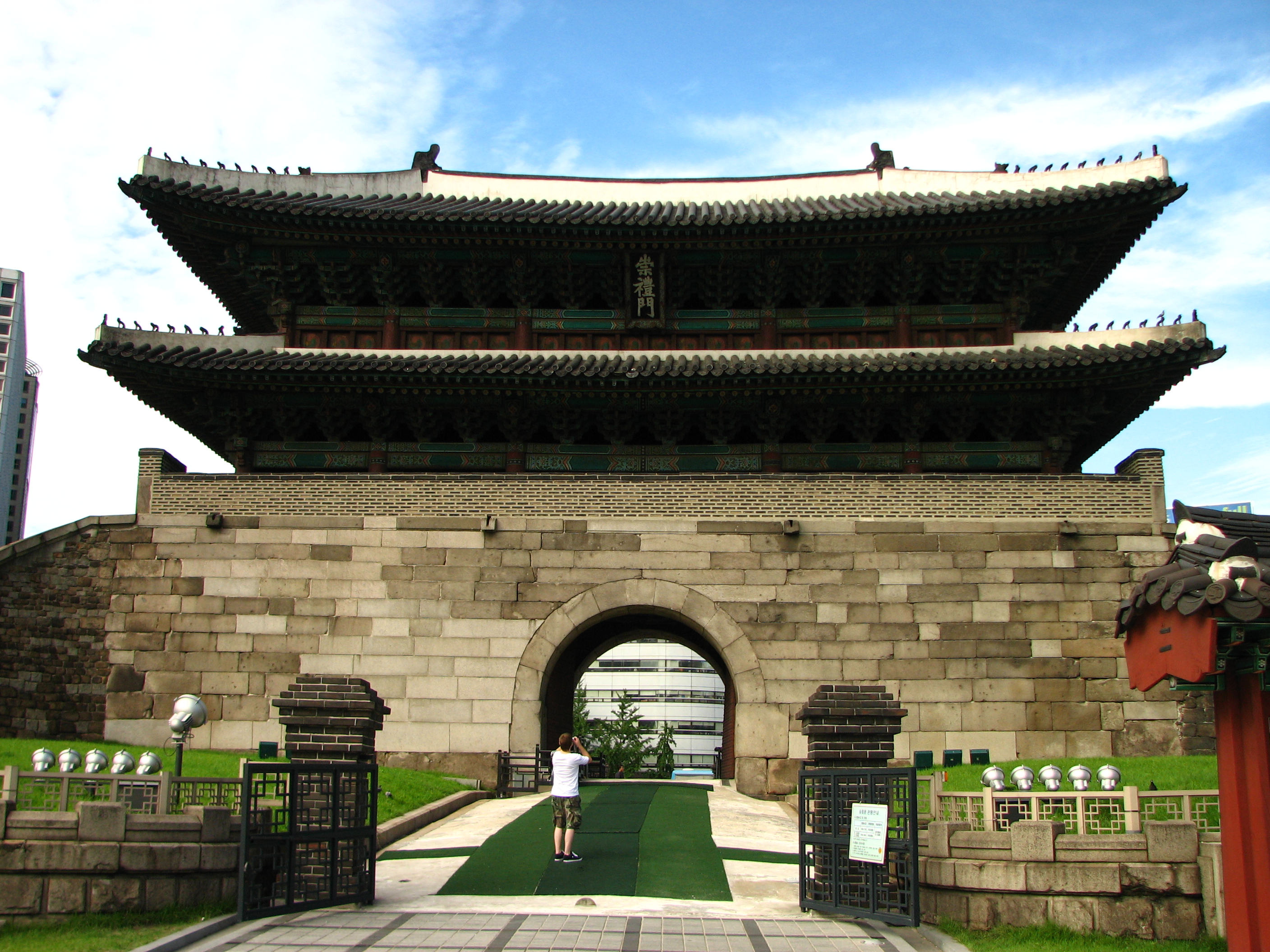
The rebuilding of Sungnyemun (also known as Namdaemun, literally "South Great Gate") has just been completed. This is what it looks like now:

                                                                                                        from Wikipedia Commons
Why was it rebuilt? Well, because in 2008, this happened:

                                                                                           also from Wikipedia Commons
Some ass-hat set fire to the darn thing and burnt it to a crisp.

That we may be clear, Sungnyemun is National Treasure No. 1 in South Korea. There used to be a huge retaining wall 20 feet high which encircled the citadel of Seoul, back in the Joseon Era (1392-1897). The gates were all built between 1396 and 1398, and they marked the cardinal directions. The northeast, northwest, southeast and southwest gates were the "Four Small Gates," and the north, south, east and west gates were the "Four Great Gates." Only six of 'em still exist today; I've been to four of them.

Sungnyemun (which literally translates to "Exalted Ceremonies Gate") is the best-preserved and most iconic. It shows up most frequently in travelogues and brochures about SoKo. It was nothing short of a tragedy when it was destroyed, and it was a long, torturous labor of love to set it to rights again. But now it's back, and reopened, and everyone can behold it in all its glory. The city government took pains to reconstruct the gate using materials and methods which were correct for the period, and they went slow and steady instead of rushing things (which has bitten them in the butt with previous restoration projects, I hear). I advise everybody to stop by the gate on their way through Seoul. It's worth your while.

Okay, onto the second news story:

The Korean SATs have been canceled.

No joke. It turns out that the office of the Korean Supreme Prosecutor (ain't that a badass title?) raided six college prep schools (hagwons) in Gangnam in February on suspicion that they were selling SAT questions which they sourced from Southeast Asia. In response to this information, the College Board canceled the test on the peninsula. Period.


This is unprecedented. The test has never been out-and-out canceled here before. A lot of Korean college students are going to be heavily disadvantaged by this. Just like in the U.S., SAT scores are an integral part of the university application process. Without 'em, students have little to no chance of getting into any sort of credible institution. It remains to be seen what the overreaching effects of this development will be.

And in the national news section of the Joong-Ang Ilbo, there was this little gem of a headline:

Filial attitudes get less respectful, says survey.


Here's the nut graph, just so you can get an idea of the article's message:

"As Korea's Confucian values continue to give way to modern or Western ways, a decreasing number of young people think they should be solely responsible for elderly parents."
Interesting, huh? I don't want to sound puffed-up, but this is something that I've been noticing myself in my discussions with students and young Korean people. The steady seep of Western films, music and philosophy into Korean culture has wrought its subtle magic, for good or ill. According to this study (conducted jointly by Statistics Korea and the Ministry of Gender Equality and Family, which is apparently a thing), only 35.6 percent of Koreans between the ages of 15-24 said they intend to fully support their parents when they get old.

Just to give you some perspective, that figure was 67.1 percent in 2002. 

Increasingly, it seems, young Koreans are expecting the government to take care of the elderly, leaving them free to pursue their own hopes and dreams free of the financial burden of dependent parents. This is quite a turnaround. They don't have a Parents' Day in this country for nothing, you know. Time was that Koreans would sacrifice everything for their parents and grandparents. Nothing was more important than caring for and obeying one's forbears. (Every single story I read in Professor Jeong's Folk Tales from Korea reflected this to a degree.) The unconditional care and support the elderly would receive from their children when they became too old to work was...a given. It was universal. It was the Confucian retirement plan. It was a reflection of Kongzi's emphasis on filial piety and respect for the elderly. These two ideas were ubiquitously practiced in the East for centuries, so much so that they were identified in the West as an integral part of the Oriental mindset.

But all that's changing now. The influx of Western ideas, particularly those which emphasize individualism, are well on their way to supplanting the old Confucian ways in Korea. (Potentially elsewhere, too: I'm curious to know if this same thing is happening in far-more-liberal Japan or far-more-conservative China.)

I know it'd be trite to say that Korea is a "nation of contrasts"; but hey, I'm a hack writer, so I can say it if I want to. That's precisely what this country is. They lovingly restore a 700-year-old gate, and yet their young 'uns don't want to take care of the old fogies anymore. They practically kill themselves working and studying, but some of them seem perfectly willing to cheat to get ahead. All I can say is that I'm glad I'm on the ground to formulate these opinions firsthand instead of trying to construct a picture from newspaper clippings and TV talk shows.

Postie out.

Friday, January 25, 2013

your humble foreign correspondent?

Okay, here's the deal:

My contract with my current hagwon expires in mid-February. As a courtesy I've agreed to stay on until the end of that month and the conclusion of the current semester, just so I can finish up my classes and let my replacement start from a clean slate.

In the meantime, though, I need to find myself another job.

I figured I'd just get another teaching position down in Anyang where Miss H works. That plan went to crap a couple of weeks ago, when Miss H was informed that her school would be downsizing and (once again!) she'd have to be let go. This is the second time it's happened to the poor girl and she's rather downcast, but soldiering on courageously.

All the same, we didn't know what we would do. It was looking like we'd both be homeless and jobless at the end of February. But then one of my coworkers, a sweet young lady from Connecticut, drew my attention to something. It was a job posting on a popular ESL teacher's website and forum. The position was for a writer-editor with the NE Times and NE Times Kids, two periodicals edited by a single combined staff. I wasn't sure what kind of periodical it was (I later found out that it was a weekly kids' educational newspaper). But I applied regardless. Fifteen vacation days per year and a "competitive" salary—not to mention a chance at building my résumé—were too good to pass up.


The paper is based in the Mapo district of southwestern Seoul, just north of the Han River. This would be a heck of a commute from Anyang every morning, but I figured that was worth the price too.

Well, the Times called me back two weeks ago. They wanted me to come in and take their written test. I did it two Saturdays ago. Wish me luck, folks, I thought. This could be a whole new stage in Postie's life. I might soon be living like Hemingway, a print journalist in a foreign capital, rubbing elbows with great writers and luminaries.

Th
e writing test went fine. I knocked it out of the park. The proctor (and my potential supervisor), a man I'll call J.S., told me that the test would probably take three hours. I did it in an hour and a half. I left the building feeling confident, shivered my way to the subway station and returned home.

A short while later, I was called in for an interview. My heart fairly quaked with excitement. I had passed the first round of the application process! I had gotten a callback! It was interview time! And for once, I felt that part went well, too. Normally I don't do very well in interviews. The close scrutiny of several high-ranking managers, asking me questions like Tell us about yourself and Why do you want to work here and What do you feel you could bring to the table and whatnot, turns me into a stammering mess. But this time (it happened this past Wednesday) everything went fine, I felt. I answered questions competently and without hesitation. J.S. and his two female co-interviewers looked quite impressed with my answers. The interview took precisely an hour. I had to wait 30 minutes for the big red intercity express bus, but it dropped me off on my doorstep in Bucheon, and I slept well that night.

Well, the roof fell in yesterday evening. I got an e-mail from J.S., explaining that it had been a heartbreaking decision and I had been second in line for consideration and I had all the talents they were looking for, but they couldn't offer me the position. In the end, they decided to go with someone who had more experience in English education.

I was rather crushed. I felt grateful for J.S.'s honesty and the courtesy with which I'd been treated, though. I understood their decision. But I couldn't help wonder what might have been: me working as a writer and editor in Seoul, Korea. That would have looked pretty good on a
résumé. The loss was compounded by the salary I soon learned that I'd missed out on: 3.5 million Korean won per month. That's roughly $1500US more than I was making as an English teacher. Great googly-moogly. That would have made my future a whole lot rosier. Debts paid off, a nest egg accrued, money for traveling...

Ah well, it doesn't do to dwell on the past. I've moved on. Miss H has secured jobs for us at a kindergarten in south Incheon, so we're going in today (Saturday) at 10:50 a.m. for training and contract-signing. We still have to move at the end of February, but at least now we've go somewhere to go. I'm looking forward to taking on a new challenge (teaching at a kindy), exploring a new bailiwick, living closer to the ocean, scooting farther away from Seoul, and being on the same daily schedule as my girlfriend.

I am not, however, looking forward to moving. I'm looking around my apartment here in Bucheon and it seems we've a lot more stuff to shift than I originally thought. I've never moved from one apartment to another in Korea before. It promises to be an...interesting experience. Don't worry, I'll keep you informed.

Wish us luck, and stay tuned.

This will be our new subway stop. I'm looking forward to exploring it, hee hee.

Thursday, January 10, 2013

an immoveable feast

Goodness, ten days into 2013 and I haven't posted yet? Let's rectify this, shall we?

I'd like to say a few more words about my last post before we begin. I declared my intention to eschew any further references to airplanes, booze or literature in my blog and focus solely on travel, but due to popular outcry I am hereby rescinding that declaration. Thanks to you and your wonderful comments, I've decided to keep on writing about the things that interest me (alcohol, flying, good books and travel being the most prominent). If people would like to get more specialized information, they can click on the lower right of this main page, among the swarm of yellow keywords with which I've seeded my posts, and narrow the topics down that way. So there. The Vaunter abides. Thank you for your support, y'all.

Speaking of support, I have only 80 official followers but my page views are skyrocketing. I cracked 100,000 in late 2012 and am already well on my way to 150,000. I've noticed, thanks to the crisp and clear statistical analysis which Blogger provides, that some of my posts appear to have been backlinked. I'm writing like I have a clue what "backlinked" means, but in reality I don't. I think it means that somebody posted links to my blog in high-traffic areas of the web, and they're getting clicked on a lot, thus driving up my page view count. Also, I have taken advantage of the "post-tagging" function that Blogger offers, and have made my posts highly searchable. (I believe the cyber-gods call this SEO, or "search engine optimization.") So there ya go. Hopefully someone in power will notice me and start paying me to write this blithe and mellifluous blog.

Anyway, on to the heart of the matter: Ernest Hemingway.

I don't think I ever truly realized in high school exactly what Hemingway's books were about. The Old Man and the Sea was thankfully self-explanatory, but For Whom the Bell Tolls sounded like it was about somebody's funeral and A Farewell to Arms made me think of a wood-chipper. A Moveable Feast was no different. I thought it was a buffet on wheels.

Then, on a whim, I looked the book up. To my surprise, it was a kind of memoir, posthumously compiled from Hemingway's notes and manuscripts, recording his time as a young writer in Paris in the 1920s, and his encounters with other famous expatriates. The story behind it was quite charming, really: during his time in the French capital (working as a foreign correspondent for the Toronto Star), and beginning to spread his novelist wings, Hemingway bumped into a lot of luminaries: Aleister Crowley, Ezra Pound, F. Scott Fitzgerald, James Joyce and Gertrude Stein, among others. He took copious notes about his time in Paris, the things he saw and did, and the places where he and the other expats habitually hung out: restaurants, bars, seedy cafés and whatnot. In 1928 he stashed these notes in two small trunks in the basement of the Ritz Hotel. He retrieved them again in 1956, had them transcribed and was in the process of collating them into a memoir when, well...

Yeah. You know what happened. The dude offed himself. The editing process was finished by his fourth wife, Mary Hemingway, and published by Scribner's.

This information has seized my imagination with incandescent fingers. I now have yet another book I need to read, another chance to expand my Hemingway collection. It also made me see that I have something in common with Ernest, as well as Mark Twain, Sinclair Lewis, Stephen Crane and Willa Cather: I worked as a journalist before becoming a writer.

(Okay, I didn't work as a journalist very long, and I'm not a published writer yet; but I will be, dang it. I have some exciting news to tell you on the journalism front, so hang tight for that this weekend.)

But apart from the superficial facts, there's another thing that I realized. All the notes I've made about Korea—all my thoughts on this nation's complexities, dualities, dichotomies and idiosyncrasies—are digital. They're floating around in cyberspace, either on this blog or in various e-zines. I've got a few tiny Mead composition books filled with bus fares, random scribblings in Hangeul, the translated names of exotic dishes, half-finished itineraries and disjointed snatches of poetic prose, but that's it. It's hardly enough to fill a pair of steamer trunks.

This saddens me somewhat.

Part of me feels like walking down to Homeplus (similar to Tesco, and owned by them) and buying up every spiral notebook and composition pad in sight. I'll spend the rest of this year (and the next, if I choose to stay in Korea longer) filling them with every conceivable thought that comes into my head. The loud drone of cicadas in summer. The autumn trees' fireworks display. The children squealing as they escape their last hagwon of the day and sprint for the buses, or the old housewives chattering as they maneuver through the aisles of the supermarket. That annoying little whine that only young Korean women are capable of infusing into the final syllable of their sentences. The Koreans' dislike of China and absolute hatred of Japan. The wailing invasion sirens, tested every six months. Typhoons, cloudbursts and fog-banks. The Han River, lazy and green in summer and frozen solid in winter. The sandy beaches of Busan, the humid heat of the midlands, the fading grandeur at Gyeongju, the tropical paradise of Jeju Island. Kimchi, squid-rice, bulgogi soup and fried sweet potatoes. The cloud factory behind my apartment.


Yeah. That sounds like a plan. Something for future generations to mull over. In print. This URL might not last forever, you know. But maybe a manuscript hidden in a chest in the attic for 200 years will.

Even if I don't go through with it, and those notebooks are never bought and filled with exciting scribbles, I am going to make a determined effort to write more on this blog about Korea. In addition to my travel writing (which I need to do some more of), and in addition to being more assiduous in my reporting (bus fares, travel times, ports of call), I shall simply give you more info about my bailiwick, and paint a more vivid picture of my life in East Asia.

Sound like a deal?

Friday, December 30, 2011

le grande update

As you may have noticed, my last two posts were exceedingly brief. And as you're aware, I'm a long-winded bugger who can't abide sparing the slightest detail. So I think it's about time I gave you a full update on where I stand, before things get crazy.

First, I'm going back to Korea. It's official. It's genuine. It's true. I don't want to jinx it (this will be my fifth attempt, and every previous job offer has gone south due to unexpected delays and unforeseen obstacles), but nothing short of an Act of God can stop me now. I'm Asia-bound, so help me.

I sure didn't see this coming. I loved Korea, rest assured. It was a blast. A kick in the pants. The cat's pajamas. The elephant's instep. Despite the complete and abject lack of limes, turkey, single-malt Scotch, sausage, real cheese and decent hamburgers, the place was alright. I had a ball. I crammed my existence into a tiny studio apartment, took frequent walks, wrote in my journal, blogged, scribbled a novel, taught hyperactive children the rudiments of the English language, tried to learn Korean, lost 20 pounds, became addicted to bulgogi and kimchi, acquainted myself intimately with debauchery, danced, raved, sang, drank, ate, and was merry. Oh, and I made myself a ton of cherished friends, with whom I remain in contact to this day (and many of which I will see again come February).

But I didn't think I'd go back. I thought I was done with living overseas and making money there. I figured I'd return to the States, get some stuff done (like my pilot's license) and then find a job and get busy. I really had no ruttin' idea that things were so bad here. Now I look back at the day in 2009 when I stepped off the jetliner and into the warm, moist, smoggy air of the Inland Empire, and I giggle at how naïve I was. I thought I was set for life. I had a year of international job experience under my belt and a wad of cash in my pocket. I thought I was sitting pretty. Boy, was I whistling Dixie. What I should've done was move someplace with low rent and cheap gas (like, I don't know, Kansas perhaps?), get a crummy job and work for five years until I had a suitable sum of money saved and a modicum of job experience. Then I could've looked about me, gauged my options, moved to Alaska, gotten my pilot's license, whatever.

But I jumped the gun. Drunk on prosperity and globetrotting confidence, I decided to get my pilot's license right away. Hang the job, hang security, hang responsibility. You know what came of that. I got myself stuck in this goddamn desert pest-hole for two and a half years.

They say hindsight is 20/20. My hindsight should've been a lot clearer, though, considering how far up my ass my head was.

So, poor economic decisions aside, I got my pilot's license. I worked two low-paying jobs (a temp job at the local newspaper, which lasted about a month, and that flying job I've been talking about for ages). I lived in my parents' house. That was godawful. I felt rotten, like I was a kid again, not a forward-striding, self-sufficient man's man as I'd imagined. My folks were sweet as pie, and did everything to make things as comfortable as they could for me, giving me loads of excellent advice (most of which I didn't listen to until it was too late). They salvaged my pride at several pivotal junctures, too, bless them. But the malaise, the ennui, and the remorseless hindsight gnawed at me day and night. And worse yet, I had no escape route. Jobs there were none. Prospects there were none. Money was running out. It seemed I was doomed to remain in the doldrums forever.

It's difficult to believe that Miss H and I started looking for jobs in Korea back in June. June! Thanks to delays and unguessable disasters, we've endured one of the roughest, bleakest times of our lives. The ennui was ten times worse for her; she couldn't find any jobs at all. She worked a seasonal stint at Target last year during the holidays, and that was it. There's nothing in this damn desert. Zilch. Squat. Nada. The desperate downward spiral took a heavy toll on us.

Our hand had been forced. We decided to go to Korea. But couple's positions were thin on the ground, and the delays and backups just kept mounting. We had to make some tough calls. Ultimately, Miss H decided to stay behind. She would not accompany me to Korea. We would separate temporarily, she to seek her fortunes, I to seek mine farther afield. And lo and behold—snap—the pieces began to click together. I got a job offer from a hagwon in Bucheon (somewhere between Seoul and Incheon) the very same day I told my recruiter to find me a singles' position. And things bloomed at Heather's end, too: she got several bites from a social work agency in the same town she'd gone to college in. She knows the area, and rent and gas are very reasonable. Boom: just like that, things are looking up for us. Seems like an impossible dream after the long hard slog we've had for the past two years.

And in other news, I finished my novel. No, I mean finished: it's written, it's edited, it's proofed, everything. Of course there are few tweaks to be made, and it has to be peer-reviewed, but the thing is largely done.

That feels good.

No, really. You remember how scared, nervous, self-conscious and maudlin I've been? For three years it's been like this. I started the dang novel in Korea. Finished it not long after I returned, in late 2009. Ever since I began I've had the feeling that it was crap, and that I was a the world's largest hack, and that the whole thing was a waste of time. Normally I'm a secure and confident bloke and don't entertain thoughts like these. But I did. And they bedeviled me and my writing efforts for three long years, before I finally wised up, gained perspective, achieved Nirvana or whatever, and buckled down and finished.

The second rewrite was much easier than the first, because I felt no insecurity. I felt fine, in fact. The novel felt like a novel. The author felt like an author. The work felt like work, but more than that, it was fun. For the first time, it was actually fun. Hallelujah for that!

So I spent about a fortnight just blasting through my entire manuscript, line-editing, spell-checking, rearranging syntax for mellifluousness, and making some major revisions and rewrites. And you know what I came out with? A novel. An honest-to-Gawd debut science fiction novel. It's got plot. It's got theme. It's got premise. It's got character. It's got conflict. It's got action. It's got a climax, a denouement, and all the rest. It may be a bit amateurish (after all, it's my first book) but everything's there.

Now I just need somebody to read it. And a publisher to send it to.

This is tremendously exciting.

So, in summary, I'd just like to say that after thirty months of waiting, worrying, striving and stagnating, things are looking up. The novel's done, and I'm going to Korea. And Miss H and I are doing better than ever. 

Thanks for sticking with us.

Friday, December 16, 2011

e-hiatus, day 3

I have to be honest: I fudged yesterday a little. After I finished Day Two's post I fiddled around on TV Tropes for a while before going to bed. But I'd edited the hell out of my novel and annihilated seven chapters of Starship Troopers, so who's to say I didn't accomplish something regardless?

Today was excellent. I didn't even have a chance to violate the rules. At twelve o'clock Miss H and I went down to the most charming coffeehouse in town, set up our computers, and went on a job-hunting spree. We were at it for over four hours.  I created a complete profile on Clear Channel Radio's job search site, including my complete résumé and references. I applied for two jobs, a radio dispatcher position in Seattle (which I won't get, because 476 other people applied to it) and a technical writing position in Madison, Wisconsin (which I feel I have a decent shot at; they cover relocation costs, too!). I know two jobs doesn't sound like much for four hours' work, but believe me, jobs were mighty thin on the ground. I searched Monster, CareerBuilder, JournalismJobs, and several media companies' private websites. Those were the only two positions I found that (a) I could do, (b) I had the credentials for, and (c) didn't require one year of experience. That's been my biggest stumbling block in finding a job in my field thus far: lack of on-the-job experience. I'm beginning to think I should've applied myself more at my job at the newspaper, and I should've tried to go two semesters at my college radio station instead of just one.

The draining hunt for work sustained us until five o'clock, at which point Miss H and I, tired and discouraged, closed down our machines, bought some necessaries at the grocery store, went home and cooked dinner (quesadillas with avocado, tomato and chicken). We watched a movie, and read for a bit. And that has been my day. I haven't even touched my phone. I'm so tired I think I'll just go to bed at midnight instead of 1:00 a.m. like usual. Let's hope some of those job apps bear fruit.

Sunday, October 11, 2009

the Pretentious Vaunter

Over the course of the last few years, I've gradually come to suspect something unpleasant about myself that I can't wholly dismiss. I'm a great deal less intelligent than I like to think. Want an example? I recently got into a grammar-quiz competition with a college friend. The rules are simple. She sends me, either by e-mail or text message, a word picked at random from a dictionary. If I know the word, I send back the definition. If I don't, I take my best guess. The original purpose of the game, as stated by my friend, is twofold: she gets to be dazzled by my reputedly impressive vocabulary, and she also learns the meaning of a few words herself. The score currently stands at 1-3. I knew the meaning of one word ("descry") while the definitions of the remaining three words ("foofaraw," "titivate," and "convivial") abjectly defeated me. As such, this pastime has served a second purpose, likewise twofold: it has simultaneously shown me that I (a) don't have nearly as many words in my vocabulary as I have loudly and proudly proclaimed in the past; and (b) that, while I understand the connotation of many uncommon English words, I am increasingly unable to articulate their literal denotation. There once was a time, back during my homeschooling days, when I could rattle off word definitions like I'd swallowed Merriam and Webster. Now, either because my reading and writing habits have gone into a decline in recent years, or because I have allowed myself to become mentally lazy, or because I drink too much—those days are gone. I forget words I used to know (and cherish) and find it difficult to properly and eloquently verbalize the meanings of others. In short, I'm a pretender. A fake. A phony. A fraud. A charlatan. I claim to be a wordsmith, a grammarian knowledgeable of bizarre and unusual diction, and yet I'm not. Heck, I only vaguely know the meaning of most of the words I routinely use in conversation or print; I certainly don't understand many of their roots, proper usage, or (as previously mentioned) even their literal definition. I have forgotten most of what I learned in ground school in the spring of 2008, and with my flight physical (and therefore, my first flying lesson in over 16 months) drawing nearer, I am frantically paging back through all of my pilot's textbooks to try and rebuild the dike. Most of what I read I remember, but had wholly forgotten in the meantime. Another, more painful example is my recent dismissal from the newspaper I worked at. I simply wasn't intelligent enough to get my mind in gear, learn lessons the first time, quit making stupid and obvious blunders, and write the way I was supposed to write. This is neither the first example of such bumbling idiocy which I have exhibited, nor will it be the last. This worries me deeply. If my vaunted literary prowess—hell, my mental prowess in general—is crumbling now, what kind of state will it be in when I'm forty? Fifty? Eighty? I don't want to wind up one of those cranky, senile old buggers who harangues everything in sight, can't remember the names of his grandchildren and is a burden to his friends and family. I'd sooner be shot dead, or ground up into fish food. Even more terrifying is the prospect of Alzheimer's disease, the only form of dementia I truly fear, which will rob me of my precious memories and my formerly reputable vocabulary. That is, I'm sad to admit, the main reason I'm going to such trouble to write in this blog and keep up a daily journal, so when the Alzheimer's hits, I can thumb or click back through the pages and remember all the cool stuff I've seen and done. Call it a fatuous superstition. I may not even remember that I kept a journal when I have Alzheimer's, for all I know. But just in case... The suspicion that I am gradually turning stupid—or have always been stupid—has been gnawing at me for some time, and is beginning to prey upon my mind and heart. To someone who values intelligence higher than almost anything else in this world or the rest, this new mental trend is anathemaagonizing torment. I've built my reputation and my life on learning, on knowing things nobody else does, on having a tremendous vocabulary, on retaining vital information that will serve me later. And now, it seems, a plug has been pulled somewhere in my brain, and all that which I have mentally striven for is leaking slowly away...or worse, might never have been there in the first place. I am ashamed at my lack of cerebral rectitude, and deathly afraid that my friends and family might find out just what a jumped-up, pretentious nobody I really am—as has already begun to happen with this grammar-quiz game between my friend and me. I almost wrote "between me and my friend." I'm doing it again.

Monday, September 28, 2009

the quarter-life crisis

Let me just say, here and now, that I did not come up with that sardonic title by myself. It's actually a phrase coined by a friend of mine, David, whose plight is somewhat similar to mine. (He didn't get dismissed from his last job, though, I'm pretty sure.) Well then! Nothing's written in stone yet, but I have a good idea about what I'm going to do now that I find myself, a 23-year-old unemployed college graduate living in my parents' house, unemployed and living in my parents' house. My friends have been wonderfully supportive, my parents and grandparents have given me some good advice, and I'm feeling largely at peace with what's happened. My pride still stings a little, but as soon as Mom bakes some cookies I'll get over that in a hurry. As you'll recall, it says "aviation" up at the top of this page. Thus far, there hasn't been much in this blog concerning aviation, except me prattling on about my flight-related ambitions. This is because you have caught me in the interim. I completed ground school in the spring of 2008, shortly before I went off to Korea. Between then and the time I departed for the Orient, I took flying lessons at Cheyenne Regional Airport in Wyoming, and racked up about twelve flight-hours. I started this blog up in March of 2009, and only just returned to the United States in July. I haven't resumed my flight training yet because, well, I've been working part-time and trying to save money, and since lessons cost roughly $200 a pop... Excuses, excuses, I know. If you're a veteran pilot or a halfway serious student you're probably castigating me as unenthusiastic or cowardly. But it isn't true. It's been heartbreaking for me to be stuck on the ground so long, believe me. But I felt I had to accumulate some savings before I embarked upon my grand quest to become a commercially-licensed pilot with multi-engine, complex, high-performance and seaplane ratings. That takes some doing, you know. And some serious cabbage. Getting dismissed from newspaper has changed all that. I'm now free to move around and do things again. And I've decided, borrowing my mother's wisdom and my grandfather's counsel, to start moving toward my dreams in a more definite manner. What I really mean is, I'm going to not work at all and start flying a lot instead. Good plan, eh? Yes, you read that correctly. I'm going to start hammering away full-time at getting my piloting qualifications. The nice thing about this flight school here in town at the Apple Valley Airport (Apple Valley Aviation, it's called) is that they do both multi-engine ratings and commercial licensing. That's half of my airborne ambitions right there. If I can get that taken care of, then wherever I go from here I'll have the qualifications to work for pretty much any small regional cargo airline there is. Sure, I'll be green. I won't have a lot of flight-hours racked up. But I'll have the basic credentials, and that'll be something. But wait! There's more. There is another prong to my chase-down-dreams plan. As you might have guessed from my cocktail reviews and my ardor for all things boozy, I am something of a liquor enthusiast. I'm an amateur bartender, a newly-minted professor of mixology if you will. I mix cocktails for my parents most every night, and I ran a cocktail bar out of my apartment in Korea for some months. I've always wanted to try my hand at being a bartender. There's something so romantically human in it: me, behind the bar, in a dimly-lit room, shiny bottles arrayed behind me as I methodically polish a glass, two or three regulars sitting on bar stools, getting smashed, getting a load off their chests, the pungent aroma of spirits (alcoholic and human alike) in the air. I've been told I'd be good at it. Not to brag or anything, but people do come to me with their problems. I'm not much good at comforting them, but I like to think I give them some perspective. Sometimes that's all it takes. And anyway, as long as things didn't get too hectic, I think it would be the neatest thing to mix drinks and pull pints for people all day. Great potential for philosophical debate, that's for certain. I don't want to have a hoidy-toidy, hippy-dippy bar, you understand; I really want to work in (or own) a pub. Quiet place, not too big, kind of old-fashioned, lots of dark wood...a cozy, comforting, intimate venue. But to do that, I need a liquor handler's license. And if I'm going to go to the trouble of getting that, I could do worse than go the whole hog and just go to bartender's school. There are some good ones pretty close to me, down the hill in Riverside and San Bernardino. I'd get some practical training, I'd get an insight into the most popular drink recipes, I'd learn to navigate behind the bar, and most importantly, I'd get certified. That means I should be able to get work at any respectable bar, anywhere. Wherever I go from here, then, I'll have those two notches on my belt. Not only do I have my journalism degree and a little experience along with it, but I'll have my commercial pilot's license and a bartender's certificate. Think of it as an epistemological hat trick. If I go to Australia, I don't have to depend on finding writing jobs, which could be really scarce. I could work in any of the myriad bars in Sydney or Perth or Adelaide. Heck, I might even find a job as a bush pilot in the outback. (Gee, wouldn't that be swell? It makes me tingly just thinking about it.) The same would be true if I went to Anchorage: I'd have two trump cards up my sleeve, two fun ways to make a living in a new place. It seems like a good idea to me. It's a bit embarrassing to be acquiring this dual education while under my parents' roof, but they're kind and generous, and living here is drastically inexpensive. Here is the best place to base my educational expeditions with fully reserved capital. So, to that end, I shall pursue knowledge relating to two of my favorite things: booze and airplanes. And in so doing I shall finally fulfill the promise of this blog, that aviation should be one of the topics discussed within it. Further bulletins as events warrant.

Saturday, September 26, 2009

a small dose of the real world

Boy, have I ever got things to tell you. First, I no longer have a job. I was dismissed. You remember some of the stuff I've written about before in untoward happenstance and William Zinsser, eat your heart out? Well, it's caught up to me at last. My incompetence has finally devolved upon me instead of innocent people. Here's how it happened. The straw that broke the camel's back fell on Wednesday. I made an error, yet another one in a long string. I got the date wrong on an obituary again. I'm not sure how. The obit was submitted without a date, and I suppose I must've called and asked the mortuary for one, and then put it down wrong, somehow. (Sometimes I don't know where my mind goes. I thought I was past doing stupid mental fumbles like that.) More shameful still, the date was blatantly wrong: the date the obituary was submitted was September 23, and I put down the date of service as September 20. Temporally impossible, you see. Anyway, it got past the editors (I don't blame them at all; I was the one who wrote it wrong in the first place) and the customer who'd placed the obituary noticed it. They called me on Wednesday, and wanted to rerun it. Of course, my employer's policy is to rerun an ad for free if there's an error. But before we could rerun for free, I had to go tell Ron. He told me to rerun it, but he also said he was disappointed in how many mistakes I was making. He called me into his office later and gave it to me straight: because I was making so many mistakes, because I'd made it clear that I was not yet ready to be a reporter at that newspaper, I was now out of the running for the full-blown reporter's position which I'd originally applied for. (I'd had no idea that I was still in the running for it, but that didn't make what he said any easier to hear.) He said he liked me, but it was apparent to him that I wasn't yet ready. I thanked him for telling me, and asked where we'd go from here. He said I'd continue working in the capacity of editorial assistant, filing obituaries and letters to the editor, and then (after I'd said that I understood and thanked him for informing me) I left the office. This was a far cry from being fired, but it felt about as bad. I don't know about you, but when I get criticized, no matter how just or gentle the criticism, I feel horrible. Hearing Ron's voice as he told me how disappointed he was, seeing that disappointment in his face and frustration in his eyes, I suddenly felt as if a balloon filled with ice water had exploded in my chest. It was a struggle to keep up eye contact. I'd made this mistake before, and lots of different ones besides. Ron didn't want apologies, he wanted corrected behavior. And I was letting him down. He'd given me this position out of the goodness of his heart and I was letting him down. That's why my veins suddenly froze and my knees nearly failed me. It wasn't because I was being criticized. I was ashamed of myself for disappointing him. I was mortified, but also a wee bit grateful. He had told me why I was out of the running. Furthermore, he was very gentle. He had criticized me very gently. Not that I'm weak or insecure or anything, but I probably would have died of shame if he'd been nasty about it. So the obituary was rerun the next day, Thursday. Thursday was an ordinary day, although I was extra-judicious in making sure that the dates on that day's obituaries were correct. At about 5:00, Ron came by my desk and told me to drop by his office on my way out. I didn't think anything of it. I thought he might ask me to come in on Friday, or Monday. I came into his office at 5:30 and sat down unbidden on the soft leather couch in front of his desk. And Ron told me it was my last day working at that newspaper. I was half-stunned. I couldn't pretend that I hadn't seen (or sensed) it coming. I was actually surprised that I hadn't been fired the day before. But it had only been postponed for a day. As I sat there with my nerves slowly bleaching, Ron gave me the story. He reiterated that he was disappointed in the mistakes I'd made, even with something so simple and innocuous as obituary writing. There were some things I should know by now, he said. I still had much learning left to do and some things about news writing that I needed to work on, and until that time, my employment with the newspaper had, as he put it, "run its course." He was not speaking to me in the usual way he spoke to me (and the other reporters). He normally spoke quickly, quietly, almost harshly: disjointed, rapid-fire admonitions, recommendations, and suggestions, with a good scattering of colloquialisms and idioms sprinkled in. I had overheard him talking to Patrick (another reporter) earlier that day, exhorting him to either finish the story he was working on or, failing that, find something else to do. "We've got to get on this thing. We've got to pull our fat out of the fire. When you fumble the football, you've got to pick it back up fast." On Thursday, as he had Wednesday when he told me I was out of the running for a reporter's position, he adopted a new tone: slow, cohesive, gentle. He was very nice about the whole thing. He could've lambasted my incompetence and told me to get the hell out of his sight. He had every right to. But he didn't. He made it clear that he was letting me go, and he told me the reason civilly, reasonably and straightforwardly. He didn't yell, he didn't kvetch, and he didn't say "You're fired." Despite my shame, despite the acute deadness that was spreading everywhere throughout my body as I heard this, despite how angry I was at myself, it didn't feel like I was being fired. What's more, everything he told me about my performance was true; I could see that immediately. A child should be able to do obituaries correctly, and call for verification when needed, and make sure that all dates and addresses are true and correct before publishing them. But I couldn't. Or wouldn't. So I was being dismissed. Ron signed what was now my final time sheet. I thanked him again for informing me and giving me this opportunity, then turned around and walked out of the office. I felt like I was moving through the cloying, dense air of a dream as I walked back to my desk. I strode mechanically through the newsroom, past reporters whom I'd come to know by name and personality. It was strange to me suddenly. I was an outsider again. Though I hadn't liked the job, it was still a sudden and saddening thing to be leaving. Not to mention shameful. Didn't even make it a whole month, I thought. That phrase kept pounding through my head as I cleaned out my desk and collected my lunchbox, AP style guide, and a few papers that I wanted to keep. (Ron's hand-typed list of journalism basics was one of them.) My guts were curdling. My heart felt like it was shriveling up. My hands and feet and head felt like they were miles away from my body. I couldn't believe it. I'd screwed the pooch. I'd been dismissed from a job. And it was entirely my fault. And then, desk was bare. The wall next to it was clean of notes and reminders. Old press releases and business cards were stacked neatly on the old desk behind. My possessions were in my hands. It was time to leave. Unable to walk out without saying a sort of goodbye, I wrote Thanks again on a scrap of notepaper and left it lying on top of the stacked documents. I stopped by Ron's office once more to shake his hand, say thanks, and apologize. He told me if I ever needed help or a recommendation then he'd supply it. That was too much for me. I left the office with one last over-the-shoulder "Sorry." I walked out without saying a word to anyone. I couldn't bring myself to speak to them. I was just too ashamed. For the rest of that day I really sympathized with whoever invented hara-kiri. I had to call up the staffing service that had placed me with the newspaper and let them know I'd been dismissed. I didn't sugarcoat it, but I didn't beg for sympathy by saying I'd been fired, either. They let me know that they'd process my final paycheck and send it along...and then they said "Good luck." Yeah. Right. I knew I had to keep myself busy or I'd start thinking. Thinking about how big a failure I was. Thinking about how many people I'd inconvenienced. Thinking about what a piss-poor a writer I'd always been. Thinking about how much of a loser I must be for not holding down a job (a temp position, for Pete's sake). Thinking of a lot of other condemning, gut-churning, excoriating, reproachful things. I did pretty well. I kept reading The World Turned Upside Down, watched a couple of movies, and planned out all the errands and cleaning I needed to do on Friday to prepare for my birthday party (more about that later). My mood improved as the evening wore on. Yeah, okay, so I'd been fired...dismissed, anyway. It was my own fault, yes. But it wasn't the end of the universe. I could get another job, somewhere. I was now free to go to Australia, what's more. I'd been given a warning, that was all. This was a small dose of the real world. I'd been given an opportunity, blown it, and had reaped the consequences. At the very least, I should take a lesson from this and do better next time. I wasn't an idiot, just a very, very slow learner. By the end of the evening I was getting excited about the party (which I shall inform you about later), and had largely shaken off the shame, depression, malaise and self-loathing that had been gnawing at me. Then I went to bed, and shut off the light. And thought.

Monday, September 14, 2009

Swedish farriers and so on

This weekend was somewhat...odd. I had a Swedish man in my living room the whole time talking about horses' hooves.

His name was Ove Lind, and he was a farrier (somebody who works on horses' hooves, clipping them and making sure they're healthy). He's attracted the attention of a well-to-do horsewoman in the area named Melissa who is busily showing him around. He lives out of a van somewhere in Nevada and gives talks on his revolutionary new method of hoof care and feeding. These techniques are supposedly guaranteed to extend the life of the hoof (and thereby the horse).

Our neighbor, Sharon, was supposed to host one of his talks at her house, but it seems that her domicile is ill-suited to large groups and prohibitively hard to reach. Our house being lower down on the slopes of the San Gabriel Mountains, easier to find, and larger, Sharon convinced Mom to host the event. In return, Mom and Dad didn't have to pay the $150 admission fee.

All the previous week Mom and Sharon were out at Smart & Final buying up the necessary supplies: buns, lunch meat, mixed vegetables, fruit salad, potato salad, tortilla chips, plastic forks, paper plates, and all that lot. They moved all the furniture out of the family room and into the living room (where the computer is) and unfolded all of the tables and chairs Sharon rented. Then, all Saturday and all Sunday, 9 a.m. to 6 p.m. (and even after), Ove stood in the front room with a projector and some hoof bones and talked. And talked. And talked.

A refreshingly different and charming accent he may have had, but even that got to be wearing after the first six hours; especially all the endless jive about coffin-bones and foundering and ionized silver. Honestly, the man didn't know when to quit. There were occasional breaks for snacks and lunch, which was the only time I budged from my room and greeted the half-dozen or so Apple Valley horsewomen who'd come to our house to hear Mr. Lind speak. The rest of the time I stayed in my hidey-hole and read comic books, or wrote, or fooled around on my computer, or blogged. It was nice having all that time to myself, but it became hideously boring all too soon.

On a lighter note, the weather's been lovely: for some reason, yesterday, the sun was mild and the breeze almost cool, so that it never strayed much above 90. Then in the evening a truly temperate sea breeze began blowing and the temperature dropped further. It got down to 54 last night, and it didn't get above 80 today. Yippee! Mom and I took a glorious walk in the cool wind with Maggie and Harriet. It was glorious. Feels like fall's already here.

This weekend was also opening weekend for NFL football season. Normally I've had only a passing interest in sports, but I've decided to follow football more closely: particularly my favorite team, the San Diego Chargers. Tonight's game was San Diego vs. Oakland: my most beloved team versus my most hated adversary. The Raiders play so dirty and their fans are so ill-mannered and disreputable that everybody in the western conferences hates them. When I finally got tired and left during the third quarter, the score was tied up 10-10. The Chargers were having a horrendous time on defense, and despite decent showings in offense, including a couple of brilliant catches, the Raiders kept turning over the ball. I'll see what the score is tomorrow morning. It had better be good.

In current events, Saturday was September 11th: the anniversary of the attack on the Twin Towers. Of course there was a humongous memorial celebration in New York, with live music, speeches, and an impressive cluster of spotlights whose combined beams imprinted the ghostly images of the World Trade Center on the damp night sky. There were a few news stories here and there about 9/11-related charities and political rehashes...and of course, the obligatory slew of documentaries. Apart from that, the day was just like any other day.

...except that I got called into work unexpectedly early. Mark, the editorial assistant, phoned me at 9:06 a.m. He asked if I could come in. I said I'd be there at eleven when the Pastor was scheduled to come in and talk to me about his Life Changing Mentor Program. Mark said the sooner I could come in, the better. I put down the phone, sighed, got ready, and left. I arrived at just after ten, and got some obituaries done. Then the Pastor (from Ontario) and his Victorville counterpart sat in Ron's office and gave us the rundown on their program. I scribbled notes like mad, trying to keep up and not look like a fool in front of the editor. I think I managed to be pretty thorough. I paid close attention to the questions that Ron asked the pastors, to try to get an idea of the news values involved in such a situation as this, as well as which story angles Ron places the highest priority on. Afterward, Ron assigned me to write an article detailing what Life Changing Ministries was doing up here in the High Desert (starting up the mentor program), what they needed most right now (volunteers and partner organizations), and any upcoming events (a talk given by the Presiding Judge of the San Bernardino County Juvenile Court, Marsha Slough). I think I did pretty well on it. I'll find out tomorrow.

Wish me luck, William Zinsser.

Friday, September 11, 2009

William Zinsser, eat your heart out

I've heard several perspectives from the debate about good writing. Some authors claim that writing is only done well when it's natural: when you feel like writing. They insist that if you don't feel like writing, when the inspiration isn't coming, and words drip onto the page like dirty motor oil, then it's time to quit. You ought to get up, go outside, take a long walk, and clean out your mind. Other writers (most of them, it seems) believe the exact opposite. Writing is not art; it's a craft which must be unceasingly polished and honed. Therefore, you must write every day, whether you "feel like it" or not. Your writing must not be overly florid, dense, or vague; it must be clear, direct, and succinct at all times. Needless words need to be omitted, ungainly phrases ousted, cluttered prose excised or simplified. This, some claim, is the essence of good writing. One of the doughtiest proponents of this latter theory is William Zinsser, author of one of the most widely-read books on writing ever published: On Writing Well. This is on many a college professor's must-read list; and I'm sure phalanxes of journalists and textbook authors have gotten something out of it as well. Zinsser proclaims (clearly, directly, and succinctly) that writing is hard work. What you write must not only be written well, but it must be edited several times for brevity and clarity. Sounding suspiciously like William Strunk, Zinsser recommends a stringent literary filtering system which expunges all needless words and distills prose into a straightforward, functional message. I refused to believe it at first. Writing, a chore? Heavens, no! It was meant to be fun! Certainly, I could see the value in editing. I never liked my writing as much when I reviewed it; I always saw something worth fixing. I also knew that I was a poetic, garrulous writer, and could do worse than to go back over my scribblings and chop out the fluff ("fuzz," according to Zinsser). But I couldn't accept that good writing was possible when the writer wasn't in the mood. As someone suffering from acute writer's block, I thought I knew what was possible and what wasn't. It just couldn't be true that sitting down in front of your computer or typewriter when you didn't "feel like it" could bear fruit. Then this week rolled around. You remember the untoward happenstance that occurred last week? Well, this week was worse. I got yet another lecture from Ron, the editor-in-chief. I'd been assigned an article about real estate values in the High Desert. We'd been faxed a report which suggested that property values around Victorville, Apple Valley, Adelanto, Barstow, and Hesperia were on the rise: amazing, given that housing prices had been almost uniformly slumping for the last few years. My job was to take these findings, call up some realtors and some other people who were knowledgeable about the local residential housing market, get their opinions, and synthesize all that raw information into a brief, compact summary. Ron wanted a snapshot of the High Desert housing economy, if you will. This I miserably failed to do. Worse yet, it was because I'd made the same mistakes as I had on other articles. I didn't distill information fully enough; instead I just regurgitated data. My discussion leaped about, from the number of houses sold to housing prices to inventory statistics. My second paragraph didn't explain the lead: a cardinal sin in journalism which made my nut graph a hopeless, disjointed mess. Ron was frustrated, and rightly so. I should've learned this in journalism school, he said. That was the worst part. I had learned this in journalism school. But for some reason, I wasn't writing my best. Maybe I'm mentally lazy, and I get complacent. Subconsciously I figure, "Hey, any idiot ought to be able to piece this stuff together," forgetting that a journalist's job is to take raw data and boil it down into osmotic blurbs. ("Do their thinking for them," Ron told me.) Maybe it's because, up to this point, I've been writing mostly travel articles: a world away from hard news, stylistically speaking. Perhaps my mind has a hard time switching gears between writing styles. Maybe I'm just not taking this job as seriously as I ought to be. Whatever the reason, the result was the same: my article was terrible. Ron called me on the carpet, and I practically crawled out of his office on my stomach. My pride in my writing ability had taken a serious digger, and I was angry and ashamed at myself for letting Ron down and not being able to write something correctly the first time. This was Thursday; I wouldn't be back in to work until Tuesday, relegating my sorry article to next week's printing. Until then, Ron would have to find something else to fill the weekend pages. I'd messed up like this before, just last week, and I thought I'd put it behind me. For about 24 hours I wished I could crawl into a hole and die. But then I perked up, like I usually do, and resolved to do better. The very next day I picked up William Zinsser's book and started in on it. This time, what had previously rubbed me wrong now made good sense. Write every day to stay in practice. Write briefly. Write directly. Write simply. (Those were the very words Editor Ron had repeated back to me: "Simplicity, simplicity, simplicity.") Suddenly I knew how wrong I'd been, and how much I still have to learn. So I've resolved to do better. As Ron has suggested, I'm digging into about three major nationwide newspapers online every day, and reading a few articles from each to get a better idea about how to write well. I'm reading On Writing Well; I want to finish it this weekend before the next workweek rolls around. And most importantly, I've finally resolved to write every day. It doesn't matter what. If I have an idea for an article, I'll write that. If I feel like going on with my novel (and I intend to "feel" like that a lot more often), I'll go on with it. Tonight I spent the better part of an hour writing the opening paragraphs to a brand-new short science fiction story. (Reading The World Turned Upside Down, a classic science fiction anthology, has inspired me to write more often, and write more than just my novel and a few travel articles: all the strange, wonderful, multifarious story ideas I have floating around in my skull.) I intend to submit the finished story and dozens more like it for publication. I've seen the light. I understand how complacent and lazy I've been. I need to write more. I need to write a lot. I need to practice. I need to get better. I need to get into shape, in a literary sense. I need to jump-start my career. I need to rediscover the joys of stimulating my own imagination. I need to wake up. I need to do better. So I will. One hour every day, just like the thirty minutes I've devoted to exercise and the half hour to an hour I've set aside for learning Korean (starting tomorrow). Humans should never stop striving for improvement, even if they don't think they need it. And I know I need it. I've been doing push-ups for my body; now I'll do push-ups for my writing. My scrivener's muscles will grow, and I will finally become the competent, prolific and well-rounded writer I've always hoped to be. Was that succinct enough?

Tuesday, September 8, 2009

untoward happenstance

Today wasn't necessarily a bad day at work, mind you. I performed my duties most efficaciously, by my own modest estimation. I discharged my office as obituary-man most diligently all day, and it was a busy day. I hate to cast a pall over Labor Day, but a lot of people seem to have died over the weekend. Or rather, their relatives picked this Tuesday to come in and deliver their hand-written obituaries to me. This included one woman, whom I'll call Anna, who was crying. Now, how do you go about asking somebody for their payment information when they're still grieving over the death of the person whom the obituary is for? I ask you, how? It wasn't easy, I'll tell you that. I felt the most insensitive brute. But I kept my voice low and sympathetic, made eye contact, kept my movements slow and docile and respectful, and discharged my office. The young man in question had died at age 28 of something that wasn't written on the obituary form. Something sudden, judging from Anna's behavior. Her eyes were wet and her voice cracked and wavered as she handed me the obituary. There was a photograph and a ten-dollar bill attached to it with a paper clip. I handed her back the ten and told her (somehow) that we'd calculate her total after I'd finished typing up the obituary, on par with our employer's new policy of reproducing people's submitted obituaries in exact facsimile. Apparently there was a nasty incident with one man some months ago, during which he screamed and burst into tears over the phone just because the paper hadn't printed his obituary precisely the way he'd written it...that is to say, rife with spelling and grammatical errors. So there I was, feeling like the farthest person in the world from Anna's grief, stringently clean-cut and in a spotless white button-down shirt, putting the word out about her nephew's untimely death. As I walked back into the recesses of the newsroom, I glanced over my shoulder. Anna's head had slumped down onto her arms, which were themselves resting upon her knees. Emotions warred within me: the officious, callous working man who told me to avert my eyes and hurry up with that obituary; and the sentimental softy who insisted I could've done a better job comforting the poor woman. No clear rapprochement had been reached by the time I reached my desk and began to type. And so it went, all morning and into the afternoon, a ceaseless pile of obituaries and free death notices (which, as the name suggests, cost nothing...but are clinically distant and brief). No sooner would I start in on one than the receptionist's voice would come on the horn summoning me up to the lobby yet again. Not that I'm one to complain, mind you. It kept me busy. The morning flew by. Neither would I complain about people's spelling. After some of the heartrendingly sincere sentiments I've seen expressed in some of these obituaries, pockmarked as they are by childish spelling and punctuation errors, I've sworn off criticizing anyone for their lack of proper education. Still, the rush-rush-go-go feeling I've mentioned does not sit well with me. I was mentally drained (and therefore physically) by lunchtime. To compound matters, the editor-in-chief gave me a new challenge: not only to write up some news stories, but to come up with the topics and angles myself. Now, this is the real deal. It's the task of the true reporter: not only to accept assignments but to set them for himself as well, to generate news rather than synthesize it. Once again, I say that I am not complaining. However, I angered myself by not being able to come up with a single thing. I had a pretty good idea for a story about the rising welfare population in San Bernardino County (spawned by a previous story I've been working on about anchor babies), but that was dampened by the fact that the most recent reports weren't fully finalized yet. That idea had to go on the back burner. The only other notion I had was a feature story about cheap, fun things to do around the Victor Valley that people my age would enjoy (and that haven't been written about a million times already). I got some good inspiration. The editor wants a bulletized list of my activity ideas on his desk tomorrow, so I'll work on that. In the meantime, however, I generated not a single tangible article for tomorrow's paper. True, I didn't start actually working on this until about 3:30 p.m., what with the enormous load of obituaries I had (which even the obituaries editor commented on), but still...I've been here nearly three weeks. It's time to get with it. I've vowed not to disappoint the editor-in-chief, and I mean not to. Lunch, on the other hand, was excellent: leftover stir-fry with some golden raisins and a pear on the side. Halfway through it, Doris, an elderly lady who works in the features section (the B pages, doing paginating and some photography) came in and sat down at my table. She's an interesting lady, she is. Somewhat pessimistic and curmudgeonly, but in an entertaining and lighthearted way. You get the sense that underneath her downer exterior there's a jocular sort of person just sitting back and giggling at the lunacy of this world. There's some bitterness, of course; during our conversation I got the sense that she missed her looks ("I used to be a femme fatale; now I'm just fatale."). Previously she'd also spoken to me about how she used to be a more prolific photographer before she hurt her back and couldn't shoot so well anymore. But for all that, she is still an honest person with a great deal of pithy things to say. She's easily one of the most quotable people I've ever met. Some of it's intentional. She told me a quote that she proudly said she had made up herself: "Secrecy is the enemy of truth." Stop and think about that for a moment. There's a great deal of depth there. That sounds almost like it could be a Zen koan or a Confucianism, to me anyway. At one point, we were discussing career experience, and Doris held up one employee as an example (who was sitting only ten feet away at another table in the break room). This, of course, led to a discussion about discreetness. "I can't even open my mouth without putting my foot in it," I said, to make her feel better. "I've just gotten used to the taste," she replied, and I realized I didn't need to. Shortly after 5:30 p.m. I walked outside to my Jeep. It was at this point that I remembered that, eight hours earlier, one of the fellows who works back in the printing section of the building had informed me that I'd left my headlights on. Somehow I'd forgotten that salient fact. Upon reaching my car, I remembered. I now knew that it would do no good trying to start the car; it was as dead as a lump of iron. This had happened to me once before, you see. Drove to work at 8:00 in the morning with my lights on for safety purposes, and left 'em on in the parking lot. Killed the battery. I had to enlist Patrick Thatcher, another reporter, for help. Thankfully, this time (after a quick call to my mother, and then a frantic cancellation of her services just before she pulled out of the driveway 40 minutes away) I found someone else to help me. Joyce, a nice lady who works in the...in the...she told me where she worked but it's slipped my mind. She pulled her SUV up beside mine, I connected up the jumper cables (for the first time by myself) and fired up the Jeep. While disconnecting I accidentally touched the red and black clamps together; but thankfully nothing came of it but a few sparks. Satisfied with myself (but a bit irked at the delay), I headed out, got some money out of an ATM at Food4Less, purchased $40 of gas, and returned home to martinis, tortilla chips, salsa, and homemade personal pan pizzas. Not a bad day...just hectic, with a fair bit of untoward happenstance in it. Now I must simply figure out what in heaven's name I can do an article on tomorrow.