Showing posts with label news. Show all posts

Saturday, May 3, 2014

the death of Neo-Confucianism in Korea...?

All eyes are once again on Asia this week, President Obama having wrapped up his four-nation Asia tour (leaving hearty Filipino protests in his wake) and the Sewol disaster fresh in everyone's minds. However, yet another disaster—or near disaster—in South Korea has stolen the public eye. 

You might have heard about the subway train accident we had this Friday. QiRanger does a very thorough video update about it here, where you can get all the facts.

I'm not here to debate particulars, cast blame or express relief that everyone aboard those two trains survived. I'm not here to tell you that I travel on Line 2 all the time and could have easily been involved in the accident. (I have, actually, been aboard a Line 5 train that braked so hard and so unexpectedly that all six dozen people in the car with me went sprawling like dominoes, and I wound up flat on my back with a rucksack full of booze under me and my livid fiancée on my stomach.) 


I just want to say two things. 

First, subway accidents in Korea never happen. They are the exception, not the rule. Korean railways are tightly and safely run. The Seoul metro is one of the cleanest, safest, most efficient and easiest-to-use metropolitan light rail systems in the world, despite being one of the busiest. Its safety record was, to my knowledge, flawless up to this point. There was a nasty incident in December 2013 when an inexperienced train operator filling in during a strike ordered the subway doors closed too early, and an 84-year-old woman was dragged a short distance and killed. Oh, and the Daegu subway fire ten years before that, I suppose. But those were freak occurrences brought on by circumstance: a vengeful cab driver and an unschooled scab, as it were. This recent subway accident took place during regular hours, and wasn't caused by a mass murderer or a strike. It just happened. I would have said it was impossible.

Second...you may be witnessing the death of Neo-Confucianism in Korea. 


An Hyang (1243-1306), widely
considered to be the founder of
Neo-Confucianism in Korea.
As I discussed in my previous post about the Sewol sinking (which I linked to above), Korea's guiding star has been the Neo-Confucian model ever since the early days of the Joseon Dynasty (1392-1910). Some of Confucianism's central tenets are filial piety, respect and reverence, loyalty, and shame. It is unthinkable to disobey or show disrespect to one's elders. There is a very strict social hierarchy wherein each individual is classified according to age, experience, seniority, and other factors. Someone who's above you on that scale deserves the highest respect; anyone below you is yours to command. 

And in fact, this system, which served Korea well throughout its long and often brutal history, was just what caused the deaths of so many children during the Sewol debacle. The children and other passengers were told to stay put in the cabins and corridors, and bowing to the captain's lofty position and experience, they obeyed. Unfortunately, the captain proved to be an incompetent and untrustworthy coward, and many children met their fates as a result. This event, as I noted in my blog post about the sinking, has shaken Korea to its roots, particularly the younger generations. Many in Korea seem to have begun to doubt the worth and universal applicability of Neo-Confucian values. 

Nowhere is this growing doubt more apparent than in the subway train passengers' reaction to the drivers' instructions in the moments following the collision at Sangwangsimni Station. They were told to stay put, and hardly any of them listened this time. Quite a number of passengers pried open the train doors and leaped down onto the tracks and into the tunnel.

Now there's something I never would have believed possible. Korean folks disobeying instructions from a competent authority? Prying open doors and leaping onto train tracks? Anarchy!  


Does it mean that the Neo-Confucian underpinnings of this country's culture and society are beginning to erode? Only time will tell, but I think the signs are there. Goodness knows what will happen if I'm right. A complete paradigm shift might be in the offing. You may rest assured that I'll keep an eye on things over here, and let you know if I see anything noteworthy. 

But now you must excuse me. I have a four-day weekend to get back to. Children's Day is Monday and Buddha's Birthday is Tuesday. Two unrelated lunar holidays in a row. That never happens here, either. The unexpected double-whammy has convinced all the foreigners on the peninsula to throw a grand Cinco de Mayo bash. Colored lanterns are strung up all across the city, Seoul's high society are turning out in droves in their best tailored suits and tulle skirts, and the Americans and Canadians are getting blitzed in the bars and staggering around Itaewon wearing sombreros in broad daylight. Me, I'm taking introspective walks by the Yangjae Stream and meeting friends from out-of-town for a bite of Thai-Japanese fusion and a sip of beer. Oh, the expat life. 

Postie out...

Friday, April 18, 2014

the wreck of the Sewol

Well, your TV and news sites are probably teeming with stories about South Korea right now. I wish there was a happier reason for it than the sinking of the Sewol, a large Japanese-built ferryboat hauling nearly 500 people, which sank in the western fringes of the Korea Strait on its way from Incheon to Jeju Island.

                                                                                                      Yonhap News

You're probably familiar with the specifics. Just a few minutes before 9:00 a.m. the passengers on the ship heard a loud bang and the ship started to list severely. A distress signal was sent at 8:55 a.m. The Sewol's captain, Lee Joon-seok (who was recently arrested), failed to issue any sort of evacuation order for a critical 30 minutes, at 9:30 a.m. The ship sank further, rolling over and becoming almost completely submerged by noon, with only the bow remaining above water by 2:00 p.m. The ship in its entirety has since sunk and settled on the bottom 90 meters below the surface. 


Horrifying, heartrending and heroic stories have risen from this disaster. Twenty-nine people are confirmed dead, 174 have been rescued and 239 remain missing. It's a well-known fact that 300 of the 476-odd people aboard were young students from an Ansan high school. (In an earlier draft of this post I wrote Incheon, but I was in error.) One of the crew is rumored to have lost her life ensuring that all passengers had their life jackets. Heartbreaking tales of the students texting their parents and relatives from the wreck on the bottom of the ocean have populated the web. 

Controversy is among the most prominent survivors of the Sewol wreck. Two at the moment are occupying my attention, and they are both mentioned in that link I posted up there about Captain Lee being arrested. The first is Lee's refusal to issue an evacuation order for a full 30 minutes, which has rightly come under harsh scrutiny and criticism; and that the helmsman, Cho Joon-ki (also arrested) made a "sharp turn" just before the bang was heard. He admitted that he was "familiar" with the operation of the helm, but that the wheel "turned farther than expected." This has led to speculation that the turn was too sharp, dislodging some of the containers in the hold and perhaps compromising the integrity of the hull, leading to the sinking. Other parties maintain that a hidden rock was to blame, but that doesn't make sense to me. Ferries have been traveling up and down that same route for decades. If there was a rock, surely it would have been detected by now? 

It seems that, as is commonly the case, human error is to blame for the horrific loss of human life. The ship's authority figures failed to act in a sagacious manner, trapping hundreds of innocents in the wreck of the vessel. 

To many abroad and in the West, this may seem like "just another disaster." Another captain asleep at the wheel, like the Costa Concordia in 2012. But it's more than that, folks. This catastrophe has shaken South Korea right down to its roots. Many of my students at Sejong University are tremendously disturbed, not just by the deaths of so many young ones but the accompanying implications. 

What implications, you ask? 

I've explained before that Korea has a strong Confucian mindset. This has been the case since the Joseon era (1392-1910), when Neo-Confucianism came to dominate the Korean court and both Buddhists and Christians were severely repressed. One of the fundamental tenets of Confucianism is unflinching obedience to one's elders and betters. Korea and China, during their medieval days, had rigid hierarchical societies. Things like birth, wealth, occupation, and even surname determined one's position in the caste system. When confronted with a member of a higher echelon, one must show them the greatest respect. To do anything else would be to violate sacred societal mores and traditions. It goes without saying that children must obey their parents and grandparents as a lowly foot soldier would obey a general. 

And that's precisely what the children aboard the Sewol did. They wanted to evacuate, to leap off the ship into the cold grey seas and swim for their lives, but Captain Lee, their elder and better—whose mind was paralyzed with fears that his passengers would drift away and be lost in the turbulent waters—ordered them to stay put. So stay put they did, in the cabins and corridors. And there they remain. 

Needless to say, many minds in Korea—particularly the younger ones—are beginning to call this whole Confucian system into question. This disaster has highlighted its fundamental weakness: what if the authority figures in question are pure-D wrong? There's little point in unquestioningly following a leader if he or she hasn't got the brains of an ice cube. Many Japanese samurai might disagree, but this isn't the Warring States Period, guys. This is the 21st century. And now, young folks across the Korean peninsula are wondering whether the Confucian ideal is, well...ideal anymore. One of my students, normally chipper and articulate but grave and hesitant when I spoke with him, told me that he couldn't really process the whole affair. 

"I love my country," he said. "I believe in Korea. But this disaster has made me question everything." 

Everyone feels that way, partner. My fiancée, a die-hard Titanic buff, has been quiet and subdued the past few days, shocked to the core that a major maritime disaster such as the Sewol sinking can still happen in this day and age. I must confess that it all seems a bit surreal to me. It's hard to believe that only a few hundred kilometers from where I sit, down in the muck at the bottom of the Korea Strait, sits a capsized ship filled with hundreds of people who may very well be siblings or relatives of the twentysomethings I teach. 

My thoughts and prayers are with them. May justice be served to those at fault. 

Sunday, September 15, 2013

preconceptions about China

No word yet on that nightly journal I'm supposed to be keeping. Be that as it may, I have some thoughts to share with you.


I'm researching China, particularly the eats, and I'm getting really jazzed about this little four-day jaunt. But some unsettling questions remain in my mind.

I have mixed feelings about China.

The government, not its citizens, mind you. So far I've found that people are people, no matter where you go. But China, and her communist leaders, have done some things that I find difficult to swallow. The country's history is more checkered than the flag at the NASCAR finish line. I'm trying real hard to be objective here, but I am and always was a subjective bugger, and that usually filters through to my perceptions about other places. Some of these issues that I have with China and its history are seeping in around the loose edges of my consciousness, and I have to get them off my chest before they're diluted by experience.

The first thing that comes to mind when I think of China, of course, is the color red. Communism. Mao Zedong. The Great Leap Forward. Josef Stalin, Kim Il-sung, Pol Pot, and other prominent communist dictators who've influenced or been influenced by China and its politics.

I have a problem with communism. What's good for the goose isn't always good for the gander. I get that. China has a different moral code, a different work ethic, a different societal paradigm and a much different history than America or any other Western state. But still: the idea of communism itself seems, to me, fundamentally flawed and diseased. In my mind, human beings were not meant to exist in classless, moneyless, stateless societies. I'm no social Darwinist; there's times when I've despaired of the ossification of class in Western society and its total dependence on currency. But there's no denying that capitalism and competition encourage hard work and innovation. That, to me, seems preferable to the alternative: a society focused on production (at the expense of intellectualism)
—a breeding ground for conformity, mediocrity, and stagnation, in which the group is superior to the individual.

Whether or not that's what's happened in China is debatable, because of the second problem I have with the place:

They're not even doing communism right.

I remember penning a passionate article about this in my high school's literary magazine back in 2002 or thereabouts. One of the basic tenets of communist theory is that the people have control, and that's that. Society is stateless: there is little to no concentration of power, no overarching authority. This is what makes North Korea's proper name so laughable: the "Democratic People's Republic of Korea" is four lies in one. It's anything but democratic, inasmuch as the power is held by one family and one family only, with the mere pretense of choice on the part of the people. The citizens do not own the means of production, nor do they have any say in the government
—the Great/Dear/Outstanding Leader does. The definition of the word "republic" is a state in which political affairs are public matters and not the private concern of the rulers; as I pointed out before, the people have about as much say in (or knowledge of) political affairs in North Korea as do chipmunks or cucumbers. And finally, "of Korea" implies that the DPRK considers itself the rightful government of the entire peninsula, which is about as horrifying as it is hilarious.

Not my photo. This is China, not North Korea.

Though China's human rights record is far from spotless (I'll get to that in a minute), they at least seem to have empowered their citizens to a greater degree than the Hermit Kingdom. Even so, power is centralized and concentrated in Beijing, which means that the "stateless" part of communism is being openly flouted. Moreover, even a superficial glance at China's economy and society reveals that it is neither moneyless nor classless. At best this makes the Chinese government hypocritical; at worst, it makes them dishonest. I have no use for dishonest people—let alone a dishonest political system.

Setting that aside, let's talk about the biggest bee in my bonnet about China: human rights.

Here's a little preamble from Amnesty International's website:


Amnesty International has documented widespread human rights violations in China. An estimated 500,000 people are currently enduring punitive detention without charge or trial, and millions are unable to access the legal system to seek redress for their grievances. Harassment, surveillance, house arrest, and imprisonment of human rights defenders are on the rise, and censorship of the Internet and other media has grown. Repression of minority groups, including Tibetans, Uighurs and Mongolians, and of Falun Gong practitioners and Christians who practice their religion outside state-sanctioned churches continues. While the recent reinstatement of Supreme People's Court review of death penalty cases may result in lower numbers of executions, China remains the leading executioner in the world.

Possibly I was biased by being born in a country where freedom of speech and freedom of the press actually mean something, are protected by a constitution (the supreme and inviolable law of the land), and are sacrosanct in the hearts and minds of the people. Thus it shocks me when I hear that the Internet is heavily censored in China, with social media sites like Facebook being routinely shut down or blocked. The Propaganda Department of the Communist Party of China (CPC) is indefatigable at censoring news reports and filtering what information the people receive. The Chinese government is enormous, inefficient, bureaucratic, and callous. Petitioners cannot easily seek redress of grievances, and are often lost in the shuffle or crushed by the big wheels. The class system is not only extant but downright marginalizing, equal to anything seen in South Africa. In 2005, Jiang Wenran, acting director of the China Institute at the University of Alberta, stated that an apartheid-like segregation system was in effect in China. City-dwellers, he said, enjoy a wealth of social and economic perks while peasants, or "rural workers," are treated like second-class citizens. They require a portfolio of hard-to-obtain passes to work in provinces other than the ones in which they reside. Movement is restricted. Freedom of association is nonexistent, freedom of religion is a joke, and people are regularly stripped of their rights if they do something, anything, that causes the CPC to label them "subversive." And then of course there's the one-child policy. To me, a government that fines its citizens for having more than one kid is just plain tyrannical.

In addition to these documented transgressions, dark rumors abound of torture, brutality and degradation in China's arbitrary detention centers. Evidence has surfaced that Mao and his followers abused the science of psychiatry to their own political ends, declaring thousands of people mentally ill, thereby discrediting them. (Statistics hint that this practice continues to this day, especially in the persecution of practitioners of Falun Gong, which the CPC has branded undesirable.)

Besides all that, we have the official Chinese policy of refusing to acknowledge North Korean runaways as political refugees. Instead, China calls them "economic migrants," captures them and deports them back to North Korea, where, as we all know, they face separation, torture, "reeducation," forced labor and execution.

And speaking of North Korea, let's not forget that China has abetted the existence of that oppressive regime with food and electricity for nigh-on 60 years now. I have a bit of a problem with that as well. For all I know, Chinese soldiers might have killed some of my grandfather's best buddies back during the Korean War, too. So I'm a little ticked off at the country on my granddad's behalf, silly as that sounds.

And do I even need to mention Tibet?

Not my photo.

I don't like any of this. No way, no how.

What really sticks in my craw is that China does (or allegedly does) all of this stuff even after signing UN-sanctioned agreements saying that it won't do it. China signed the International Covenant on Civil and Political Rights, but never ratified it. So they just do whatever they please. Hell's donkeys.

In a nutshell, my preconceived notion of China is this: it's a country, a big country, with a huge population and a long and storied history, which in the 20th century had some tremendous political and societal upheavals, during which a rather unscrupulous man came to power, espousing communism and imposing his vision upon the country and its people with varying degrees of success. What we have now is a country used to be doing told what to do, which is really too big to regulate, whose citizens are finally starting to get fed up thanks to the unstoppable influx of Western technology (and with it, ideology), and whose ruling party has all but abandoned the proper pursuit of dogmatic communism in favor of a corrupt regime based on absolute power, suppression of dissent, a single-party state, and strict regulation of economics, society and human life, thereby blighting a nation and its sovereign dignity.

The Temple of Heaven, one of the things on my Beijing to-do list. From Wikimedia Commons.

So, yeah. I'll visit their country. I'll peruse their monuments. I'll stand in their square. I'll tour their palaces. I'll eat their nibbles. I'll breathe their air and sleep in their beds and watch them go about their lives. But that doesn't mean I have to like the way they run their business.

We'll see how much this trip changes my mind.

Friday, September 13, 2013

mid-September 2013 bulletins

Hey there, blogsphere. In the next few days I'm going to publish a confessional about the prejudices and preconceived notions I harbor about the People's Republic of China. Might be best to do that before I go there next week, you know?

Before that, though, here's the news:


  • I am fully recovered from that week-long bout of tonsillitis that plagued me the first week of the new semester. 
  • The weather appears to be turning. The dreadful summer heat has subsided, though the humidity is still sky-high. And speaking of the sky, the heavens have opened: the middle peninsula has been deluged with 120 millimeters (not quite 5 inches) of rain every day for the past three days. I'm surprised the subways haven't flooded yet. The downpour was so heavy yesterday that the lower half of my slacks were soaked through as I made my way from Gangbyeon Station to my final appointment with the ENT specialist. The rain bucketed down so hard that it was finding cracks and chinks in my umbrella, and icy drops were falling on my head at intervals. Yikes. Coupled with the unpleasant humidity (and the insane amount of sweating I do whenever it occurs), the situation has been untenable. I can't wait for fall to properly set in.
  • In other news, the first two weeks of Sejong University's fall semester are over. Chuseok, the Korean harvest festival (roughly analogous to America's Thanksgiving Day) is coming up next week. It's three days, Wednesday to Friday, and that's when Miss H and I are actually going to China. I think this semester is starting out pretty well, but I feel tired already—the prospect of another four months of teaching is daunting. I think I'm finally starting to be well and truly burned out on education. I wanna go home and fly again. I may have some further news about that in the coming weeks, actually; Miss H is pretty burnt out too, what with her kids being so spoiled and unmanageable and all, so we may decide to go home early. We're going to talk it over.
  • After many fits and starts, Miss H and I are going to start implementing some healthy habits around here: resuming our evening tea-and-yoga routine, for starters. It really helps us sleep. We've been looking around and garnering information about gyms, and tomorrow we'll probably stop by a few and ask about their rates and facilities. We've made dozens of attempts to get into shape on our own, but we've decided that forking over a membership fee and having personal trainers bark at us would overcome our lack of willpower and provide us with motivation. We have to start getting in shape for the wedding, you know!
  • I also think I'm going to start keeping a nightly journal again. I keep buying blank journal books, excitingly leather-bound and full of blank college-ruled pages ripe for filling with life's intimate details, but I never write in 'em. It's difficult to get into the habit, for one thing. Our evenings can be so unpredictable. Hectic, too: I cook and wash dishes and plan lessons and so forth. Moreover, since I'm keeping a blog, there hardly seemed to be any point in keeping a journal...but I've realized that this blog is more like a twice-a-month thing (when I don't have travels to report on), while the journal would be every night. It'll be good to marshal my thoughts, clear my head, and sleep soundly knowing that the events of the day have been recorded and analyzed (in a non-electronic medium). Might help with penning my memoirs down the line, too. Journal-keeping rather sounds like a constructive habit to cultivate.
  • Apart from that, there's not much news. After China, I don't have definite travel plans. I'm still considering doing a working holiday in Australia in January and February of 2014, but that might have to change if Miss H and I are going home early.
  • Speaking of 2014, the World Cup qualifiers have begun. I was in a bottled-beer bar with a couple of coworkers last Tuesday and the Korea-Croatia game was on. I didn't stick around to see the whole thing, but apparently Korea lost 2-0. The national team has a rookie coach this year and this loss has made it warm for him. Korea will play Mali and Brazil in the coming weeks and they'd better put on a good show, or they might not qualify for the Cup. Golly, I'd hate to see what'll happen to that coach if that happens.

Alright, it's time for me to run. Miss H and I are meeting our friends Josh and JB (my coworker and his North Korean wife) for a double-date today: coffee, the Paul Gauguin exhibit at the Seoul Museum of Art, and samgyeopsal for dinner.

What's samgyeopsal, you ask?


Barbecued pork belly—strips of thick, streaky bacon fried Korean-style and eaten with lettuce leaves and ssamjang (meat sauce). Very fatty, very delicious and very popular among the locals.

Toodle-oo!

Tuesday, May 28, 2013

some thoughts on Japan (before I go)

I don't know if anybody out there's been keeping up with international news lately, but if you have, you might recognize this fellow:


His name is Toru Hashimoto, and he's the mayor of Osaka, Japan. But let me back up further.

While keeping this blog I've alluded several times to the ongoing friction between Japan and both Koreas. Each has a long list of grievances with the other. The most prominent bone of contention is probably the Occupation. I've written it with a capital "O" because that's how Koreans refer to it. I've never heard 'em say "the Japanese occupation" or "World War Two." It's just "the Occupation." Neither North nor South Korea has forgotten the 35 years of oppression they endured at Japanese hands.

Compounding matters is the issue of "comfort women." (This must surely ring some bells, right?) It's widely known that the Japanese military kidnapped thousands of women and girls from their conquered territories in East Asia and pressed them into sexual slavery. Korea was no exception. Many elderly Korean women have come forth in recent years and told horror stories of the indignities they were subjected to.

But matters aren't as simple as that. There's still a great deal of debate going on about what exactly happened. Historians on both sides of the Sea of Japan have argued that the comfort women's recruitment was voluntary, and the 200,000 women involved came of their own free will. Others, of course, vehemently deny these allegations and insist that the Empire of Japan committed a brutal war crime, violating these women's human rights. To my knowledge, no reparations have been called for; a simple acknowledgement of guilt is all the Korean protesters are looking for.

Most everybody in Korea (except for those historians I mentioned) is united in the belief that Japan kidnapped their women. Most young folk in Japan don't dispute the matter. However, the nexus of Japan's right-wing party, which has long been defined by its hardline nationalism, insists that Korea is making much ado about nothing. Their arguments have run the gamut: at times they've alleged that the comfort women came voluntarily; at others, they hold that, yes, even though it was a terrible thing to take these women by force, it was necessary to keep up the morale of the soldiery.

This is where Mayor Hashimoto comes in. He created quite a buzz during a recent press conference when, instead of apologizing for some off-color remarks he made earlier, actually wound up making some more. He essentially said that, while what happened to the comfort women was a terrible and inexcusable thing, there's no evidence that the Japanese government was directly involved.

Many in Korea beg to differ.

This recent gaffe has got me curious. I've often longed for a chance to go to Japan and figure out what they think of Koreans. You know, hear their side of the story. I'm not saying that they're not to blame for what happened to the comfort women; I'm just curious to know what the average Japanese man on the street thinks about all this, now that I know what the Korean one does.

Well, now's my chance. Summer break's coming, and I'm spending the month of July at home. After that, though, I'm heading for Japan to meet Miss H and our mutual friend from Bucheon (whose codename I've forgotten). We'll spend two days in Tokyo, going to Disneyland, checking out the sights and sounds of Shibuya and Shinjuku, eating ramen and sushi and perhaps even fugu, and then we'll split. Miss H and our friend will head back to Korea to work (suckers), but I'm a free agent. I reckon I'll ride the shinkansen (bullet train) down the length of the country, see Kyoto and Osaka, visit Miyamoto Musashi's grave, go to Kumamoto and lurk outside my idol Eiichiro Oda's birthplace, stand beneath Rashomon, et cetera, et cetera. Then I'll take the train to Fukuoka and ride the high-speed ferry back to the Korean peninsula. Perhaps I'll chill with Adam in Busan for a few days and then take the KTX back to Seoul. Who knows? I have yet to plan it all out.

But I'm going to Japan, that's the main thing. And may many adventures, new experiences and lucrative travel articles come of it.

Stay tuned...

Thursday, May 16, 2013

peninsular news

What I'm about to tell you is two weeks old already, because the newspapers I'm using were a week old when I picked them up, and it's been a week since I picked them up. So there. Yeah.

But anyway, the news was so interesting and so genuinely Korean that I had to share it with you. Y'might get a better idea of what goes on over here on this peninsula after reading these stories:

From an issue of the Joong-Ang Ilbo, dated May 3rd:

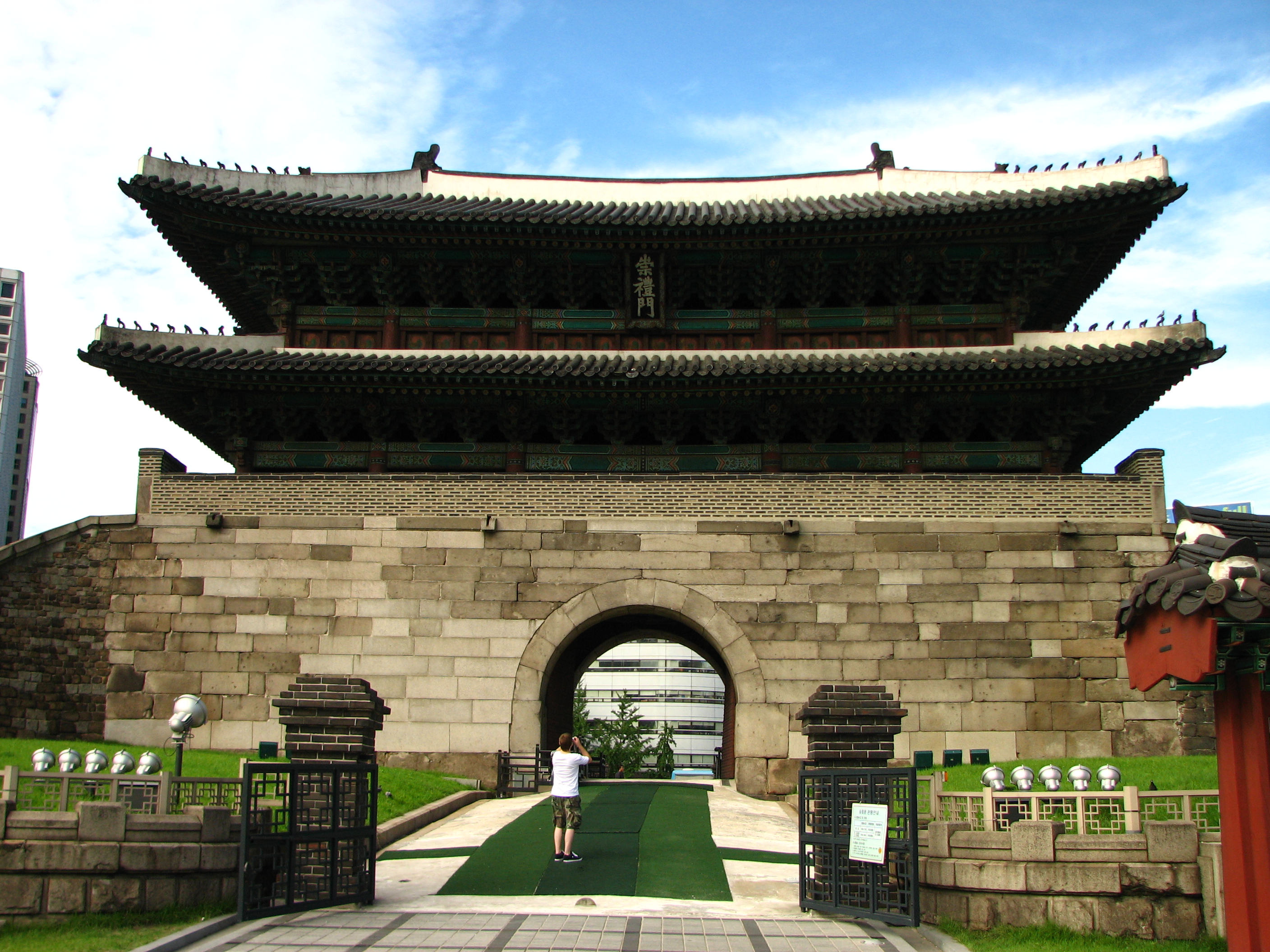
The rebuilding of Sungnyemun (also known as Namdaemun, literally "South Great Gate") has just been completed. This is what it looks like now:

                                                                                                        from Wikipedia Commons
Why was it rebuilt? Well, because in 2008, this happened:

                                                                                           also from Wikipedia Commons
Some ass-hat set fire to the darn thing and burnt it to a crisp.

That we may be clear, Sungnyemun is National Treasure No. 1 in South Korea. There used to be a huge retaining wall 20 feet high which encircled the citadel of Seoul, back in the Joseon Era (1392-1897). The gates were all built between 1396 and 1398, and they marked the cardinal directions. The northeast, northwest, southeast and southwest gates were the "Four Small Gates," and the north, south, east and west gates were the "Four Great Gates." Only six of 'em still exist today; I've been to four of them.

Sungnyemun (which literally translates to "Exalted Ceremonies Gate") is the best-preserved and most iconic. It shows up most frequently in travelogues and brochures about SoKo. It was nothing short of a tragedy when it was destroyed, and it was a long, torturous labor of love to set it to rights again. But now it's back, and reopened, and everyone can behold it in all its glory. The city government took pains to reconstruct the gate using materials and methods which were correct for the period, and they went slow and steady instead of rushing things (which has bitten them in the butt with previous restoration projects, I hear). I advise everybody to stop by the gate on their way through Seoul. It's worth your while.

Okay, onto the second news story:

The Korean SATs have been canceled.

No joke. It turns out that the office of the Korean Supreme Prosecutor (ain't that a badass title?) raided six college prep schools (hagwons) in Gangnam in February on suspicion that they were selling SAT questions which they sourced from Southeast Asia. In response to this information, the College Board canceled the test on the peninsula. Period.


This is unprecedented. The test has never been out-and-out canceled here before. A lot of Korean college students are going to be heavily disadvantaged by this. Just like in the U.S., SAT scores are an integral part of the university application process. Without 'em, students have little to no chance of getting into any sort of credible institution. It remains to be seen what the overreaching effects of this development will be.

And in the national news section of the Joong-Ang Ilbo, there was this little gem of a headline:

Filial attitudes get less respectful, says survey.


Here's the nut graph, just so you can get an idea of the article's message:

"As Korea's Confucian values continue to give way to modern or Western ways, a decreasing number of young people think they should be solely responsible for elderly parents."
Interesting, huh? I don't want to sound puffed-up, but this is something that I've been noticing myself in my discussions with students and young Korean people. The steady seep of Western films, music and philosophy into Korean culture has wrought its subtle magic, for good or ill. According to this study (conducted jointly by Statistics Korea and the Ministry of Gender Equality and Family, which is apparently a thing), only 35.6 percent of Koreans between the ages of 15-24 said they intend to fully support their parents when they get old.

Just to give you some perspective, that figure was 67.1 percent in 2002. 

Increasingly, it seems, young Koreans are expecting the government to take care of the elderly, leaving them free to pursue their own hopes and dreams free of the financial burden of dependent parents. This is quite a turnaround. They don't have a Parents' Day in this country for nothing, you know. Time was that Koreans would sacrifice everything for their parents and grandparents. Nothing was more important than caring for and obeying one's forbears. (Every single story I read in Professor Jeong's Folk Tales from Korea reflected this to a degree.) The unconditional care and support the elderly would receive from their children when they became too old to work was...a given. It was universal. It was the Confucian retirement plan. It was a reflection of Kongzi's emphasis on filial piety and respect for the elderly. These two ideas were ubiquitously practiced in the East for centuries, so much so that they were identified in the West as an integral part of the Oriental mindset.

But all that's changing now. The influx of Western ideas, particularly those which emphasize individualism, are well on their way to supplanting the old Confucian ways in Korea. (Potentially elsewhere, too: I'm curious to know if this same thing is happening in far-more-liberal Japan or far-more-conservative China.)

I know it'd be trite to say that Korea is a "nation of contrasts"; but hey, I'm a hack writer, so I can say it if I want to. That's precisely what this country is. They lovingly restore a 700-year-old gate, and yet their young 'uns don't want to take care of the old fogies anymore. They practically kill themselves working and studying, but some of them seem perfectly willing to cheat to get ahead. All I can say is that I'm glad I'm on the ground to formulate these opinions firsthand instead of trying to construct a picture from newspaper clippings and TV talk shows.

Postie out.

Wednesday, April 3, 2013

an escalating situation


I've never written much about the Democratic People's Republic of Korea on this blog. This is the first time I've ever tagged a post with "North Korea," in fact. I'm reading Barbara Demick's book Nothing to Envy, which follows the lives of six North Korean citizens through the famine of the 1990s; I was probably going to scribble a bit about that at some point. But now that the rhetoric and posturing and threats are escalating, I feel like I should tell you what's on my mind. Just in case I get blown away in the next 48 hours.

As you may have heard, things are getting out of hand over here. The situation here is tenser than I've ever seen in my 26 months of living in South Korea. Kim Jong-un has torn up the armistice, effectively putting the Koreas back into a state of open warfare; disconnected the hotlines between the two nations; mobilized his military and beefed up artillery and infantry forces along the border; refused entry to South Korean workers at the jointly-run industrial complex inside the DMZ; and leveled a constant stream of invectives and hostilities against South Korea, the U.S.A. and their allies.

In its latest move, Pyongyang has gone so far as to threaten a nuclear strike against the United States. Stating that its military has been cleared to use "smaller, lighter, and more diversified" nuclear weapons, the rogue nation declared that war could break out "today or tomorrow."

Although Al Jazeera reports that Korea has threatened the U.S. specifically, by proxy those threats refer to South Korea as well. Expert analysts believe that, despite all the bluster, the D.P.R.K. does not have the capability to deliver a missile to an American territory in the Pacific, be it Guam or Hawaii. (The U.S. recently announced its intention to place a missile defense system on Guam, which might be what's got Pyongyang's panties in a twist.)

If that's true, then the only places that North Korea can hit are South Korea or Japan. Japan would be an unwise choice, as it's a key U.S. ally and bombing it would bring on the wrath of the sleeping giant. South Korea is no less an important friend of the United States, but as we've seen with the Cheonan disaster and the Yeonpyeong Island incident, South Korea's not shy about poking its neighbor with a big stick. The attack that North Korea has threatened may come "today or tomorrow" might be leveled at Seoul or somewhere close by.

I don't know about you, but this has got me rather worried. I'm not one to panic easily, but things are different now than they were when I lived in Korea before. This time I'm in Seoul, just in case you missed my last six posts. I'm at ground zero, so to speak. The front lines. I've read that an estimated one million missiles will fall upon this city if war ever breaks out. And it's not just me anymore, either: Miss H is here, and our black cat Charlie. Whatever befalls me befalls them as well, good or ill. That would wrack anybody's nerves. Mine are fraying a smidgen.

On the ground, the situation is calm. Everyone here is going about their lives as usual. Blah, blah, blah, we've seen it all before. And I have to admit, I'm pretty blasé about North Korea now, having lived on the peninsula for almost two and a half years without incident.

So why am I so worried? Well, a couple of reasons. First of all, North Korea usually doesn't close the jointly-run Gaeseong Industrial Region. It's a source of hard currency for the regime and closing it hampers its floundering economy. Even when Seoul and Pyongyang are trading rhetorical blows, the complex stays open. The fact that it's closed to South Koreans now is...disturbing, to say the least.

Second, while I've seen heated exchanges between the two nations before, this most recent one is quite a bit more vitriolic than usual. The barrage of threats from the North has lasted longer and been more vehement than any I've previously witnessed (well, since the death of Kim Jong-il, anyway).

And that brings me to my final point: there's been a recent regime change. Kim Jong-un is running the country now, and he may feel that he's got something to prove. His grandfather and his dad kept the United Nations and the U.S. on their toes for 60 years; now it's Kim the Third's turn. He may have a chip on his shoulder. Perhaps he's looking for ways to make his mark, and has decided that a smoking crater in the center of downtown Seoul is just the way to do it. He may even be foolish or naïve enough to assume that he'll get away with it.

So here I am—with my loved ones—at the epicenter of six decades of stewing resentment and barely-controlled aggression.

What's new with you lately?

Sunday, March 10, 2013

movers, tailors, professors, and dust

Well, wherever should I begin?

                                                                                from Wikipedia

Saturday was in the sixty-degree range, the warmest of the year, and our lingering winter blues were demolished in a wave of warm breezes and sunny skies.

The yellow dust from China (a cloud of sand, heavy metal particles and chemicals that blows off the Gobi Desert every spring) has blanketed Seoul. The air is a sickly yellow color, and Miss H and I have been coughing and sneezing like nobody's business.

Yesterday I went to a tailor in Itaewon to do something I've never done in my life: get measured for a suit. Not a full suit, mind you. Just a blazer. I'm a professor now, after all. I need to look the part. So I located a tailor whom all my expat friends recommended. His nickname is "the Jokeman." He always has a new zinger to tell you whenever you go see him. He has a joke for every U.S. state (and probably a few for Canada and England, too). He's a short man, but wiry, with a hard-lined face, well-defined cheekbones, and short gray hair. He looks something like Daniel Craig, if Daniel Craig had been born in Korea and was 20 years older. If photographs are to be believed, Roger Clinton once visited the Jokeman, got fitted, and bought a suit. A slew of other minor luminaries have been in and out of the shop, too, according to the gilt-framed pictures adorning the walls of the Jokeman's basement shop. Anyway, I was fitted, I heard the spiel, I paid my money ($313 U.S.) and got a California joke.

"So," the Jokeman said. "Judge Judy was speaking to a criminal. She asked, 'Why did you break into the same shop three times in a row?' The man said, 'I stole a dress for my wife.' Judge Judy asked, 'So why did you go back again?' The man answered, 'I had to get it taken in twice.'"

Those are the blurbs and tidbits from our life thus far in Gwangjang-dong, eastern Seoul. As you may have already gleaned by now, Miss H and I moved from our comfortable bailiwick in Bucheon (west of Seoul, abutting Incheon) and came here, seeking better jobs and opportunities. I have accepted a job as an assistant professor of English at Sejong University, and Heather is now a kindergarten teacher at the NOAM, just down the street from our new apartment.

This is how it came about:

I had handed in my notice at my old hagwon in Bucheon. My last day would be Thursday, February 28. Meanwhile, Miss H received some disastrous news. Her kindergarten was downsizing. Henceforth it would focus on after-school elementary-age kids. The kindergarten levels would be dissolved. This meant Miss H would lose her job on February 15. Things were looking desperate. We would both soon be out of work (and therefore out on the streets, too, since our apartment was commensurate with my job).

We considered various solutions. We even (briefly) entertained the idea of going home and trying our luck there. But the hand of fate intervened, in the form of a generous benefactor (one of my coworkers, whom I'll nickname Jules). Jules appointed himself my unofficial agent, and assiduously combed the classifieds in the Korea Herald on my behalf. Lo and behold, he found something: an assistant professorship (one-year contract, non-tenure track) at Sejong University, in the Gwangjin borough of eastern Seoul. What the heck, I thought. I'll go for it. So I applied.

I was contacted a short time later and asked to come in for an interview. Sejong University sits across the street from Children's Grand Park, an enormous amusement park-cum-zoo where urban kids frolic on the weekends. The park is on the same subway line as Bucheon (Line 7), but it's 29 stops away. This takes 60-70 minutes. To get to Gwangjin on time for my interview, I had to abandon my usual languorous paradigm and get up at 7:30 a.m. to shower and shave. I rode in and had the interview. It was disastrous, or so I thought. I had zero experience teaching at the university level. My career as an educator extended to two nonconsecutive years of elementary and middle-school students in two after-school academies, and no further. I felt I had nothing to bring to the table, and began to wonder at how stupid I'd been to apply. When the interview was over, I slunk from the room and crawled off the campus.

You may imagine my surprise when, two weeks later, I received a phone call during my lunch break. I was hired. I was to be an assistant professor (조교수) of English for the 2013 academic year, which would begin on March 4. In the meantime, there was an orientation for new teachers on Thursday, February 21, and a general staff meeting the following Monday. Both of these required hour-long rides into eastern Seoul, and a lot of scrambling to return to Bucheon in time for my first class at my soon-to-be-former hagwon. It was stressful and not a little intimidating, but it was exciting as well. I would be exchanging a thankless, drudge-filled academy job for a genuine, honest-to-God teaching position with full benefits, six weeks' summer and winter vacation, 15 hours a week (plus four mandatory office hours).

The only hard part was leaving Bucheon. I'd come to love the community: the broad avenues, the green trees, the plentiful parks, the abundant public transportation and the wealth of shopping and eating venues. Not to mention that our apartment there was spacious, bright and airy. We'd be moving to a three-story brick villa that had to be twice as old as Estima Officetel, and whose rooms were tiny and dark, if considerably more airtight.

Fortunately Miss H and I had a three-day weekend to finish packing and physically move. March 1-3 was a commemoration of the Samil Movement, or Three-Day Movement (the first organized and voluble protest against Japanese colonial rule), which took place in 1919. It was violently put down by the Japanese military, and many Korean protesters were killed or sent to the infamous Seodaemun Prison. A dozen Korean flags fluttered in the windows of the apartment complex behind Estima as Heather and I sweated to pack all our things. In all, our worldly possessions amounted to new fewer than 45 small- and medium-size cardboard boxes. Where had it all come from?

Then the mover arrived. Miss H had arranged for him. He was actually the business partner of the man who was supposed to move us, but since the man himself was tied up in prior engagements,  his partner came in his stead. He proved to be a wiry old Korean man with crooked teeth who shifted boxes like they were feather pillows. In less than 40 minutes our things had been transferred from Room 908 to the basement level, where the moving truck (a humble Kia Bongo III) awaited. Little by little our precious boxes, lamps, shelves and folding chairs were stacked aboard and secured with a cargo net. Miss H took our cat, Charlie, and a backpack full of valuables with her on the subway to endure the hour-long ride to our new apartment. Our new home was a block or two away from Gwangnaru Station on Line 5 (only three subway stops and one transfer from Children's Grand Park on Line 7). I rode in the Bongo with the old Korean man. An awkward silence persisted as we chugged along the Gangbyeonbuk Road (which straddles the northern shore of the Han River). I hunched forward in my seat, cradling my schoolbag in my lap and my backpack on my shins, watching the glowing skyscrapers of downtown Seoul on the left and the darkly glittering waters of the Han River on the right.

After half an hour, we reached the Gwangjin area. Thanks to an oversight on my part, I had written down the wrong address, and therefore our mover's dash-mounted GPS proved useless. Fortunately I had a rough idea of where the apartment was in relation to Gwangnaru Station, and I managed to direct the mover there after a delay of only 20 minutes. Our new apartment was separated from the street by a meager six-step staircase. In less than half an hour the mover and I shifted all of the boxes and bulky items to the apartment floor. I made a quick dash to a nearby ATM and paid the man 100,000 Korean won for his troubles. Then he drove off. Miss H arrived some 15 minutes later, and the three of us (Charlie, Miss H and I) bunked down as best we could amid the detritus of our material lifestyle.

And that was the move. Sometime in the next few days I'll tell you about my first week as a professor.

Stay tuned...

Thursday, November 8, 2012

well, rats

I can't say much right now because it's 1:26 p.m. KST and I have work in thirty minutes. But I've been having a hard time lately. Somebody's karma ran over my dogma or something.

Long story short (pun intended), I'm five thousand words behind on my NaNoWriMo project. I have three tests left to grade and input. Miss H has gone home for two weeks to get some stuff done. The cat's acting crazy and I'm getting over a head cold. But hey, at least the weather's nice. It's cool and moist. There was a luscious thick fog at 5:00 this morning and it was so dense I couldn't even see the neon sign on the church a hundred yards away. (Yes, the churches here light up their crosses with red or blue neon lights, and usually have illuminated names, too.)

Excuse me, I'm going to go grade the hell out of those tests and then eat me some stir-fried squid over rice (ojingeo deopbap, for your edification). TGIF, people. TGIF.


From the correct side of the International Dateline, this is Postie. Over and out.

Wednesday, October 24, 2012

I hate that feeling

...but I suppose I'd better get used to it. I've had it before and I'll have it again. It stings, though. Smartly.

You know that feeling you get when people you know are doing something really cool but you can't go along with them because of your job or your family and you get to watch from afar as they have the time of their lives?

Yeah, that's the one. That's what I've got right now.

A couple of my friends from Canada and the U.S. have signed up for the Mongol Rally.

Don't know what the Mongol Rally is?

I'll tell you what the Mongol Rally is.

It's this:

                                                                                                                    from The Life of Adventure

...a 6,000 mile race across Europe and Asia, hosted by the Adventurists, a Britain-based adventure club and charitable organization.

Here's the idea: you start in London, sometime in July. You buy a piece-of-crap car with a 1000-cubic-centimeter-or-less engine. You, and as many friends as you can pack into this pathetic machine, drive said pathetic machine from London to Ulaanbaatar, the capital of Mongolia.

The team name is up to you. The car's paint scheme is up to you. The car itself is up to you. The equipment and supplies are up to you. The route and timing are up to you. All you have to do is acquire a conveyance and get it and yourselves to Mongolia before August is over.

The point, as you might have guessed, is the journey. Voyage of exploration, connecting with buddies, reaching deep inside yourself for survival (and mechanical) skills, challenging the raw forces of nature and all that hogwash.

Sounds lovely. Just the kind of quest I would like to undertake.

But I can't. June 2013 would be midway through my second year's contract. I could re-up in February for just a few more months, but then Miss H would have to find a new apartment. It's in my name. I would also have to go home and restart the whole finding-a-job-in-Korea-and-getting-the-requisite-documents nightmare that I've already delineated to you.

It's just not possible. I can't do it.

So off my friends go, doing this amazing thing without me.

It's not a fun feeling.

Ah well. I was never one for sour grapes. (I see what you did there, Aesop.)

Good luck, Mr. E and Mr. S. I wish you the best of luck. I hope you have the time of your lives and I'm behind you all the way. Send me some pictures and bring back some weird-ass souvenirs.

And I hope scraping up the requisite $8,000 for entry fees, charitable donations, vehicles, gas, food and airline tickets doesn't take too long.

Bah. Suddenly I feel like some cheese...and wine.

Sunday, October 14, 2012

the fastest man alive

Hats off to "Fearless" Felix!

Felix Baumgartner, the intrepid Austrian skydiver and daredevil, has departed a bare patch of weathered asphalt at an airport in Roswell, New Mexico. He is sitting in a tiny capsule attached to a gossamer balloon 700 feet high. He is clad in what resembles a full-blown spacesuit. Readouts and checklists surround him. A vast crew of people, including Baumgartner's friends and family, watch from the ground. In about an hour and forty-five minutes, he will reach an altitude of 120,000 feet. He is attempting to break the record for the fastest speed attained by a human being in free-fall: 690 miles an hour, or Mach 1. That's right...the speed of sound. In so doing, he will break three other records: the highest skydive, the longest free-fall, and the highest manned flight in a balloon.

Watch it live, here. Godspeed, Mr. Baumgartner.

Saturday, July 28, 2012

routine change

Hello the blogsphere!

You already know that people's maudlin problem-laden blogs creep me out. Speaking for myself, posts about people's lifestyles also annoy the cocktail sauce out of me. You know what I mean
—the ones about weight loss, green living and the like. Now, don't get in a twist. Hear me out. I realize that these blogs are kept for a reason. Two reasons, in fact: (A) informing readers about useful tips if they want to go green or lose the pounds, and (B) as a sort of self-policing diary for the writer. Those are good reasons. Like I said, my sense of umbrage isn't always logical.

That having been said, if you're anything like me, you're about to be annoyed.

I am pleased to announce that I have made some much-needed changes in my lifestyle. First and foremost, I am actually writing every day now.

It's true! You remember all those posts I wrote about how hard it was to establish a writing routine? How difficult it was to get into the writing mood every day? Well, I put my shoulder to the wheel and forced myself to do it. I started bringing my computer to work every day and trying to write during my breaks. It was tough at first, but it got easier. Soon, I had conditioned myself to get into the writing mood—to turn on the creativity—within seconds of opening MS Word and gazing over the pages of my manuscript.

It's an absolute blast. I've gotten over the shoal water (as Mark Twain would say) and am floating along pretty easily through the chapters that I'm adding. This manuscript has gone from twelve chapters, 296 pages and 58,404 words to twenty-one chapters, 436 pages and 90,106 words
—and three of those chapters haven't even been written yet. I estimate the work's final length at 120-130,000 words...twice the size of the first draft.

Awesomeness.

And so, I've managed to overhaul the writing aspects of my life. Excellent. Nice work there, Postie. But it's not enough. There are other matters which also require my attention. As a follow-up, I've decided to focus on something that desperately needs improvement: my level of physical activity. I just read an article on the BBC which frankly disturbed me. Apparently the sedentary lifestyle
—sitting around for hours and hours instead of exercising—is a killer. Literally. It zonks 5.3 million people a year, as many as do smoking-related health problems.

Yikes.

I don't want to be a statistic. I'd rather live to a ripe old age, which I'll have to if I want to publish all of the planned twenty-one books in this novel series, and continue to decry anthropic technological obsession for decades to come. Moreover, I'm sick of being doughy. I'd like to be in good enough shape to battle a charging Minotaur, hold on to a bucking Pteranodon, or outrun a zombie. One should always be ready for anything, physically and mentally.

So I've decided to make a change. A link provided within the BBC article explained that a mere 150 minutes of moderate physical activity per week is just what the doctor ordered. In addition, one should do muscle-strengthening exercises like push-ups, sit-ups, or yoga two days a week.

Heck, that's nothing. I've no excuse for not doing at least that much. I don't need to be running marathons. I just need to get off my heinie.

In the manner of an annoyingly self-righteous fitness blog, I shall now tell you my new workout routine. This is less for your illumination and more for my own lack of willpower. The following will serve as a public statement, made on the record, which I must hereafter cleave to or face public denouncement.

And so, without further ado, the new era begins. I'm playing an hour or two of basketball with my fellow expats at 5 p.m. this evening in Gyeyang Park. Now that summer intensives are here, and our schedules at work have been changed from 2-10 p.m. to 9 a.m.-5:30 p.m., I have double incentive. I'll have cool evenings to exercise in for the next three weeks. I have a beat-up old bike sitting out in the corridor, which I have failed to employ on a regular basis. I shall start taking evening bike rides. When summer intensives come to an end, I'll ride my bike whenever I can, and walk 30 minutes in the mornings. I shall supplement this with push-ups and sit-ups, with which I am intimately familiar already.

I shall fear neither heat nor humidity. I shall hydrate regularly. I shall ignore all but the most life-threatening aches and pains. My will is set. Only death can break it.

If the fitness regime sticks, my finances will be the final frontier.

Postie out...

Who's the hero in this picture, the guy who sits around all day, or Race Bannon?

Sunday, July 22, 2012

blurbs

I went to see The Dark Knight Rises this evening, and was only mildly annoyed with it. That must be some kind of record.

Corn actually tastes pretty good on pizza.

My novel manuscript is 411 pages (double-spaced) and clocks in at 81,476 words.

I went to the bank in my pajamas two days ago.

Somehow I'm in the middle of reading three books: The Chase by Clive Cussler, The Longest Day by Cornelius Ryan, and Cross the Stars by David Drake.

If I take a walk in the afternoons or make a run to Costco in the mornings, I sweat so much that I leave salt deposits on my T-shirts. It's that hot and muggy out there. This is worse than Tennessee.

Terra Nova (a sci-fi TV show, formerly on Fox) has been canceled. It'll be put out on DVD soon and will henceforth be presented as a "motion comic." I suppose I should know what that is, me being an aspiring comic book writer. But I don't.

The weirdest Google search I've ever done was for "alien draft animals"...three days ago.

Intensive courses begin at work on Tuesday. I'll be working from 8:00 a.m. to 6:00 p.m., or something. For the next month. Goodbye, sleep schedule.

Sometimes I get the idea that the Koreans' cultural respect of the greater good and their belief in the insignificance of the individual are all a sham. They're all rugged individualists once they climb behind the wheel of a car. Or maybe cars are just Asian Kryptonite.

Listening to Winston Churchill speeches on YouTube gives me goosebumps.

Until tonight I had no idea what the phrase "to wit" meant.

I put one of my felt hats in the laundry last week (it got completely soaked with sweat on my last outing). It came out all limp and misshapen. I still love it.

Getting into the habit of watering houseplants every day has been tricky, but well worth it. We have little red flowers blooming constantly on the plant by the window.

They're not "pushpins," people. They're "thumbtacks." I dare you to tell me there's a difference.

These are just a few of the things occupying my mind at the moment.

Sunday, April 22, 2012

quiet down for a week or two

Recently it was announced that there's something called a naeshin week coming up at my hagwon. I haven't the slightest clue what "naeshin" means, but it has something to do with tests. The middle schoolers have big tests coming up. I don't mean SATs or ACTs or anything. This is a long, brutal week in May when the little rotters take a sort of assessment/achievement test to determine how well they've absorbed the endless miasma of knowledge siphoned into their heads by their teachers. These tests assess their chances of getting into a good university, acquiring high-paying jobs and supporting their parents in their leathery old age.

Anyway, during this upcoming week, the middle school students will be having cram sessions every night with the Korean teachers. That means we foreign teachers will have no middle schoolers to teach. However, we shall have to take up the slack with the elementary kids, whom the Korean teachers will be too busy to handle. So, we will have an increased course load during the early afternoons. Our own elementary classes will continue as normal, with lessons and such. But the classes we're subbing for will do things a bit differently. There will be a sort of "presentation class" where the students will be given a topic at the beginning of the week, distill it into a presentation, and deliver it at the end of the week. That should be intriguing. The topic will be "time travel"—if you had a time machine, where would you go? What would you change? How would this affect the future?

Following the increased afternoon course load, our evenings are largely vacant. From 6:15 p.m. onwards (7:45 on Tuesdays and Thursdays) I'm pretty much just lounging around.

Things get really interesting the week after this. This is called the "holding period." During this time the middle school students are off actually taking those big exams. They don't come to the academy at all. The Korean teachers go back to teaching elementary classes, and everything resumes as normal, sans the middle schoolers. This means that we'll have even fewer classes and be done even earlier. Think of how much novel-editing I'll get done during that span!

And now, because every good blog post needs a picture (so it'll look all fresh and appealing when it's down there in the "You might also like" zone), please take a moment to consider this:

Friday, December 30, 2011

le grande update

As you may have noticed, my last two posts were exceedingly brief. And as you're aware, I'm a long-winded bugger who can't abide sparing the slightest detail. So I think it's about time I gave you a full update on where I stand, before things get crazy.

First, I'm going back to Korea. It's official. It's genuine. It's true. I don't want to jinx it (this will be my fifth attempt, and every previous job offer has gone south due to unexpected delays and unforeseen obstacles), but nothing short of an Act of God can stop me now. I'm Asia-bound, so help me.

I sure didn't see this coming. I loved Korea, rest assured. It was a blast. A kick in the pants. The cat's pajamas. The elephant's instep. Despite the complete and abject lack of limes, turkey, single-malt Scotch, sausage, real cheese and decent hamburgers, the place was alright. I had a ball. I crammed my existence into a tiny studio apartment, took frequent walks, wrote in my journal, blogged, scribbled a novel, taught hyperactive children the rudiments of the English language, tried to learn Korean, lost 20 pounds, became addicted to bulgogi and kimchi, acquainted myself intimately with debauchery, danced, raved, sang, drank, ate, and was merry. Oh, and I made myself a ton of cherished friends, with whom I remain in contact to this day (and many of which I will see again come February).

But I didn't think I'd go back. I thought I was done with living overseas and making money there. I figured I'd return to the States, get some stuff done (like my pilot's license) and then find a job and get busy. I really had no ruttin' idea that things were so bad here. Now I look back at the day in 2009 when I stepped off the jetliner and into the warm, moist, smoggy air of the Inland Empire, and I giggle at how naïve I was. I thought I was set for life. I had a year of international job experience under my belt and a wad of cash in my pocket. I thought I was sitting pretty. Boy, was I whistling Dixie. What I should've done was move someplace with low rent and cheap gas (like, I don't know, Kansas perhaps?), get a crummy job and work for five years until I had a suitable sum of money saved and a modicum of job experience. Then I could've looked about me, gauged my options, moved to Alaska, gotten my pilot's license, whatever.

But I jumped the gun. Drunk on prosperity and globetrotting confidence, I decided to get my pilot's license right away. Hang the job, hang security, hang responsibility. You know what came of that. I got myself stuck in this goddamn desert pest-hole for two and a half years.

They say hindsight is 20/20. My hindsight should've been a lot clearer, though, considering how far up my ass my head was.

So, poor economic decisions aside, I got my pilot's license. I worked two low-paying jobs (a temp job at the local newspaper, which lasted about a month, and that flying job I've been talking about for ages). I lived in my parents' house. That was godawful. I felt rotten, like I was a kid again, not a forward-striding, self-sufficient man's man as I'd imagined. My folks were sweet as pie, and did everything to make things as comfortable as they could for me, giving me loads of excellent advice (most of which I didn't listen to until it was too late). They salvaged my pride at several pivotal junctures, too, bless them. But the malaise, the ennui, and the remorseless hindsight gnawed at me day and night. And worse yet, I had no escape route. Jobs there were none. Prospects there were none. Money was running out. It seemed I was doomed to remain in the doldrums forever.

It's difficult to believe that Miss H and I started looking for jobs in Korea back in June. June! Thanks to delays and unguessable disasters, we've endured one of the roughest, bleakest times of our lives. The ennui was ten times worse for her; she couldn't find any jobs at all. She worked a seasonal stint at Target last year during the holidays, and that was it. There's nothing in this damn desert. Zilch. Squat. Nada. The desperate downward spiral took a heavy toll on us.

Our hand had been forced. We decided to go to Korea. But couple's positions were thin on the ground, and the delays and backups just kept mounting. We had to make some tough calls. Ultimately, Miss H decided to stay behind. She would not accompany me to Korea. We would separate temporarily, she to seek her fortunes, I to seek mine farther afield. And lo and behold—snap—the pieces began to click together. I got a job offer from a hagwon in Bucheon (somewhere between Seoul and Incheon) the very same day I told my recruiter to find me a singles' position. And things bloomed at Heather's end, too: she got several bites from a social work agency in the same town she'd gone to college in. She knows the area, and rent and gas are very reasonable. Boom: just like that, things are looking up for us. Seems like an impossible dream after the long hard slog we've had for the past two years.

And in other news, I finished my novel. No, I mean finished: it's written, it's edited, it's proofed, everything. Of course there are few tweaks to be made, and it has to be peer-reviewed, but the thing is largely done.

That feels good.

No, really. You remember how scared, nervous, self-conscious and maudlin I've been? For three years it's been like this. I started the dang novel in Korea. Finished it not long after I returned, in late 2009. Ever since I began I've had the feeling that it was crap, and that I was a the world's largest hack, and that the whole thing was a waste of time. Normally I'm a secure and confident bloke and don't entertain thoughts like these. But I did. And they bedeviled me and my writing efforts for three long years, before I finally wised up, gained perspective, achieved Nirvana or whatever, and buckled down and finished.

The second rewrite was much easier than the first, because I felt no insecurity. I felt fine, in fact. The novel felt like a novel. The author felt like an author. The work felt like work, but more than that, it was fun. For the first time, it was actually fun. Hallelujah for that!

So I spent about a fortnight just blasting through my entire manuscript, line-editing, spell-checking, rearranging syntax for mellifluousness, and making some major revisions and rewrites. And you know what I came out with? A novel. An honest-to-Gawd debut science fiction novel. It's got plot. It's got theme. It's got premise. It's got character. It's got conflict. It's got action. It's got a climax, a denouement, and all the rest. It may be a bit amateurish (after all, it's my first book) but everything's there.

Now I just need somebody to read it. And a publisher to send it to.

This is tremendously exciting.

So, in summary, I'd just like to say that after thirty months of waiting, worrying, striving and stagnating, things are looking up. The novel's done, and I'm going to Korea. And Miss H and I are doing better than ever. 

Thanks for sticking with us.