Showing posts with label Joseon. Show all posts

Saturday, May 3, 2014

the death of Neo-Confucianism in Korea...?

All eyes are once again on Asia this week, President Obama having wrapped up his four-nation Asia tour (leaving hearty Filipino protests in his wake) and the Sewol disaster fresh in everyone's minds. However, yet another disaster—or near disaster—in South Korea has stolen the public eye. 

You might have heard about the subway train accident we had this Friday. QiRanger does a very thorough video update about it here, where you can get all the facts.

I'm not here to debate particulars, cast blame or express relief that everyone aboard those two trains survived. I'm not here to tell you that I travel on Line 2 all the time and could have easily been involved in the accident. (I have, actually, been aboard a Line 5 train that braked so hard and so unexpectedly that all six dozen people in the car with me went sprawling like dominoes, and I wound up flat on my back with a rucksack full of booze under me and my livid fiancĂ©e on my stomach.) 


I just want to say two things. 

First, subway accidents in Korea never happen. They are the exception, not the rule. Korean railways are tightly and safely run. The Seoul metro is one of the cleanest, safest, most efficient and easiest-to-use metropolitan light rail systems in the world, despite being one of the busiest. Its safety record was, to my knowledge, flawless up to this point. There was a nasty incident in December 2013 when an inexperienced train operator filling in during a strike ordered the subway doors closed too early, and an 84-year-old woman was dragged a short distance and killed. Oh, and the Daegu subway fire ten years before that, I suppose. But those were freak occurrences brought on by circumstance: a vengeful cab driver and an unschooled scab, as it were. This recent subway accident took place during regular hours, and wasn't caused by a mass murderer or a strike. It just happened. I would have said it was impossible.

Second...you may be witnessing the death of Neo-Confucianism in Korea. 


An Hyang (1243-1306), widely
considered to be the founder of
Neo-Confucianism in Korea.
As I discussed in my previous post about the Sewol sinking (which I linked to above), Korea's guiding star has been the Neo-Confucian model ever since the early days of the Joseon Dynasty (1392-1910). Some of Confucianism's central tenets are filial piety, respect and reverence, loyalty, and shame. It is unthinkable to disobey or show disrespect to one's elders. There is a very strict social hierarchy wherein each individual is classified according to age, experience, seniority, and other factors. Someone who's above you on that scale deserves the highest respect; anyone below you is yours to command. 

And in fact, this system, which served Korea well throughout its long and often brutal history, was just what caused the deaths of so many children during the Sewol debacle. The children and other passengers were told to stay put in the cabins and corridors, and bowing to the captain's lofty position and experience, they obeyed. Unfortunately, the captain proved to be an incompetent and untrustworthy coward, and many children met their fates as a result. This event, as I noted in my blog post about the sinking, has shaken Korea to its roots, particularly the younger generations. Many in Korea seem to have begun to doubt the worth and universal applicability of Neo-Confucian values. 

Nowhere is this growing doubt more apparent than in the subway train passengers' reaction to the drivers' instructions in the moments following the collision at Sangwangsimni Station. They were told to stay put, and hardly any of them listened this time. Quite a number of passengers pried open the train doors and leaped down onto the tracks and into the tunnel.

Now there's something I never would have believed possible. Korean folks disobeying instructions from a competent authority? Prying open doors and leaping onto train tracks? Anarchy!  


Does it mean that the Neo-Confucian underpinnings of this country's culture and society are beginning to erode? Only time will tell, but I think the signs are there. Goodness knows what will happen if I'm right. A complete paradigm shift might be in the offing. You may rest assured that I'll keep an eye on things over here, and let you know if I see anything noteworthy. 

But now you must excuse me. I have a four-day weekend to get back to. Children's Day is Monday and Buddha's Birthday is Tuesday. Two unrelated lunar holidays in a row. That never happens here, either. The unexpected double-whammy has convinced all the foreigners on the peninsula to throw a grand Cinco de Mayo bash. Colored lanterns are strung up all across the city, Seoul's high society are turning out in droves in their best tailored suits and tulle skirts, and the Americans and Canadians are getting blitzed in the bars and staggering around Itaewon wearing sombreros in broad daylight. Me, I'm taking introspective walks by the Yangjae Stream and meeting friends from out-of-town for a bite of Thai-Japanese fusion and a sip of beer. Oh, the expat life. 

Postie out...

Thursday, April 3, 2014

Park, Lee, and Kim...oh my!

Have you ever wondered why such a staggeringly large slice of the Korean population is named Park, Lee, or Kim? 

So have I. In fact, it used to be the most burning question I had about this peninsula, right behind what "Seoul" means

But not anymore. I found the answer. 

First, let me introduce you to a building:

                                                                                                               from Wikimedia Commons

It's called Gyeongbokgung ("Palace Greatly Blessed By Heaven") and it stands in central Seoul, near the intersection of Lines 3 and 5. Up the hill behind it is a famous Buddhist temple and the Blue House, the official residence of the Korean president. Gyeongbokgung was the largest and grandest of the Five Grand Palaces built by the Joseon Dynasty. Originally constructed in 1395, right after Joseon's foundation, and then later burned and abandoned for three centuries, it was reconstructed in 1867. 

Now here's where things start to get controversial. 


The official word is that Gyeongbokgung was burned to the ground by Imperial Japan shortly after their annexation of Korea in the early 20th century. But various reports and accounts I've heard tell a different story. Let me back up and do some more explaining.

Korea's surnames, like Scotland's, were all clan-based in antiquity. The Kims were a clan unto themselves back in the day, and a very powerful one. So were the Parks (or Bak, as I prefer to romanize it). The Lees, too. But there were hundreds of others: Choi, Bae, Woo, Lim, Jang, Jeong, Bang, Go, Min, Hong, Seo, Gang, Yoo, Heo, Yoon, Gwak, Gwon, Yang, Hwang, Myeong, Dong, Ryu, Noh, Na, and Pyo come readily to mind.

Here's the thing, though. Korea used to have a caste system. The Kims, Lees and Parks got so powerful that they became the rulers of some of the peninsula's mightiest kingdoms: Baekje, Silla, Goguryeo, and Joseon. Everybody else got the shaft. The Gangs and Yoos and Yangs remained commoners. Granted, any commoner could sit for the gwageo (civil service examination) and become a yangban (civil servant), entitled to an estate and aristocratic privileges...but hey, noble names were still noble names, and common ones common.


When the Japanese annexed Korea in 1910, one of the first things they did was abolish the caste system. Suddenly a Kim was no better than a Choi, and Park no worthier than a Jang. But the names themselves still retained some time-honored clout. It was a mark of prestige to be a Kim or a Park, even if the Japanese had barged in and said it didn't count for beans anymore. 

So, according to what I've heard, Gyeongbokgung wasn't burned down by the Japanese. It was burned down by the Koreans. See, Gyeongbokgung was where the Hall of Records was. Everybody's birth certificates and genealogies were in there. With those reduced to ashes, a lowly Pyo or Hong could waltz right into the nearest Japanese registrar's office and say "Hello there. I'm Mr. Kim." Or "Howdy doody, ilbon saram! I'm Mr. Lee!" 

I don't know if that's true or not, but I have to admit it's a compelling theory. Korea suffers from a deplorable excess of Kims, Lees and Parks because their granddads all wanted to put on airs and had no qualms about committing arson to do it. This is why I secretly rejoice whenever I see an extremely rare surname (such as Gwak, Yang or Pyo) because I know that that person's ancestors had enough pride in their roots not to torch the royal palace and then fake their names during the next census.

And now you know the rest of the story.


P.S. Can you think of anybody else who might be using the name "Kim" to give themselves some street cred...?

Thursday, May 16, 2013

peninsular news

What I'm about to tell you is two weeks old already, because the newspapers I'm using were a week old when I picked them up, and it's been a week since I picked them up. So there. Yeah.

But anyway, the news was so interesting and so genuinely Korean that I had to share it with you. Y'might get a better idea of what goes on over here on this peninsula after reading these stories:

From an issue of the Joong-Ang Ilbo, dated May 3rd:

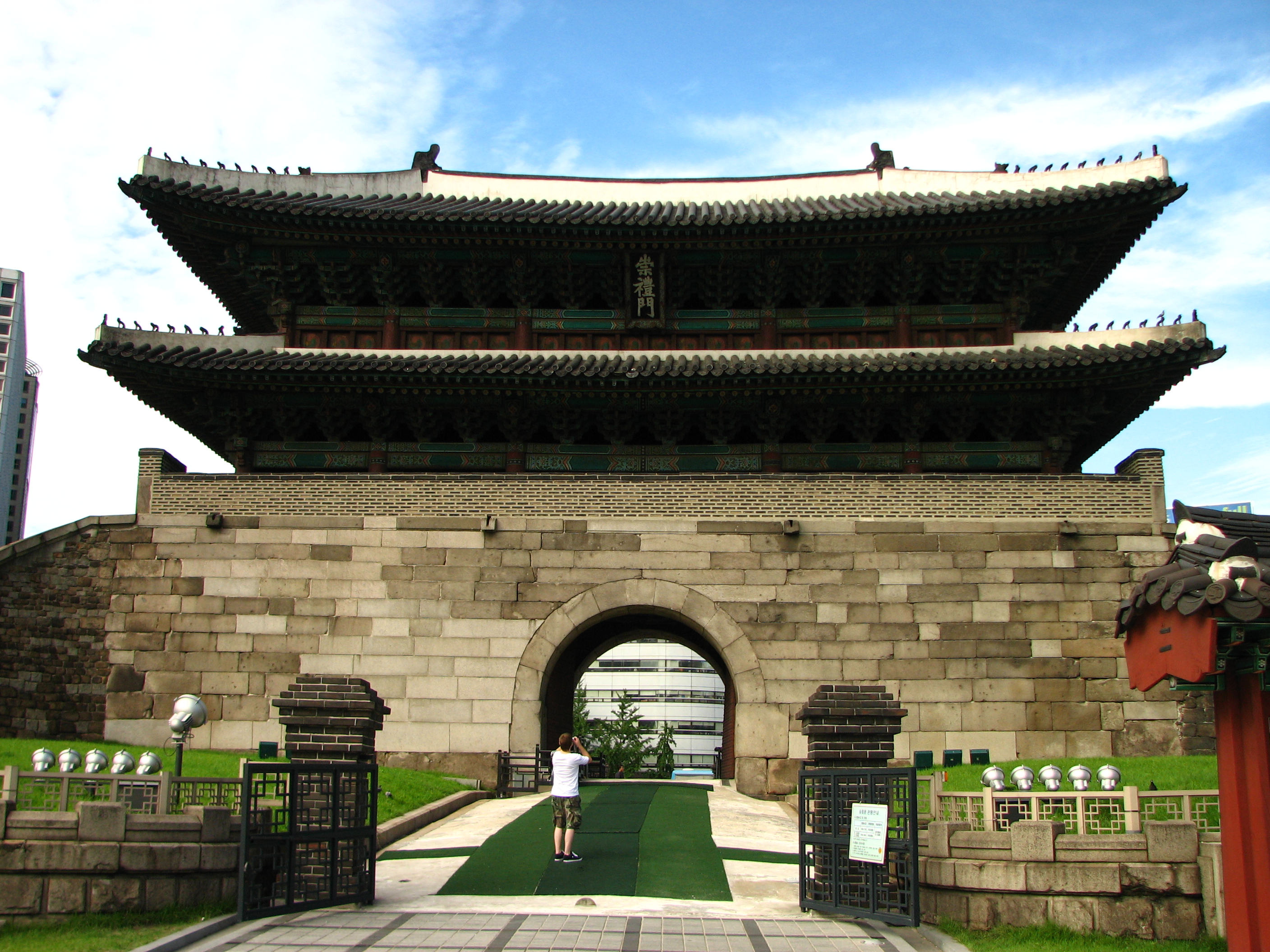
The rebuilding of Sungnyemun (also known as Namdaemun, literally "South Great Gate") has just been completed. This is what it looks like now:

                                                                                                        from Wikipedia Commons
Why was it rebuilt? Well, because in 2008, this happened:

                                                                                           also from Wikipedia Commons
Some ass-hat set fire to the darn thing and burnt it to a crisp.

That we may be clear, Sungnyemun is National Treasure No. 1 in South Korea. There used to be a huge retaining wall 20 feet high which encircled the citadel of Seoul, back in the Joseon Era (1392-1897). The gates were all built between 1396 and 1398, and they marked the cardinal directions. The northeast, northwest, southeast and southwest gates were the "Four Small Gates," and the north, south, east and west gates were the "Four Great Gates." Only six of 'em still exist today; I've been to four of them.

Sungnyemun (which literally translates to "Exalted Ceremonies Gate") is the best-preserved and most iconic. It shows up most frequently in travelogues and brochures about SoKo. It was nothing short of a tragedy when it was destroyed, and it was a long, torturous labor of love to set it to rights again. But now it's back, and reopened, and everyone can behold it in all its glory. The city government took pains to reconstruct the gate using materials and methods which were correct for the period, and they went slow and steady instead of rushing things (which has bitten them in the butt with previous restoration projects, I hear). I advise everybody to stop by the gate on their way through Seoul. It's worth your while.

Okay, onto the second news story:

The Korean SATs have been canceled.

No joke. It turns out that the office of the Korean Supreme Prosecutor (ain't that a badass title?) raided six college prep schools (hagwons) in Gangnam in February on suspicion that they were selling SAT questions which they sourced from Southeast Asia. In response to this information, the College Board canceled the test on the peninsula. Period.


This is unprecedented. The test has never been out-and-out canceled here before. A lot of Korean college students are going to be heavily disadvantaged by this. Just like in the U.S., SAT scores are an integral part of the university application process. Without 'em, students have little to no chance of getting into any sort of credible institution. It remains to be seen what the overreaching effects of this development will be.

And in the national news section of the Joong-Ang Ilbo, there was this little gem of a headline:

Filial attitudes get less respectful, says survey.


Here's the nut graph, just so you can get an idea of the article's message:

"As Korea's Confucian values continue to give way to modern or Western ways, a decreasing number of young people think they should be solely responsible for elderly parents."
Interesting, huh? I don't want to sound puffed-up, but this is something that I've been noticing myself in my discussions with students and young Korean people. The steady seep of Western films, music and philosophy into Korean culture has wrought its subtle magic, for good or ill. According to this study (conducted jointly by Statistics Korea and the Ministry of Gender Equality and Family, which is apparently a thing), only 35.6 percent of Koreans between the ages of 15-24 said they intend to fully support their parents when they get old.

Just to give you some perspective, that figure was 67.1 percent in 2002. 

Increasingly, it seems, young Koreans are expecting the government to take care of the elderly, leaving them free to pursue their own hopes and dreams free of the financial burden of dependent parents. This is quite a turnaround. They don't have a Parents' Day in this country for nothing, you know. Time was that Koreans would sacrifice everything for their parents and grandparents. Nothing was more important than caring for and obeying one's forbears. (Every single story I read in Professor Jeong's Folk Tales from Korea reflected this to a degree.) The unconditional care and support the elderly would receive from their children when they became too old to work was...a given. It was universal. It was the Confucian retirement plan. It was a reflection of Kongzi's emphasis on filial piety and respect for the elderly. These two ideas were ubiquitously practiced in the East for centuries, so much so that they were identified in the West as an integral part of the Oriental mindset.

But all that's changing now. The influx of Western ideas, particularly those which emphasize individualism, are well on their way to supplanting the old Confucian ways in Korea. (Potentially elsewhere, too: I'm curious to know if this same thing is happening in far-more-liberal Japan or far-more-conservative China.)

I know it'd be trite to say that Korea is a "nation of contrasts"; but hey, I'm a hack writer, so I can say it if I want to. That's precisely what this country is. They lovingly restore a 700-year-old gate, and yet their young 'uns don't want to take care of the old fogies anymore. They practically kill themselves working and studying, but some of them seem perfectly willing to cheat to get ahead. All I can say is that I'm glad I'm on the ground to formulate these opinions firsthand instead of trying to construct a picture from newspaper clippings and TV talk shows.

Postie out.

Thursday, November 1, 2012

NaNoWriMo, go!

Let me tell you everything about myself. I'm an intensely private person.

And that's it, really.

Haha, I'm just kidding. Long story short, I got bored waiting for the requisite six weeks to go by before I could start editing my new-and-improved novel manuscript (118,500 words). Stephen King says you should stick a newly-finished manuscript in a drawer and let it stew for a few weeks before you revise it. This gives you some time to draw back from the work and approach it with fresh eyes. So that's what I'm doing. Miss H is reading it in the meantime, and I'm on tenterhooks until I hear her review.

Anyway, I was bored. So I started looking into publishing options just to kill time. First, I thought I'd check out self-publishing. I contacted a free third-party service which connects you with the nearest self-publisher. I was contacted by someone anonymous who worked for a multinational firm which shall remain nameless. They gave me the details. Basically, even though this company was renowned and reputable, I was looking at an investment which was way out of my league; anywhere between $600 and $14,000. I just can't do that right now. Therefore self-publishing has been shelved until I can check into the more traditional methods. Like Baen Books.

Now that we're past that little update, it's time for the big news...

NaNoWriMo!

National Novel Writing Month, obviously. I'm doing it for the first time in 2012. I have my idea all worked out (historical fiction), I've done some pre-planning, the idea is fresh and fun and new, and I'm anxious to test myself against it. (Don't worry, I'll give you a full synopsis in a few days.)

Who knows...this could be that crappy novel that teaches me a lot about writing, or my first success. Who can tell?

The possibilities are endless.

Tuesday, October 30, 2012

sunken ships and captured forts


A Korean junk, circa 1871. (Photo taken by U.S. military personnel; courtesy of Wikipedia.)
Did you think the Korean War of 1950-1953 was the first U.S. military action on the Korean peninsula?

Have you ever wondered who the first American soldiers to receive Medals of Honor in a foreign conflict were? And which conflict it was? 

You're about to discover the truth.

The year was 1866. The American Civil War had recently come to an end. The heart-rending, gut-wrenching conflict was finally behind us, and the process of reconstruction was underway. America now gazed across the oceans, seeking new horizons, searching for trade partners, hoping enterprise would soothe its bruised soul. Commodore Matthew Perry had pried Japan open with a crowbar in 1854, and U.S. interests had been entrenched in China for decades. Korea had been on the table since 1844, neglected due to lack of interest. American eyes now turned to the isolationist empire on its small peninsula. It offered a tempting and pristine target for merchants and traders.

On August 16, 1866, a merchant marine side-wheel steamer named the General Sherman puffed into Korean waters. Belonging to the British trading firm Meadows & Co., the 187-ton Sherman carried a cargo of cotton, tin and glass, hoping to entice the Koreans into a trade partnership. The Sherman was also heavily armed, just in case the Koreans weren't in a listening mood. She was crewed by a Captain Page, Chief Mate Wilson, and almost twenty Chinese and Malay sailors. Also aboard were the ship's owner, W.B. Preston (American) and Robert Jermain Thomas, a Protestant missionary and the excursion's official interpreter. Assisted by Chinese junks, the General Sherman steamed up the Taedong River and anchored just outside the Geupsa gate, at the border of the Pyongan and Hwanghae Provinces.

The traders established contact with the Koreans and told them they wanted to dicker. The Koreans refused, but agreed to supply the foreigners with provisions. The Sherman was told to wait at the Geupsa gate until the Korean regent could be consulted. He would then either send the envoy home or invite them into Pyongyang. For unclear reasons, however, the Sherman weighed its anchor and steamed further upriver, eventually running aground on an island in the midst of Pyongyang. A Korean ambassador was sent to the ship with an offering of food, and a stern warning: the ship must return to the Geupsa gate, or all aboard would be killed.

This is where accounts get muddled. The Koreans claim that the foreigners kidnapped the ambassador and held him hostage. They demanded to be allowed inside the city and even went so far as to fire the ship's cannons into the crowd which had gathered on the banks of the river. This went on for four days. More envoys were sent, words were exchanged, and the vessel kept firing its guns up and down the riverside.

Reality check, here. I'm not an apologist, but I find it difficult to believe that a trading ship would just up and start a war on an isolated nation for no reason. Doing so would hardly have been profitable. More likely there was some massive misunderstanding that took place. The Reverend Thomas was the only Westerner aboard who could speak Korean, and no one knows exactly what his level of proficiency was. After living in this country for almost 21 nonconsecutive months, I'm well aware of just how easy it is to cause massive misunderstandings. The language barrier is pretty thick here. The cultural discrepancies between Korea and the Western world don't seem great at first, but they can sneak up on you. And Koreans wear their hearts on their sleeves: they will react passionately and vehemently if something untoward happens, and they will correct forcibly if they can't make themselves understood. Perhaps Thomas, Captain Page or Mr. Preston all underestimated their hosts' magnanimity. Perhaps they just failed to keep their minds, eyes and ears open.

Whatever the cause of the misunderstanding was, it cost them their lives. The Koreans tied several boats together and filled them with wood, sulphur and saltpeter. They set them aflame and sent them drifting toward the General Sherman. The first two boats left the steamer unscathed, but the third lit her up like a Christmas tree. Unable to quench the blaze, her crew dived into the water, where the Koreans unceremoniously beat them to death.

And so ends the first part of my story. The second now begins.

Nobody knew what had become of the General Sherman, but since there had been American nationals aboard her, it was a cause of concern for the United States of America. So, in 1871, a military expedition to Korea was mounted. Its mission was to ascertain the fate of the Sherman and her crew, protect a new diplomatic legation being sent to open trade routes with the peninsula, and to establish a treaty with Koreans for the protection of shipwrecked sailors. (The Joseon Dynasty, like the Tokugawa shogunate, took a rather dim view of castaway foreigners on its shores.)

American history books (if they mention it at all) call this the 1871 Korean Expedition. The Koreans call it the Sinminyangyo, and it was centered on an island in the Han River estuary called Ganghwa-do. It already had a history of punitive incursions; the French had mounted a military expedition there in 1866, the same year the Sherman was destroyed. The Japanese would later invade there in 1875, and shanghai the Korean regent into signing a trade agreement, thereby ending the Joseon Dynasty's isolationist policies.

The American warships first attempted peaceful overtures, but the local officials dodged the subject of the Sherman incident, perhaps to avoid having to pay recompense. The Americans stated their intention to explore the region peacefully. Official Joseon policy, however, forbade foreign ships on the Han River, which led directly to Seoul. So the Korean troops fired on the American ships from their stone forts on Ganghwa's heights, without inflicting much damage. The Americans demanded an apology within 10 days. None was forthcoming, so
on June 10, 650 American sailors and Marines off the Colorado, Alaska, Palos, Monocacy, and Benicia landed at Ganghwa-do. They stormed several Korean forts on the island, one after the other. Set against them were some hundreds of Korean regulars, known as the "Tiger-Hunters" and led by General Eo Jae-yeon.

Another Wikipedia image. This is a posed photo, but these are the U.S. Navy commanders. That's Admiral John Rodgers, the expedition's commander, leaning over the table on the right.

The account of the action is quite thrilling, and can be read in detail here. Suffice it to say that about 250 Koreans armed with outdated matchlock muskets were killed, for the loss of three Americans. The fort defenders were easily defeated by the better-armed Americans, who were also aided by artillery fire from the Monocacy. Five Korean forts were taken, as well as numerous prisoners. The Americans hoped to use these spoils as bargaining chips to force the Joseon rulers to the table. No dice. The Koreans refused to negotiate with the Americans and told them they were welcome to keep the "cowardly" defenders of Ganghwa-do.

So the American ships sailed away to China, and that was the end of it.

But was it? This seemingly insignificant action had far-reaching consequences. Firstly, Daewon-gun, the Joseon regent, saw fit to strengthen his isolationist policies in the wake of invasion—to no avail. The Japanese sailed up the Han River in 1875 and threatened to fire on Seoul unless the Koreans agreed to trade. (The Japanese must have taken a leaf out of Perry's book, huh?) Trade agreements with the Western nations soon followed, including one signed with America in 1882.

Perhaps more importantly, though, nine sailors and six Marines of the American expeditionary force were awarded the Medal of Honor for the actions at Ganghwa-do.

These were the first Medals of Honor ever awarded for action in a foreign conflict.

How about that, eh?

AND NOW YOU KNOW...

Monday, May 25, 2009

Korean History 104

So here we are in 1392. The Joseon Dynasty has just been established. Joseon was the last great kingdom of Korea before that little thing we call "modern history" happened: you know, the Japanese invasions of the 1590s, the Manchu incursions, World War II, the Korean War, and what has followed after, leading to the foundation of the Republic of Korea. Joseon was the longest-lasting Buddhist dynasty in Korea (roughly 500 years, until 1910); it saw the relocation of the capital to Seoul and the modern-day boundaries of Korea established (through subjugation of the aforementioned Jurchens to the north); and it heralded the height of Korean culture. It is to the Joseon Dynasty that modern-day Korea owes much of its customs, habits, thought processes, and etiquette...not to mention its very alphabet.

Yep, Hangeul was created during the Joseon Dynasty. Mighty late, it's true. By order of Sejong the Great, one of the Joseon kings, the Hall of Worthies (a bunch of scholars) created the "great script." Sejong, you see, was a keen observer. He noticed that Chinese characters, which are ideographs, were proving to be rather tricky for the peasants and uneducated folk to deal with. So he ordered up a new alphabet that was easier to understand and write. The Hall of Worthies managed to crank it out in 1446, and spent the next few centuries trying to promulgate it. It did catch on eventually, though, and is now on every billboard and road sign in South Korea (although many signs are still to be found with the old Chinese characters, or Hanja as they're called in Korean, and some Koreans, like Charles, can still read them).

It worked. According to Discovery magazine (as quoted by VANK), Korea now boasts the highest literacy rate in the world, thanks to Hangeul, which Discovery called "the most logical alphabet in the world." Today Hangeul is held to be one of the foremost among Korean achievements.

Joseon was also foremost in the fields of architecture and shipbuilding, especially as regards to fortresses and battleships. Hwaseong Fortress was constructed in the late 1700s in Suwon, Gyeonggi-do Province (same province that Seoul's in). There are differing opinions for its construction. One theory is that it was built to commemorate the memory of Prince Sado, who was locked alive inside a rice chest (and thereby killed) after disobeying his father King Yeongjo's order to commit suicide. Prince or not, this seems like a mighty thin reason to build a whole dang fortress. I'm more inclined to believe that the fortress was built as a bastion against invasions such as those the Japanese daimyo Toyotomi Hideyoshi, leading a newly unified Japan, perpetrated against Joseon in the latter sixteenth century (otherwise known as the Imjin War). Some unique features of the fortress include:

  • it was not built with coercion; rather, all those bourgeoisie involved were duly compensated with sacks of rice
  • the fortress incorporated both Eastern and Western martial doctrines; whereas the normal Korean fort would've merely been a fortified wall, Hwaseong was replete with turrets, crossbow parapets, sentry towers, beacon towers, multiple gates, serried walls, and an inner keep
  • a complete record of its instruction was written in 1800; and it was fortunately left lying around, for it proved to be invaluable for the reconstruction efforts after most of the fortress was destroyed in the Korean War
Korea's battleships were something else, too.

Called geobukseon by Koreans, "turtle ships" by foreigners, they were really marvels of maritime military technology. Invented and built by Admiral Yi Sun-Shin, who apparently suspected the Japanese would invade, they were used to great effect in the Imjin War. They were shaped like boxy turtles, with a dragon figurehead, and cannon ports running down both sides of the hull. Unlike conventional ships that could boarded and taken by a force of infantry, turtle ships were nearly invulnerable to this type of attack, thanks to a sturdy layer of armor, studded with spikes, overlaying the top deck. Cannon fire bounced right off, and any foot soldier attempting to board would get his feet poked. Charles told me that sometimes the Korean sailors would lay straw over the tops of their turtle ships, luring the enemy into leaping aboard...onto the spikes waiting just underneath.

Rumor has it that the Koreans mastered the science behind chemical warfare, too: the dragon's head was actually a spout through which poison gas could be heated and vented. The Koreans had but to sail close to enemy ships, arrows and cannonballs ricocheting harmlessly off the armored hull, and spew out some gas. The hapless enemy soldiers would choke, stagger and fall, and the Koreans would sail off, leaving a dead ship in their wake. Admiral Yi Sun-Shin was a naval genius, and he used his brainchild to its full potential at the Battle of Okpo (the town just next to Gohyeon!) and also Hansando, held to be one of the four greatest naval battles in human history.

Joseon's inventions weren't just literate or military, however. There was also the Cheugugi, toutedly Asia's first rainfall gauge; and the Honchonui, National Treasure No. 230, an extraordinarily detailed and accurate astronomical clock, containing nine plates for horizon, meridian, equator, tropic, polar circle, ecliptic, and all the rest. Joseon's star maps were absolutely incredible in their intricacy and beauty as well.

Like all empires, however, Joseon was wracked with strife and infighting, and was doomed to fall someday. Not long after its bloody founding by King Taejo (formerly Yi Seong-Gye, the rogue general who did an about-face at the border of Korea and ousted the last king of Goryeo), things got ugly. If Wikipedia can be believed, the most capable son of Taejo was Yi Bang-Won, and there was no love lost between him and some of his father's advisors, prime minister Jeong Do-Jeon and Nam Eun. Seeing Yi Bang-Won's popularity, Jeong Do-Jeon went to the king and counseled him to choose his favorite son as his successor. Now, Yi Bang-Won might have been the most capable of Taejo's sons, but he wasn't his favorite. Grand Prince Uian was. After Prince Uian's mother suddenly died and Taejo was stricken with mourning, Jeong Do-Jeon saw his chance to rid himself of Yi Bang-Won, and plotted to kill him and secure his position in court. Hearing of this plan, Yi Bang-Won started an all-out rebellion, stormed the palace, and slaughtered Jeong Do-Jeon, all of his followers, and Prince Uian and his brothers. This was the First Strife of Princes.

It didn't do Bang-Won any good, though. Still grieving for his wife and horrified that his sons were killing each other for the crown, King Taejo went ahead and appointed his second son, Yi Bang-Gwa, to the throne. He switched capitals for comfort's sake and settled down. Undaunted, Yi Bang-Won began plotting how to make himself the legal successor to Yi Bang-Gwa (to his credit, assassinating him wasn't an option this time). However, out of nowhere, Taejo's fourth son, Yi Bang-Gan, got in on the action. (ARGH! Too many Yi Bangs!)

Matters came to a head in 1400; apparently there was open fighting, which came to be known as the Second Strife of Princes. Yi Bang-Gan lost and was exiled; his followers were executed. Cowed, Yi Bang-Gwa appointed Yi Bang-Won his successor and got out of Dodge. Yi Bang-Won finally ascended to the throne, and changed his name to King Taejong. After some sweeping political reforms that lasted nearly two decades, King Taejong stepped down. That's when King Sejong came in, created Hangeul, and all that jazz. After that various other stuff happened. (I don't want to go any further or I'll either be accused of plagiarizing Wikipedia or worse, worshipping it.)

Various Japanese invasions of Korea, from 1592-1598, which became lumped together into the Imjin War, pushed Korea into a more isolationist ideology. The Koreans were victorious, thanks to superior naval commanders like Yi Sun-Shin, and timely intervention by the Ming Dynasty of China, who threw their lot in with the Koreans and helped push the Japanese and their European firearms back off the peninsula. After that, relations between Korea and Japan were nonexistent, and Korean rulers tried to limit the amount of contact and exposure the nation had with outsiders.

The years that followed were sometimes turbulent, sometimes peaceful; following the Manchu invasions in the seventeenth century, Korea experienced nearly two solid centuries of peace, during which a scientific and architectural revival sprang up. But Korea remained firm in its isolationism, only encouraged by the invasions and even a brief violent encounter with the French in the 1860s over the execution of some French priests who were preaching illegally.

Things really started to go south during the First Sino-Japanese War, 1894-1895. Most of it was fought on the Korean mainland. The current Queen of Joseon, Myeongseong, who opposed Japanese influence on the peninsula, was assassinated and her body defiled by Japanese agents. Almost as bad as this, the Chinese, who were still technically allies of the Koreans, were defeated. The treaty signed between the Chinese and the Japanese supposedly guaranteed independence to Korea; but feeling the Japanese fingers closing around their necks, the Koreans sent out a plea for Western military aid. The Russians responded. Then came the Russo-Japanese War of 1904-1905. The Battle of Port Arthur was inconclusive, some say, but the very fact that the Russians failed to crush the Japanese completely took the world completely by surprise. In fact, some suspect it was a catalyst for the Russian Revolution, as it caused the Russian people to lose faith in the military.

But that's beside the point. If I ever go to live in Russia then I'll write up the history of Russia on here for you.

With the Russians out of the way, nothing stood between the Japanese and Korea. After signing a treaty, Korea officially became a protectorate of Japan in 1905. Not content with that, the Japanese annexed Korea by force five years later. The government, the old Joseon Dynasty, renamed the Korean Empire, but still maintaining the force and tradition of the old monarchy, crumbled soon thereafter. Joseon is thought to have come to its final end in 1910.

The rest you know. Korea was subjugated by the Japanese, liberated in World War II, divided into North and South afterward by the Russians and the Americans, embroiled in conflict once again in the Korean War, and ever since has existed as two nations, one a democratic, free society and a powerhouse of industry, the other a closed, dictatorial, uncooperative, immature Communist regime that oppresses and brainwashes its people and pontificates and postures pedantically at every juncture. How the world turns, and the mighty have fallen. I'm not saying I have no respect for modern-day Korea. I believe and always will believe that the good old ROK is the one of the best places for an English-speaking expatriate to live in the entire world. The food's great, the culture commands anyone's respect, the societal attitude ("can-do") is inspiring, and furthermore the products are of such good quality that even my grandfather, who tends to dislike Koreans, has said he loves Kia. (Don't blame Gramps; he was a flamethrower in the Korean War, so he saw some pretty ugly things over here.) But I mourn for the loss of glory, of heritage, of tradition, of momentousness.

On a final note, I would just like to point out, here as always, that my three main sources of information for the above were, in order of importance, (a) Wikipedia, (b) the Volunteer Agency Network of Korea's educational videos on YouTube, and (c) Charles, my Korean teacher. As such, the information I've provided here is more than likely inaccurate in some way, and more than a little subjective as well. I invite you to research on your own, and uncover the accurate information that's undoubtedly out there. If you spot any discrepancies, please inform me, and I'll edit 'em out. And thank you for reading.

Monday, May 11, 2009

Korean History 103

Right, where were we? Oh yeah, that's right: the Three Kingdoms Period has just come to an end, and we've now got the Goryeo Dynasty.


Now, before I begin, I'd just like to point out an interesting tidbit. The name Goryeo is where we (that is to say, the Western World) get our pronunciation of the name Korea. Goryeo was a trading dynasty, like Baekje and Silla before it, and Occidental wayfarers took the name back to their own lands...bastardized, of course, but still maintaining the essence of the root sound.

Let me demonstrate. Goryeo is pronounced "gor-YUH." Say that six times fast. I'll wait. You might need to give it a couple of tries; it's a tricky one. Say it as clearly as possible, as fast as possible, and listen carefully to the sound you're making. Finished? Good. Didn't that sound pretty darn close to "Korea" to you? Splendid. On with the show.

Goryeo coalesced in 918 A.D. (founded by a king called Taejo), and overpowered the limping remnants of Silla and Baekje left after the stagnation of Unified Silla. Goryeo would eventually come to dominate the entire peninsula for 474 years. This dynasty seemed a bit more imperialistic than its forebears. Instead of seeing themselves as a kingdom, they viewed themselves as an empire. For one thing, its rulers called themselves the Supreme Kings, and were addressed as "imperial majesties." That having been said, Goryeo accomplished some rather stupendous things, equal or superior to what had come before. For one thing, the fourth supreme king, Gwangjong, passed laws that emancipated slaves and (perhaps coincidentally) instated exams for the hiring of civil officials. Goryeo is also well-known for its celadon pottery (celadon being a kind of greenish glaze, quite beautiful), and the Tripitaka Koreana, the entire Buddhist scriptures inscribed by hand onto eighty thousand wooden blocks. These blocks were so well preserved (with a combination of salt, coral, and lime) that they have withstood buildings burning down around them, not to mention Korea's seasonal fluctuations in humidity, and have lasted for about a thousand years. They are still stored at Haeinsa, a temple north of my position, where they are housed in a cleverly built storage compartment with different-sized windows on its upper and lower parts, to regulate humidity and temperature.

Goryeo is perhaps best remembered, however, for inventing the world's first movable-metal-type printing press, in 1234. The Jikji, a Buddhist text, was printed in 1377 using Goryeo's press, predating the Gutenberg Bible by more than seventy years. It is the oldest surviving book printed with movable metal type; it currently resides in the National Library of France.

East Asia is not a peaceful place, nor has it ever been. Goryeo, like all of its predecessors, went to war many times. This time, the aggressors were the Liao Dynasty, also known as the Khitan Empire, which controlled bits of Manchuria, Mongolia and Northern China. They invaded first in the year 993, with a staggering 800,000 men. That attack was called off, however, after the Goryeo king Seo Hui negotiated with the Khitans and agreed to cease relations with the Chinese Song Dynasty. Khitan peacefully withdrew. The lines of communication to China were kept open, however. But then, in 1009, a rogue general led a military coup against the current king of Goryeo, Mokjong, killing him and establishing military rule. The opportunistic Khitai people invaded again with an army 400,000 strong. Gang Jo, the rogue general, fended them off as best he could until he died; the new king, Hyeonjong, had to beat feet south to Naju in Jeollanam Province (far south of the old Goryeo capital). However, Khitan was unable to establish a foothold and had to withdraw once again.

...until 1018, when they invaded again with 100,000 men. This time the Koreans had had enough of their act. The Korean general, Gang Gam-Chan, had his men dam a river. As the Khitai began to cross, he then ordered the dam destroyed. The ensuing flood did enormous damage to the Khitai forces. General Gang then initiated a tremendous counterattack that all but massacred the invaders. Barely a few thousand survived to see the final Khitai defeat at Kwiju a few years later.

Not long after this, the Jurchens (a loose conglomerate of tribes dwelling north of Goryeo) became dissatisfied with paying tribute to the Koreans and invaded. They were defeated in the early twelfth century by a force of 17,000. Fortresses were built along the northern borders to prevent this sort of thing from happening again...but it was during the Jurchen invasions that schisms in the leadership of Goryeo began to make themselves apparent. The rest of the twelfth century was taken up with a series of power struggles, coups, assassinations, puppeteering, and wholesale wangling between the kings, the military and the ruling aristocracy, most notably the Inju family.

The thirteenth century had barely come along when bam! Hither came the Mongols. Thousands of warriors under the command of Ă–gedei Khan, the third son of Genghis Khan, came galloping into Goryeo as part of a general campaign to conquer China. Between 1231 and 1259, the Mongols staged six campaigns and four major invasions that did tremendous damage to the entire Korean peninsula (even as far south as the Jeolla and Gyeongsang Provinces), costing thousands of Korean lives. The entire Korean government had to relocate to an island off Gyeonggi Province. (These invasions were actually the catalyst for the creation of the Tripitaka Koreana...or I should say, the re-creation. The original set was burned by the Mongols, and the supreme king, Gojong, ordered their reinstatement.)

Goryeo finally sued for peace in 1259, after King Choe U was assassinated by Korean powers who, ironically, were in favor of a peace agreement with the Mongols. (Rumor has it that those militants who were still in favor of fighting the Mongols fled and hid out on islands off the coast of the peninsula, where they waged guerilla warfare...who knows but that Geoje may have been among them!) Goryeo then became a satellite of the Mongol's Yuan Dynasty and paid tribute. The Mongols did no further harm to the peninsula, but annexed the northern boundaries of present-day North Korea and incorporated it into their empire. I didn't know this before, but the Mongols also recruited some Korean help during their ill-fated amphibious invasion of Japan. I'm sure you've read about this in the history books. Japan loves to hang it over everybody's heads. When the Mongol (and, now that I'm aware of it, Korean) ships were within striking distance of the Japanese islands, and all the samurai were assembled, ready to die fighting them, suddenly a great wind blew down from heaven and smashed the interlopers' ships all to hell. Most of the men were drowned or dashed to pieces, and Japan remained free from incursion. The storm or gale or whatever it was came to be known in Japan (and elsewhere) as the Kamikaze, or "Divine Wind."

In 1341 King Gongmin ascended to the throne. He was forced to spend time in the Yuan Empire, being treated like the puppet king he was. Instabilities in the Yuan Empire (soon to fall to the Ming Dynasty) galvanized Gongmin to action, however. He removed all pro-Mongol officials and generals from their positions, and set about attempting to repel the Mongol influence from the Korean peninsula. His noble ideals were shattered with the death of his wife (a Mongolian princess), however. He became disinterested and lackluster, entrusting his political reforms to others, until finally he was assassinated by his own apprentices. In 1388, the son of King Gongmin attempted to attack the Mongols in the north, but the general he sent (Yi Seong-Gye) did an about-face and rebelled. He executed all the remaining "supreme kings" of Goryeo and established the Joseon Dynasty in 1392.

Despite the military conflicts, Goryeo kept up the traditions of Baekje and Silla and did a roaring trade in ginseng, "agricultural implements" (according to the Volunteer Agency Network of Korea) and its famous celadon ceramics, importing manufactured goods, books, and silk. The dynasty apparently acquired a worldwide reputation, for traders came from not only China and Japan but as far away as Arabia and Persia. They brought away the name of the dynasty, Goryeo, and from it (remember that little exercise I had you do?) the name Korea spread throughout the world.