Showing posts with label bad ideas. Show all posts

Monday, December 15, 2014

sardine can redux

A few of my more enthusiastic followers have been insisting that I put up a picture of my actual oneroomtel room, so you can get a good look at the floral print wallpaper. Well, here ya go. This is for you, Carrie and Virginia: 


Thursday, October 2, 2014

let not dreams be your master

If you can trust yourself when all men doubt you,
But make allowance for their doubting too:
If you can wait and not be tired by waiting,
Or, being lied about, don't deal in lies,
Or being hated, don't give way to hating,
And yet don't look too good, nor talk too wise;
If you can dream---and not make dreams your master;
If you can think---and not make thoughts your aim..
.
                                                                               --- Rudyard Kipling, "If" 
       

Would you like to hear a funny story (and by "funny" I mean "relevant to my career, and yours too if you're a writer")? 

My hobby is trapshooting. It's where five people get together in a line and stand a set distance away from a small mound. Beneath this mound is a mechanical launcher which, at the first shooters' word, slings small discs made of frangible clay into the air in different directions and trajectories. The first shooter puts on his shooting glasses and earplugs, raises his gun to his shoulder, and shouts "Pull!" The scorekeeper, typically seated on a chair behind the shooters, presses a button and activates the launcher, which throws a random bird out from beneath the mound and into the line of fire. The first shooter does his best to blow the little target out of the air with a shotgun blast. If he or she hits it, then the fragile disc disintegrates into a million tiny pieces and falls to earth in forlorn fragments. If the shot was a miss, the disc wings off into the distance and shatters on impact with the ground. Then the second shooter raises his gun to his shoulder, shouts "Pull!" and the whole process kicks off again, and continues until each of the five shooters has shot at 25 "birds." 

It looks kind of like this:


I've done this dozens of times, and I've never gotten a perfect 25. 

Why?

Because I always psych myself out. I get to 24, and then I start to sweat and grit my teeth and clench my gut and think of that lovely "25" patch I could sew onto my shooting vest, and I invariably jerk the trigger too hard and miss the final bird. 

Sloppy. Eager. Shaky. 

Too much speed and too much noise.


Today I realized that I have been approaching my writing in the same way.

Most of you guys know by now that I'm a science fiction guy, but I do fantasize about mainstream fiction occasionally. One of my favorite books is The Sand Pebbles, by Richard McKenna. It paints a dynamic and emotionally moving portrait of the life of a simple machinist's mate Jake Holman, who serves aboard the U.S. Navy gunboat San Pablo. The vessel and her dedicated crew of "Sand Pebbles" patrol the Yangtze River in China, mostly a dog-and-pony show to intimidate bandits and warlords who are keen to rough up American businessmen and missionaries in the area. The book also brings to life the grand scale, social mores, political upheavals, and intimidating personalities at work in China in the 1920's. The action takes place right on the eve of Chiang Kai-shek's Northern Expedition, and the Kuomintang and the unification of China are central themes. More than a simple novel of an ignorant country boy at sea amid the oppressive hostility of the Orient, however, The Sand Pebbles is also an insightful commentary on the human condition: the raw power (and irrationality) of love, the madness and chaos of war, the eternal struggle of old traditions and new ideas. 


It's precisely the kind of historical fiction I wanted to write. So, in 2012, between penning the first and second novels of my epic sci-fi series, I did NaNoWriMo. What I wrote was a 52,000-word piece called Mugunghwa (the rose-of-Sharon, Korea's national flower). Apart from a few lackadaisical edits here and there, I haven't touched the manuscript since. 

Then, just recently, I picked up Paul Theroux's Kowloon Tong. Not historical fiction by any means—it was published in 1997, the same year that the U.K. handed over Hong Kong to mainland China. This handover, while merely a peripheral event in Theroux's novel, nonetheless forms the catalyst for much of the action. I'll give you the Wikipedia summary: "Kowloon Tong is a novel by Paul Theroux about Neville "Bunt" Mullard, an English mummy's boy born and raised in Hong Kong. The story is set in the days leading up to the handover to China of Hong Kong from the British. Bunt is made an offer for his textile factory by the shady Mr. Hung from the People's Republic of China, and has no choice but to accept, when it is made clear that Mr. Hung knows all about the part of Bunt's life that he has kept secret from his mother Betty, namely his frequenting of the 'blue hotels' of Kowloon Tong and furtive sex with one of his workers, Mei-Ping."


Sounds quite tawdry and sinister, don't it? And it is, certainly. But more than that, it does precisely what The Sand Pebbles (published in 1962) managed to do: paint a vivid picture of a time, a place, and a savage cultural clash. I'm halfway through it and I can't put it down. The backdrop of Hong Kong is enticingly exotic (and lewd) and the characters simply sizzle off the page like bacon fat jumping from an overheated skillet: the weak-chinned Bunt, his overbearing mother Betty, the vicious Mr. Hung, the shy and vulnerable Mei-Ping, the slimy lawyer Monty, and the lascivious Filipino prostitute Baby ("Let we make fuppies!"). Here is yet another type of mainstream novel I should like to write: one set in a foreign country (an Asiatic one), concerning a culture utterly foreign to the reader, and yet which manages to faithfully portray the nitty-gritty details of that culture with beautiful, vivid detailwith a pressing social issue as its canvas and inborn human nature its paints. 

So I came up with a timely idea which I could write about: the plight of North Korean girls who decide to escape to China and the promise of work and income, only to be coerced into slavery by unscrupulous Chinese and sold to rural farmers in the northeastern provinces, and there sexually abused and worked like cattle.

Whatever. The idea isn't what's important.

What's important is the undue stress which reading Kowloon Tong caused me. 

I am a weak, insecure, spiteful, and needy man. I put too much pressure on myself. I read something good and I immediately want to emulate it. No, not just emulate it—surpass it. That in itself isn't a bad thing, but I go to extremes. I tell myself that I'm a failure if I don't manage to write something at least as good. I question my own worth and talent. I rail at myself that I'm not as keen an observer of culture and linguistic subtleties as I should be. Moreover, I'm usually in an all-fired hurry to complete the work. Paul Theroux wrote a damn good book, and I need to produce something similar now, NOW, d'you hear me, or my life as a writer is fucking over. This, or something very like it, is the loud, insistent, humbling message which my id splatters all over my craven ego. 


I put way too much pressure on myself. 

I've written three books and am halfway through another. (One of those books—the complete manuscript—is currently under review by the editors at Ace Science Fiction, an imprint of the Penguin Group.) I've penned dozens of short stories. But I remain unpublished. And that, to my mind, is simply not good enough. 

I put way too much pressure on myself. 

Now that one of my books is under review by a major publishing house, I feel an insistent need to edit the sequel into a refined state of readiness, while simultaneously finishing and editing the third installment and even the fourth. And these aren't short books, either: both the first and the second novel manuscripts turned out to be about 110,000-115,000 words each.

I put WAY too much pressure on myself. 

But I've been in a slump lately. I haven't written anything new since my appendectomy last May. I haven't touched my second novel manuscript; the writer's block just won't go away. 


And then I realized that it wasn't writer's block. It was that pressure. It was the background noise. It was me thinking about leaving Korea, moving to Las Vegas, missing Miss H, getting published by Penguin (or worse, not getting published by Penguin), winning the Hugo & Nebula Awards (or worse, not winning the Hugo & Nebula Awards), feeling inferior to Paul Theroux, wondering if I was even capable of writing something as good as Kowloon Tong or The Sand Pebbles, wondering, wishing, waiting, worrying. 

Enough. Enough already. 


I was taking notes on my new idea (about enslaved North Korean women) and I realized something. There was a feeling in my chest like a great big ship's boiler, overheated and ready to burst. My veins felt like cracked valves and my head was constantly pounding. To my shock, I discovered that this wasn't a new sensation: that knot of roiling, boiling pressure had been there for weeks. No matter how many bike rides I took along the Han River or the Yangjae Stream, no matter how many walks through Ttukseom Resort or Seoul Forest, no matter how many of my students wrote perfect descriptive paragraphs because I'm an awesome teacher, I was still stressed out. I was going to bed stressed and waking up stressed, stressing out with every word of every great author's that I read. And I was about to commence writing a fifth book with that lump in my chest. I was about to write it the same way I've been writing every short story and editing every novel manuscript: too quickly, too eagerly, and with too much background noise in my head. 


No more. 

The dam broke this morning. Something snapped inside me. My stress washed away, my head cleared, and I caught myself before I fell. I looked down at my notes and an inarticulate thought trickled into my skull, like sunshine after a rain shower. 

"Even if this isn't as good as anyone else's, it'll still be fun to write, won't it? I should just focus on having fun."

I don't know why it took me so long to remember that. Writing is supposed to be fun, you know. Even when it isn't. Even when it's agonizing and painful, like childbirth, or humdrum and dull, almost like work. It's still cathartic. It's still an escape. It's still a kick in the pants. Somewhere along the line I forgot that. I put too much pressure on myself to write a lot and write it well, better than anyone else. As an egocentric male, and as a human being who wants to leave this world richer than he found it, I stressed myself out trying to succeed on the first try. And predictably, my creativity suffered. I have to remember and something tells me that I will from now onthat writing is not (just) about the destination. It's about the journey. 

Writing is like driving. You have to do it often to stay in practice. If you're only doing it to get paid and eat, it's no fun. It's nice to just take a quiet, pleasurable Sunday drive and see where you wind up. But not too fast: if you keep stomping the accelerator, you'll get frustrated and sloppy. You'll probably burn out your engine, too. Oh, and turn that radio down. It's good to listen to the sounds of the road. Too much background noise and you can't concentrate on what's important. If the engine starts acting up and you slow down, then it's time to take that baby to the repair shop—maybe even trade it in for a newer model. Get the picture?


Long story short, writing is an act of creation. And any act of creation, be it sculpture, oil-on-canvas, sand castles, babies, or fictitious worlds, should be a pleasurable one. 

Revelation over. 

Monday, September 15, 2014

snake wine in Cambodia

First, you should see what it is.

Second, you should see what it looks like.

Third, you should know that I still wanted to try it, even though I understood both of these things in advance. 

I happened to see a souvenir market set up on the broad, palm-shaded grounds of Angkor Wat, so I stopped over to have a look. I had intended to give snake wine a taste in either southern China or Vietnam, where its consumption, I assumed, was more widespread and commonplace. No opportunity presented itself. You may imagine my delight when I saw bottles of snake wine being sold at this Cambodian market, then. I picked a small bottle, talked the saleswoman down from $8 to $5 (though I probably could have gotten it for $4) and took it back to the King Boutique Hotel with me to sample.


Here's the video.


Now, I know what's going through your head. Two thoughts, roughly along the lines of "Eww gross, I wouldn't touch that stuff with a ten-foot pole," and "Why would anyone in their right mind want to drink that?"

Well, there's two things you should know. Number one, I am not in my right mind. I've been eating strange things on this blog for five years now. Number two, snake wine is a thing in Southeast Asia, because...

...well, like so many other weird foods and exotic animal products in the Orient, snake wine is believed to be a cure-all. The Chinese, Vietnamese, Taiwanese, and other-ese loudly insist that the stuff will fix everything from hair loss to farsightedness. Oh, and it increases male sexual performance as well. Holy schla-moly, if I had a nickel for every nostrum that the Asians claim improves male stamina, I wouldn't be sitting here in a hipster café off Gwangnaru Road writing about it. 

Anyway, I just thought you should see me drinking a bottle of bathtub tequila with a dead cobra in it. Don't you feel special?

Wednesday, May 7, 2014

Fox Broadcasting can go pound sand

It's Blade Runner-slash-every
buddy-cop drama ever!
What's not to like? 
This is not a political rant. I don't give a split fig about Rupert Murdoch or Bill O'Reilly or what all the puffed-up bubble-headed self-important liberal college professors and community organizers refer to as "Faux News."

No, my beef is with the television executives who sit around in board meetings and decide to cancel my favorite TV shows.

It's been recently announced that the science fiction police procedural Almost Human, which aired last fall, won't be picked up for a second season.

This is the same depressing news that I got in 2012 when I heard that Terra Nova had been canceled, and the same monstrous injustice I and the other Firefly fans who came late to the game execrated when we learned that this fantastic show consisted of just 14 episodes.

Thank goodness Marvel's Agents of S.H.I.E.L.D. is on ABC, and is therefore safe from Fox's meddling, or I might have a complete psychotic breakdown.

Seriously, what gives? This is becoming such a trend that "Screwed by the Network" and "The Firefly Effect" have become official tropes. To quote from that life-stealing wiki, "Incidentally, many of these [canceled] shows (including Trope Namer Firefly) were on Fox — basically because Fox was likely to give the sort of show that gets this effect an initial run, but tended to be too Nielsen-sensitive to be patient."

Let me repeat that for you:

Too Nielsen-sensitive to be patient.

That's gotta be it. The ladder-climbing, insecure little weasels (I'd say "network executives," but that would be redundant) over at the Fox Broadcasting Company are so obsessed with making themselves look competent and keeping their stock high 
— in more ways than one — that they'll cancel a brilliant show if the Nielsen ratings are anything less than stellar.

Now, I know what you might be thinking, particularly if you're like everybody else on the face of the freaking Earth and think Almost Human and Terra Nova were terrible shows. (If you do, then what are you doing here? You should be pounding sand, too.)

You're thinking, "Where's the injustice in that? Almost Human didn't have good ratings, so it was canceled. QED."

Ratings aren't that simple, buster. Evidence suggests that Almost Human's ratings were out of its control for half its run. Firefly's doom was spelled out when Fox aired its episodes out of order and inexplicably stuck it in the "Friday night death slot." Terra Nova had 10.8 million viewers and a 3.6 rating, but the execs were worried about the price tag, and they also (wrongly) believed that a mid-season addition called Touch would be the next big hit.

It's Lost with dinosaurs! What's not to like??

I'm not a critic. I'm not going to launch into a big long spiel about why these shows are lost treasures. I'm not going to tell you how Terra Nova was "unlike anything else on TV," and that it "found its creative legs late in the season" (the article I linked to previously does that quite eloquently). I won't mention how Almost Human was just what the doctor ordered, a by-the-book police procedural with a lighthearted, humorous undercurrent, with the added zest of its dystopian-but-somehow-still-gorgeous futuristic backdrop. I have no need to declare Joss Whedon's script-writing talents godlike, and that the cinematography, dialogue, acting and story of Firefly are second to none. That's been said before by irate fans and gushing magazine columnists the world over. 
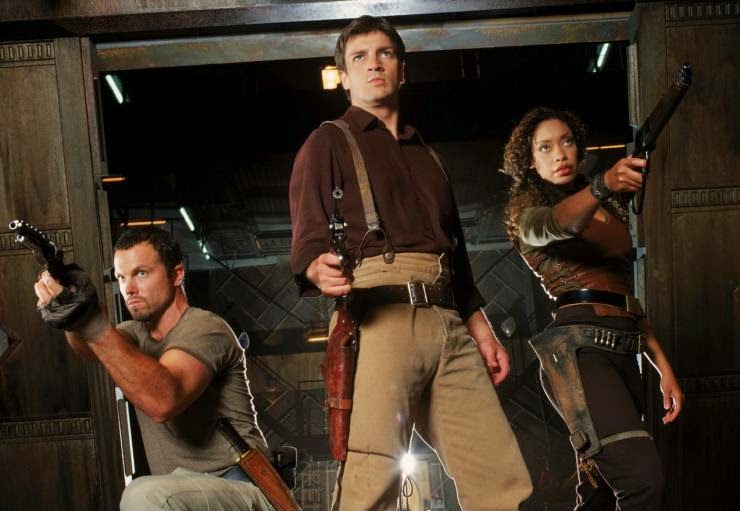
It's cowboys/Civil War veterans IN SPACE! What's not to like???

Almost Human and Terra Nova have their shortcomings, I know. The special effects and the acting aren't perfect. Pacing, characterization and story are sometimes lackluster. Everyone I know at my workplace and on Facebook loves to point out how shoddy, unengaging, static, formulaic, boring, unbelievable or artificial they are, with flat characters, unsatisfying stories and flawed concepts. But as the Guardian's pithy Glaswegian Graeme Virtue points out, the first seasons of these shows are like "the early, rough-and-ready EPs of your favourite band." Yeah, sure, the lyrics are canned and superficial, the garage-band sound is fuzzy and inexpertly mixed, the guitarist's fingers are still bleeding and the drummer hasn't found his rhythm yet, but isn't that the fun of it? Getting in on the ground floor? Liking a band because of that raw, pristine concept, the fundamental sound down deep beneath those shaky riffs and uneasy vocals? Following them while they mature into the next KISS or Zeppelin or Floyd? Watching them find their cadence, their vibe, their niche, and fill it out like a piece of loose clothing they're growing into?

That's been one of the joys of watching Marvel's Agents of S.H.I.E.L.D. Yeah, sure: it was soulless early on. A lot of people tried watching it and quit in disgust. But if they'd had the patience (unlike your average Fox network executive) to stick with it, they'd have discovered a true wonder: a flower blooming, a vine twirling its way around a beanpole, a seaweed-strewn ship emerging from its watery grave where once only the rotting, sun-bleached mastheads were visible. Watching M.A.O.S. get into its stride, establish its characters and its world and then cut loose like a slipshod stallion kicking his way out of a barn has been...well, a real kick. It's probably true that you have to be a fan of the Marvel Universe (or at least Agent Phillip Coulson, or at the very least Clark Gregg) to like the show. And you have to sit through those awkward first few episodes wherein the groundwork is laid. But then the show gets its hooks into you. Firefly and Almost Human did it during their pilot episodes, and Terra Nova managed it in the season finale.

It's just a travesty that these three shows will never have the chance to revel in the worlds they worked so hard and long to build, thanks to the pusillanimous, apple-polishing, money-grubbing swine at Fox.

That, ladies and gentlemen, is called injustice. And it's also the reason that television sucks so hard in this day and age.

Rant over.

Friday, April 18, 2014

the wreck of the Sewol

Well, your TV and news sites are probably teeming with stories about South Korea right now. I wish there was a happier reason for it than the sinking of the Sewol, a large Japanese-built ferryboat hauling nearly 500 people, which sank in the western fringes of the Korea Strait on its way from Incheon to Jeju Island.

                                                                                                      Yonhap News

You're probably familiar with the specifics. Just a few minutes before 9:00 a.m. the passengers on the ship heard a loud bang and the ship started to list severely. A distress signal was sent at 8:55 a.m. The Sewol's captain, Lee Joon-seok (who was recently arrested), failed to issue any sort of evacuation order for a critical 30 minutes, at 9:30 a.m. The ship sank further, rolling over and becoming almost completely submerged by noon, with only the bow remaining above water by 2:00 p.m. The ship in its entirety has since sunk and settled on the bottom 90 meters below the surface. 


Horrifying, heartrending and heroic stories have risen from this disaster. Twenty-nine people are confirmed dead, 174 have been rescued and 239 remain missing. It's a well-known fact that 300 of the 476-odd people aboard were young students from an Ansan high school. (In an earlier draft of this post I wrote Incheon, but I was in error.) One of the crew is rumored to have lost her life ensuring that all passengers had their life jackets. Heartbreaking tales of the students texting their parents and relatives from the wreck on the bottom of the ocean have populated the web. 

Controversy is among the most prominent survivors of the Sewol wreck. Two at the moment are occupying my attention, and they are both mentioned in that link I posted up there about Captain Lee being arrested. The first is Lee's refusal to issue an evacuation order for a full 30 minutes, which has rightly come under harsh scrutiny and criticism; and that the helmsman, Cho Joon-ki (also arrested) made a "sharp turn" just before the bang was heard. He admitted that he was "familiar" with the operation of the helm, but that the wheel "turned farther than expected." This has led to speculation that the turn was too sharp, dislodging some of the containers in the hold and perhaps compromising the integrity of the hull, leading to the sinking. Other parties maintain that a hidden rock was to blame, but that doesn't make sense to me. Ferries have been traveling up and down that same route for decades. If there was a rock, surely it would have been detected by now? 

It seems that, as is commonly the case, human error is to blame for the horrific loss of human life. The ship's authority figures failed to act in a sagacious manner, trapping hundreds of innocents in the wreck of the vessel. 

To many abroad and in the West, this may seem like "just another disaster." Another captain asleep at the wheel, like the Costa Concordia in 2012. But it's more than that, folks. This catastrophe has shaken South Korea right down to its roots. Many of my students at Sejong University are tremendously disturbed, not just by the deaths of so many young ones but the accompanying implications. 

What implications, you ask? 

I've explained before that Korea has a strong Confucian mindset. This has been the case since the Joseon era (1392-1910), when Neo-Confucianism came to dominate the Korean court and both Buddhists and Christians were severely repressed. One of the fundamental tenets of Confucianism is unflinching obedience to one's elders and betters. Korea and China, during their medieval days, had rigid hierarchical societies. Things like birth, wealth, occupation, and even surname determined one's position in the caste system. When confronted with a member of a higher echelon, one must show them the greatest respect. To do anything else would be to violate sacred societal mores and traditions. It goes without saying that children must obey their parents and grandparents as a lowly foot soldier would obey a general. 

And that's precisely what the children aboard the Sewol did. They wanted to evacuate, to leap off the ship into the cold grey seas and swim for their lives, but Captain Lee, their elder and better—whose mind was paralyzed with fears that his passengers would drift away and be lost in the turbulent waters—ordered them to stay put. So stay put they did, in the cabins and corridors. And there they remain. 

Needless to say, many minds in Korea—particularly the younger ones—are beginning to call this whole Confucian system into question. This disaster has highlighted its fundamental weakness: what if the authority figures in question are pure-D wrong? There's little point in unquestioningly following a leader if he or she hasn't got the brains of an ice cube. Many Japanese samurai might disagree, but this isn't the Warring States Period, guys. This is the 21st century. And now, young folks across the Korean peninsula are wondering whether the Confucian ideal is, well...ideal anymore. One of my students, normally chipper and articulate but grave and hesitant when I spoke with him, told me that he couldn't really process the whole affair. 

"I love my country," he said. "I believe in Korea. But this disaster has made me question everything." 

Everyone feels that way, partner. My fiancée, a die-hard Titanic buff, has been quiet and subdued the past few days, shocked to the core that a major maritime disaster such as the Sewol sinking can still happen in this day and age. I must confess that it all seems a bit surreal to me. It's hard to believe that only a few hundred kilometers from where I sit, down in the muck at the bottom of the Korea Strait, sits a capsized ship filled with hundreds of people who may very well be siblings or relatives of the twentysomethings I teach. 

My thoughts and prayers are with them. May justice be served to those at fault. 

Friday, January 17, 2014

30 Days to a Better Man, Day 18: find your N.U.T.s

That there may be no speculation, "N.U.T.s" means "Non-negotiable, Unalterable Terms."

They're related to your core values, which we discussed during Day 1 of this challenge. The example The Art of Manliness article gives is this: if one of your core values is fitness, then one of your N.U.T.s could be "I will work out six times a week, no matter what." As the article so adroitly states, "N.U.T.s are the things you’re committed to, the things that matter more than anything else: your kids, your career, your primary relationships, yourself, your purpose, your spiritual practice, your hobbies, your integrity, your morals and your psychological well-being."

Before we start, take a look at this picture, here:


That's Hiroo Onoda. He was in the news recently, but not because he has way too many Os in his name. The guy was a Japanese soldier in World War II, left behind and isolated on a Philippine island in 1945. He had been ordered by a superior to keep fighting. So he did. He refused to believe the war was over. He dismissed the newspaper and radio reports. Even when his own people dropped leaflets on him telling him to surrender, he thought they were Allied propaganda meant to demoralize him. He slept in a hole and lived off the land, waging a shadow war with the local Filipino population. He had some squad-mates with him in the beginning, but two of them surrendered in the 1950s and the other was killed in a skirmish with Filipino militia, I believe. Onoda finally capitulated in 1974, 29 years after the war ended. After a Japanese student found him in the jungles of Lubang Island near Luzon and sent his picture to some government bigwig, Onoda's former commanding officer (now a balding librarian) was flown in from Japan to personally order the steadfast soldier to stand down. Onoda handed over his sword and left the island. He then lived out the rest of his life as a peaceful citizen of his native land. He died yesterday at the age of 91.

Now, don't get me wrong. The Imperial Japanese Army doesn't have the cleanest rap sheet. Onoda may not have personally had anything to do with that, but he did kill some innocent Filipinos during those three decades as a holdout. I don't admire him for it.

What I admire him for is that unshakable sense of duty which led him to (literally) stick to his guns for 29 years, despite the whole world telling him to throw in the towel. Think about that for a second. Reach way down inside yourself. Is there anything you believe in so strongly that you'd be willing to give up 29 years of your life for it? Even then, do you truly think that you've got the determination and the stick-to-itiveness to do so? 


Onoda believed so hard in his duty as a soldier and a subject of the Emperor that he did just that. He put his money where his mouth was. He gave up thirty years of his life fighting a war he didn't know he'd already lost. In 1974, when he was discovered, Onoda's rifle was in perfect condition despite sitting in a jungle for three decades. He had stockpiles of ammunition and food which he stole from the locals. He was a literal one-man army, and he did it 'cause he felt he had to do it. Voices must have whispered to him a thousand times, a million times: stop, desist, stand down. He must have been tempted to listen to the news reports. To believe the rumors he'd heard. To turn himself in and go home. But he didn't. He never gave up. Something down deep in his soul, something made of furnace-forged steel, compelled him not to quit until his commanding officer told him otherwise.

If that isn't a N.U.T., I don't know what is. There's a reason Onoda's on this list of real-life Determinators.

So! Here are my N.U.T.s. You may think I spent a lot of time agonizing over these, but I didn't. Truth be told, I've already done this challenge. This was a separate AoM article before it was part of this 30-day challenge, and I saw it, and just for kicks I brainstormed and wrote some ideas down. I couldn't find the notebook I wrote them all down in, but I remember them pretty well. I've reproduced them here for you: 

1. I will not refrain from doing something just because my mind thinks it's scary.

2. I don't trust first impressions. I'll try anything twice.

3. I don't need to justify my choices or my actions to anyone but myself.

4. I see things through, but only if I decide that there's a good reason for doing so.


5. I say nothing about anyone behind their backs that I would not say to their faces. 

6. I accept jokes made at my expense with grace and good humor.

7. I never lie: I say what I think and I mean it.

8. I will never be satisfied with the man I am, and constantly strive to top myself. 

9. There is never a wrong time to learn. 

10. Skills can always use improvement. 

11. I waste minutes and hours, but not days: every day I write, move, live, and experience.

12. Everyone, no matter who they are, has something they can teach me.  

13. I judge movies, books, and albums by their covers, not people.

14. There is more to life than my life. 

15. I am aware of my bad habits and I combat them actively.

16. Humanity will remember me for something. 

17. I will leave this planet a better place than I found it. 

This is only the first draft. I'm going to refine these during the final weeks of January. Something should probably be thrown in there about my commitments to others: my job, my family, the love of my life, etc. But for starters, this is what we've got. What do you think, dear reader? Are these good-lookin' N.U.T.s? 

Saturday, November 30, 2013

home brewing in Korea

Here it is, the long-awaited home brewing post. You'll probably wish I'd included more pictures, but those pictures, when we remembered to actually pause and take them, were either full of screw-ups and mistakes or could give away our secrets. So I'll include one or two and you can use your imagination to fill in the rest, like you would with one of Hunter S. Thompson's columns. (I finally got around to reading The Great Shark Hunt: Gonzo Papers, Vol. 1, a compendium of Thompson's essays from the mid '50s to the late '70s. Solid gold.)

And so, to business.

Joseph (previously known as Mr. JA on this blog) is a fellow I work with at Sejong University. For anybody who's close to us, or just anyone who lives on this island of a peninsula, it won't be hard to figure out who he is. Brant (also called Mr. BP) is a little more tricky to pin down, but that's how he would like it. How we came together isn't important. It was a baseball game or a horse race or some other venial sin. There was lots of beer involved. The topic of conversation turned, as it so often does, to the outright shittiness of Korean beer and ways of remedying it. (Not Hite D Dry Finish, nor even the Queen's Ale, can rise above cloying mediocrity.)

Well, as the beers disappeared and the innings (or heats or whatever) wore on, the talk got crazy. We started thinking about home brewing ourselves. A year ago this would have been absurd. We'd've had to MacGyver a brewing kit together from whatever junk we could salvage from the foulest alleys and byways in Itaewon, and heaven knows what we would have used for sanitizing—a bucket of cheap off-brand Purell?


Fortunately, we no longer live in such a benighted state. Korean expats who feel the need to rustle up a better brand of brew now have hope: Seoul Homebrew, located just across from the Wolfhound on Bogwang-ro 59-gil in Itaewon. A harrowing trip down two flights of narrow stairs leads you to a tiny concrete-floored chamber, which looks for all the world like a garage with no door. Wooden shelves line the walls, displaying plastic hydrometers, hoses, siphons, rubber bungs, carboys, air locks and beer buckets. Tubs of grains and hops are stacked neatly against the walls, giving the room the aroma of a small-time feed store. Stark yellow lighting comes from bulbs inexplicably stuck on the end of faucets embedded in the walls. A grain grinder, an industrial sink, and a storeroom filled with white grain sacks completes the scene.

Joseph, Brant and I, having hashed out the basic kit we would need to start, betook ourselves to this mystical place and stocked up. At first, we bought a single kit, consisting of a beer bucket (spigot included), an air lock, a hydrometer, and a laser thermometer; this was kept at Joshua's residence over in Yangcheon-gu, southwest of the Han River. Since then, both Brant
—who lives in the Gangnam areaand I have acquired our own sets of buckets, hydrometers, measuring cups, air locks, grain bags, stock pots, and bottles. Especially bottles. We need at least 30 for each batch, and that takes a lot of drinking.

But I digress.

Let me take you through the process quickly so what I have to say next will make sense.

There are two ways we brew beer. The first uses malt extract. After thoroughly sanitizing our beer bucket, hydrometer, tools, pots, and spoons, we boil water. We dump in some dry or liquid malt extract, stir, cook the resultant mixture (known as wort) for an hour, add in some other kinds of malt extract at the thirty-minute mark if needs be, and then begin part two of the process.

The second species of home-brewed beer is partial mash brew. The process is similar to malt extract brews, only this time, real hops and/or grains are put into porous bags and steeped in the wort as it's cooked. This adds extra flavor and kick, though it does complicate things a bit. 


We then dump the hot wort into the fermenting vessel
—in our case, a beer bucket. We add a few more gallons of water to cool the wort down, pitch the yeast, add it to the bucket, fill up the air lock with sanitizer, stick it on the lid, put the lid on the bucket and let the whole shebang sit for anywhere from five days to two weeks.

After the fermentation period is over, we bottle. We add sugars to the fermenting brew. The yeast will eat the sugars and excrete gas, making the happy bubbles we like to see in our beer glasses. After the sugar's added, the bottling process is fairly straightforward. We fill up our sanitized bottles, cap them with a capping tool and set them in some dark, lukewarm place for another two weeks. After that, they're ready to drink (after being properly chilled, of course).  
 

Our first batch, done at Joseph's sunny, airy apartment in the Yangcheon District, turned out largely as expected: flat and tart. It was supposed to be a nut brown ale. We tried the same recipe again with the second batch; my bottles received carbonation when the requisite two weeks were over, 'cause I screwed all my caps down real tight. The brew was still unsatisfactory, however. Our third batch, intended to be a partial mash Irish red ale, was a failure
—or so we thought. We opened it up and our nostrils were assailed by a hair-curling bitterness. There was also quite a lot of sediment in the bottom of the bucket. Certain that the brew had somehow acquired a fatal bacterial infection, we dumped it. Sanitizing your equipment thoroughly is imperative. Otherwise, bacteria will elbow the yeast aside and devour the sugars, creating acid instead of alcohol and irrevocably ruining the brew.

But perhaps not as irrevocably as we thought. The guys at Seoul Homebrew later told us that we should have bottled anyway. Oftentimes a brew will smell bitter and be full of sediment but still be A-OK. Stung by the knowledge that we may have chucked a perfectly fine Irish red ale (and 
60,000 apiece) down the john, Joseph, Brant and I rolled up our sleeves. We pulled out all the stops for our next brew: a chocolate porter. That one has been bottled. This is the first time we've used glass bottles...things really feel legit now. Nine of those bottles are sitting on the lower level of my jerry-built kitchen shelving unit. They'll be ready to drink come Tuesday night.

On Friday evening, the boys came over to my place to inaugurate my own set of brewing supplies. It was the first time we'd ever brewed at my apartment. Miss H and I busted our humps to clean the place up and make it presentable (and open enough for three grown men to work). We just about managed it. The brewing process came off more smoothly than ever before, apart from a forgotten air lock left at Brant's apartment in Gangnam. This time around we brewed an IPA, somewhere between an extract and a partial mash. We used two different kinds of hops, as per the instructions. To add some holiday zest to the beer we also steeped some fresh-cut ginger in the wort for 20 minutes. It refused to cool down, preventing us from adding the yeast. So Brant and I stuck the bucket on a footstool in my bathroom and rigged up the shower head so that it would spray cold water on the bottom of the bucket. It worked like a charm. There are genuine wort coolers you can buy for your home brews, but who needs 'em? Just use your shower.

That weird red dot on the side is Brant taking a temperature reading with the laser thermometer.

The beer bucket is still sitting on that footstool. It's now under our desk. The sanitizer in the air lock is bubbling away contentedly as the fermentation process moves along. I check the temperature once every 12 hours or so. I'm trying not to be paranoid or obsessive or manic. I got the used hops out of the house as quickly as possible so the smell wouldn't upset Miss H, and thoroughly washed and put away all the supplies. I can't wait to taste it.

And that's how I got into home brewing in Korea. Yet another reason it's so good to be alive.

Feel free to leave a comment if you have any questions. 

Friday, October 25, 2013

Facebook update

Well, it's officially been a week since I quit Facebook. More than that, in fact: since I live in the future, it's Saturday here, and I quit late last Friday.

The first couple of days went well. I was out and about, getting fresh air, exercising, watching sunsets, scribbling, and generally being productive.

Now, however, I've noticed that things are starting to slow down. Instead of clicking on the Facebook link all the time (which I've since removed from my list of bookmarks), the junkie in me has fallen back on other tactics. I'm beginning to fill the void which Facebook left with other sites: YouTube, TV Tropes, and other vacuous time-wasters. I blew one-and-a-half days of my four-day weekend, Thursday and Friday, doing nothing but staring at screens. As usual. (The remainder of Friday was spent bottling our second batch of home-brewed beer. Then we went to Taco Bell. Sweet!)

This indicates to me that Facebook
as well as the other stuff I do online, even Wikipediawas never about keeping in contact with my friends. It was about my brain satisfying a craving for input. I'm no autodidact. All the hours I spent on Wikipedia educating myself about the Taiping Rebellion, Mondragón rifles or the Registan were just the fulfillment of an unworthy part of my brain, the information addict. Now that Facebook is gone and I can't satisfy myself with the doings and thrashings of my friends and acquaintances, my mind has begun to toke on my other Internet drugs of choice.

Apparently, I need to meditate more. More walks, more workouts, more bike rides, more contemplative smokes down by the Han River (if my friggin' Coleman matches would ever arrive from Gmarket). Studies have shown that meditation can be as beneficial to your health as sleeping, and even more so. It helps clear your mind of white noise and file everything away, categorizing and sorting, a sort of mental disc defragmentation, if you will. 

Oh, and there's also the O-Train this weekend.

What's the O-Train, you ask?

This.


It's a train line that runs in a big circle through three provinces in northeastern Korea. Just got started in April. There's actually two trains. The O-Train (above) does the complete circle (about four hours); the "O" represents the round shape of the route. The V-Train (below) is a little diesel engine that only runs through a particular slice of the route, but that slice is one of the prettiest, rockiest, most mountain- and stream-filled valleys in Gangwon Province. The V-Train (the "V" stands for "valley") moves slowly but scenically, and on board you'll find nostalgia like hot stoves, wood detailing, and baked sweet potatoes. It's all about atmosphere, you see? If you want the feel of a quaint old narrow-gauge steam railway (without a quaint old narrow-gauge steam locomotive) then you take the V-Train. If you want to sit in comfort and take in all the scenery that Gangwon, North Gyeongsang and North Chungcheong Provinces have to offer, then you take the O-Train.

You know how much I love trains. I've been agog to ride on one of these babies ever since I first heard about 'em. A good long train ride through gorges and over rivers, past trees clad in autumn colors, would do wonders for stress, mental clutter, and ennui.

Now, someday I'd like to ride both, but for the nonce, Miss H and I will content ourselves with the O-Train. (I can always come back and ride that zebra-striped beast later.) Tomorrow (Sunday) morning, my lady and I shall waltz into Seoul Station, grab a mugunghwa train for Jecheon, Gangwon-do, and then hitch a ride on the Big O. That ought to put paid to my inner Internet addict.

Saturday, October 5, 2013

the Forbidden City

...or not.

Look: I'm a Californian. There are certain rules Californians abide by. One of them is to never end a sentence with a preposition.

I'm joking. I just broke that rule. Rule-breaking is what we do in California. Drug laws are optional, speed limits are just conservative suggestions, and contravening societal norms is the official state pastime.

But seriously: all kidding aside, the first rule of being a sane Californian is this: avoid crowds.

Crowds are everywhere in California, and much like hurricanes, they are capricious and pervasive during certain times of the year, but can be anticipated and predicted with a degree of scientific accuracy. So over the decades, we've developed certain strategies for avoiding the other 38 million ass-hats that live in our lovely state and circumventing crowd-related calamities.

For example:

  1. Purchasing a year-long pass to Disneyland so you can take a day off and go there on Wednesday instead of having to fight your way through the weekend throngs and ticket lines.
  2. Getting the hell out of Dodge (i.e., the L.A. Basin) before 3:30 p.m. on a weekday, or else you'll be stuck in bumper to bumper traffic on Interstate 15 as the commuters head home to the High Desert. On weekends, you get out even sooner (or don't go at all), as everybody and their mother with a boat or a hole in their pocket will be leaving at noon for Lake Mead or Las Vegas.
  3. Making a reservation at Cheesecake Factory or Joe's Crab Shack or Red Lobster or even the goddamn hot dog stand on the corner, 'cause you're SOL if you don't, buster. (Or rather, SIL—standing in line, something the average Californian has about 20,000 hours of experience doing.)
  4. Picking the tiniest, dumpiest, lousiest backwater on the map and going to that town's DMV office, 'cause you'll have to camp out overnight in front of the one in your town and wait in a line around the building otherwise.

Get the picture?

Unfortunately, there's no escaping some crowds. If you're planning on a day in Santa Monica, Malibu, Venice, Long Beach, or any of the other coastal suburbs (or their fabulous beaches), you're going to get stuck in traffic. Just accept it. You'll have to fight your way in and fight your way out.

If you're anywhere near Grauman's Chinese Theatre on a premiere night, you'll be weaving through packs of sozzled socialites and dodging homicidal Lamborghinis. Might as well get used to the idea. 

And unfortunately for me, there seems to be no getting around the crowd (literally) anywhere in the vicinity of Tiananamen Square on a holiday weekend, rain or no rain. The place was packed with tourists, both Chinese and foreign. Miss H, Miss J and I had elbowed our way through the square and taken a breather in Zhongshan Garden, but now it was time for the main event: the Forbidden City.

The Forbidden City. It's on everyone's Beijing bucket list. It was the residence of the Chinese emperor from the Ming Dynasty to the end of the Qing Dynasty, a period of nearly 500 years. It consists of 980 buildings and covers 720 square kilometers
—making it larger than that imaginary sky-citadel I drew with blue and red crayons in my 3rd-grade art class. (Touché, China, touché.)

Did I want to see it? Yes.

Did I see it? Sort of.

Miss H, Miss J and I joined the inchoate mass of people funneling into the palace at the main gate. I marveled at the great honking picture of Mao Zedong which adorned this structure. It seems that the Chinese people can't get enough of the Great Architect. His mug's everywhere: on the Forbidden City gates, in private homes and businesses, on postcards and stamps and posters, and on every single bill of every denomination of the yuan. (Yikes.) This one, however, took the cake: tall as a house and glowering over Tiananmen Square as though still ticked off at those student protesters from 1989.


We passed under the enormous, intimidating archway and found ourselves in a broad courtyard flooded with human beings:


I was annoyed and dismayed by the crowd. My imagination wanted to run away with me, but the roiling stew of people foiled it at every turn. I marveled that I stood on a patch of ground which Chinese peasants had been forbidden to look upon for five centuries. I wondered what kind of defensive fire the palace guards could call down upon the invaders or rebels who somehow surmounted the main gate and entered this vast yard. But the people shouldering me aside and tripping over my feet rather distracted me from these delicious ideas.

We passed the next great archway (whose doors were studded with great metal knobs, presumably for defense) and found ourselves in...um, another courtyard. Rather similar to the first, I might add.


We were rapidly tiring of this game. The only difference between this yard and the last one was that this new one had a ticket office in it. In the mist-shrouded distance lay the most impressive gate yet. It possessed great, majestic wings which branched out from the central structure as though to lock visitors in its mighty embrace.


...and which were also coated with ugly scaffolding.

The whole thing was being restored and renovated, it looked like. Just our luck. Tokyo Tower was being renovated when I was there in August; Mao's Mausoleum had scaffolding all over it; and now this. It was just about enough for the three of us. The crowds, the drizzle, the long walk, and the castrated look of the palace under construction combined to dampen our enthusiasm. With scarcely a word between us, we three turned about and walked away from the Forbidden City. We neither penetrated its unknown depths nor paid a single yuan in admission fees. We were tired, footsore, cranky, and ready for a nap. So we returned to the Novotel Xin Qiao and had one, a sinfully good one.

When we awoke in the middle of the afternoon, we were ready for our final conquest: THE TEMPLE OF HEAVEN.

But that's a story for another day.

Thursday, October 3, 2013

Tiananmen Square

Not much needs to be said about this, honestly. Only that we wanted to see the Mausoleum of Mao Zedong, and got up early to do so, but it was inexplicably closed. Still, this being a holiday weekend, the square was quite crowded, no doubt with out-of-towners come in to see the capital. There was a light drizzle falling. The temperature was mild, but I sweated anyway. The square was smaller than I thought it'd be.

Take a look for yourselves:


The southeastern corner of the square. This big ol' gate fronts the south side, on Qianmen Street.


The rear side of Mao's mausoleum. At least, I think it's the rear side. Might be the front. Depends.

Walking around the mausoleum, up the square's east side.

And here's the square proper!


The reverse side of Mao's mausoleum. Inexplicably closed. All the apparatus was in place for stupendous lines of people waiting to get in...but no people.


The Monument to the People's Heroes.

First glimpse of the Forbidden City.

This was the bit that really ticked me off: besides the lousy weather, this part of the square, normally the biggest and widest where you can really get a feel for the size of the thing, was all mucked up with this stupid bamboo-and-red-lantern thingy. Bloody autumn harvest festival...

And there were Jumbotrons all over the place, too. Two of 'em. Reduced the apparent size of the square by a factor of five.


Next destination: ZHONGSHAN GARDEN. Don't miss it.