Showing posts with label frustration. Show all posts

Friday, October 3, 2014

10 things to do in the Hong Kong international transfer terminal

Not my photo.

What to do when you're trapped in an airport for twelve hours? It depends on the airport. Major ones obviously have shops and cafes and even game arcades where you can whittle away your time. But what if you're a lone traveler stuck in the transfer terminal of, say, Hong Kong International Airport while you wait for someone else to show up? 

No cafes, no bookstores, no arcades, and just a single forlorn noodle shop. 

Four power outlets and eight hundred people in line to use them. 

Free wi-fi that keeps resetting itself (and whatever webpage you were visiting). 

The city's too far away to reach quickly or cheaply, and besides—you don't want to head through customs and immigration and wait at the airport entrance for fear of losing your beloved partner in the crowd. 

So you sit around in the lounge for eleven hours, tapping your feet and losing your mind. 

Here are some tips to help close that day-long gap in your sanity: 

1. Leave the airport. No-brainer, this one. I was waiting for Miss H to show up on a late afternoon flight, but you aren't! Get out! Go to Hong Kong! You'll miss all the fun stuff below, but you'll save a lot of time. 

2. Take a walk. Explore! Throw that bag over your shoulder ('cause there aren't any lockers or anything) and walk the whole hundred yards from one end of the terminal to the other. If you get really bored, ride the escalators up and down for two hours. Or take in some sights at the shops...both of them. Don't just sit around; you'll give yourself bedsores. 

3. Get a snack. There's only one noodle joint, but so what? The noodles come in a salty broth and have forlorn little bits of soggy hot dog in them, and that never gets old! No convenience stores either, so that makes your choice real simple!

4. Read a book. I hope to God you brought one! Or five!

5. Surf the Web. You might have to wait around for three or four hours until someone vacates a seat near one of the four power outlet stations. Just don't forget to be polite and kick the old Chinese grandma's luggage off the seat, because goodness knows there aren't people waiting to sit down, Granny! 

6. Update your journal. Lots of exciting things happening in this terminal! Even more exciting than the time you got a dull, rusty spike driven through your head with a mallet!

7. People watch. All sorts of people come through Hong Kong, heading to and coming from every part of the planet: Chinese, Chinese, Chinese, Chinese, Chinese, an American in a business suit, Chinese, Chinese, more Chinese, two or three Arabs, Chinese, Chinese, Chinese, Chinese, a couple of Japanese coeds, Chinese, Chinese, and Chinese. You can also marvel at the aircrews (foreigners and Chinese!) stuffing their faces at that one single noodle shop with the soggy hot dogs. 

8. Meditate. You probably won't feel stressed or antsy at this point, but in case you have accumulated a smidgen of white-hot, misanthropic rage in your belly, curl up on that nice, clean carpet and oohhhmmm it all away! Just don't get run over by anyone's luggage or kicked by any Asiatic who has no sense of personal space. 

9. Shell out for extras. Some of the nicer airports in the developed world have VIP lounges where you can eat a meal, go online, watch a movie, get a haircut, or take a shower or a nap, and Hong Kong International is no exception. It might cost a little extra but it's infinitely more comfortable than crashing on a lounge bench. And by "little extra" I mean about a hundred U.S. dollars an hour. Pocket change, right?

10. Look on the bright side. I mean, eleven hours of your life isn't much, right? That's only as long as it would have taken you to eat three meals, read seven chapters of your book, spend a lovely day together with your significant other, put in a full day's work on your laptop, or basically do anything else remotely useful. No time at all! And when the eleven hours is up, you'll meet the love of your life and the two of you will have a ball in Hong Kong! 

...after you wait in line to get through security, pay one hundred Hong Kong dollars, and spend 40 minutes on the Airport Express to the city, that is.

Hong Kong International Airport, baby! It's all you can stand!

Thursday, October 2, 2014

why I hate Singapore


Apart from the stinking heat and humidity, the enforced sterility of the streets, the craven pandering to foreign investors and tourists, the banal plague of trendy Western department stores and fast-food chains, the parsimonious pedagoguery of the government, and the ridiculous expense...

...there were three things about Singapore I truly despised. 

First, this was the name of one of the Chinese restaurants near the check-in counters at Changi Airport:


Second, Changi Airport itself. The first thing that struck me about the place (apart from the above sign) was the lack of a security checkpoint. I obtained my boarding passes, got an exit stamp in my passport, and boom: there I was in the concourse. I turned left and walked to my gate. It was about ten o'clock in the evening and there wasn't much activity in the duty-free shops or coffeehouses. Most folks were curled up in the darkened departure lounges, several of which had fully-reclining seats. Snores, grumbles, and muted conversation permeated the recirculated air, making me feel like I was creeping through a dormitory after lights-out. 

Then I noticed that there were glass walls enclosing each gate, which could only be accessed through thick double doors (also of glass), behind each of which was a miniature security checkpoint. 

Ah, I remember thinking. Now that is nifty. Instead of waiting in an endless queue with everyone else in the damn airport, you'll only be waiting in line with the people aboard your particular flight. 

Then I sat down and tried to access the Internet. 

Now, I know what you're going to say. What a spoiled, privileged little white brat, hung up on his First World problems. No Internet, boo-hoo-hoo. Man up and read a book or something, chickenshit. 

And you'd be justified in saying that. But I'll declare, here and now, that the cussed Internet provided a vital link between me and (a) my lonely fiancĂ©e and (b) my terrified parents. Okay, maybe not terrified. But definitely leery of some the places I'd be passing through. I'd agreed, like any good son, to keep in close contact with my folks during my 27-day jaunt through Southeast Asia, e-mailing them whenever I arrived at or departed a new bailiwick. Even Paul Theroux phones home on occasion. Sue me. 

I couldn't access the Internet at Changi Airport. 

Why? 

Because the password could only be found on placards hung upon the wall of the departure gate. On the other side of those locked glass doors. Which wouldn't open until 12:50 a.m., an hour before our departure time. You could have the codes texted to your phone, but I didn't have a phone. 

This was tyranny, plain and simple. In any American or Korean airport you could breeze through security two or three hours beforehand and then laze around the concourse, surfing the Web, drinking coffee, eating unhealthy snacks, and splattering your smelly body, your grubby coat, your crumpled hat, and your electronic gadgetry over an entire row of benches. 

Apparently they frown on that sort of thing in Singapore. 

My American sensibilities were offended on the deepest of levels. Up to that point I had patiently put up with the pettifogging Singaporeans and their absurd laws: the bans against spitting and chewing gum and graffiti and the ridiculous fines for littering and not flushing public toilets. But this was simply too much. The prejudice leveled against some saphead tourist who showed up to Changi Airport with an iPad and no cell phone three hours early for his flight, who just wanted to contact his loved ones and let them know that he wasn't sitting in some whorehouse in Johor Bahru, shooting heroin and contracting all sorts of blood-borne diseases, was outrageous.

When the security agents finally did open up those thick glass doors and started letting us through security, the final nail was driven into Singapore's coffin. I had a grooming kit in my backpack. It wasn't expensive or irreplaceable by any means, but it had been a treasured gift from my parents—a tacit acknowledgement that I was a man, and was capable of looking after myself on my own. In it was a pair of beard-trimming scissors. I had successfully passed through security at Gimpo Airport with those very same scissors. There was no reason whatsoever for the svelte, fruity-voiced Indian lady in the blue button-down shirt and black tie and slacks to pull me out of line. But she did. She ordered me to empty my bag. She confiscated several bottles of suntan lotion which were too large. That was fine by me; I'd plumb forgot they were in there. But then she ordered me to open the grooming kit. I unzipped the small black leather case an opened it like a book, holding it out for her to see. I was writhing with impatience. The entire contents of my pack were scattered across the cold, hard, unfeeling stainless steel of the exam table, and my fellow passengers were scooting impatiently past me to get into the lounge proper. I felt naked, like someone had pantsed me in public. I was anxious to sit down, jack in, and contact home. I was half-crazed with outrage. 

"You cannot take these aboard the plane," said the security agent, her sultry eyes sunk deeply into their sockets, caked with mascara and purple eye shadow beneath plucked eyebrows, snatching the beard-trimming scissors and waggling them under my nose. 

It was then, ladies and gentlemen, that the Vaunter did something he has never, ever done in his entire life. He questioned authority. 

"Why not?" I demanded. "They're mine. They belong to me. I brought them through other airports' security lines just fine." 

"Well, I'm sorry," she said, sounding as sincere as anyone else who has to say "sorry" eighty billion times a day in their line of work. "But I cannot allow you to bring these aboard." 

"Why?" I demanded. I again brought up the other airports which had so freely and eagerly allowed me to pass, beard-trimming scissors in hand. I battled her for five minutes over those beard-trimming scissors. She kept repeating the same dull old lines. No can do. Can't be allowed. Couldn't possibly. She at least had the decency not to claim that the tiny half-inch scissor blades could be used as weapons, perhaps in a desperate bid to take over the plane and crash it into the Marina Bay Sands Hotel. Finally, understanding that I was making no headway, and would probably have to take a different flight if I kept this malarkey up, I relented. 

"Well, all right then," I said, grudgingly, sounding exactly like my dad did when I was a kid and I did something idiotic in his presence that he was powerless to halt or avert. 

I began to give the Indian lady my address, so she could mail the scissors to me. She looked confused for a moment, and then she interrupted. 

"No, no, no," she said. "No mail. Confiscation." 

I stood there for a moment, blinking, not comprehending. From way deep down in my brain, there was the sound like a twig snapping in the woods on a dark, frozen, snowy night.

"What?" I asked. "You're confiscating them?"

"Yes," she said, moving away to deposit my things in a bin, but (wisely) not turning her back to me. 

"But they're my scissors."

"We cannot mail them to you. They are being confiscated."

"What's going to happen to them?" 

"I don't know." 

Both of us knew perfectly well. Incineration, probably. Garbage. Waste. Somehow I didn't see Singapore as being the kind of place that would have an Unclaimed Baggage Center. 

"Those are my property, miss," I huffed. I was riding high. The anger endorphins were pulsing through my brain and veins, lifting me higher than the plane I was about to board. I'd never, ever challenged a security agent at an airport, or an authority figure of any kind, really. It was intoxicating. I felt powerful. I felt manly. I felt assertive. And I felt truculent. The more adamant and insurmountable the wall of red tape and bureaucratic posturing erected before me was, the harder I wanted to push against it, headbutt it, knock it down, crumbling and tumbling. 

"Why?" I demanded, my voice calm and clear and cool like a freshwater spring, but with a welter of venomous alkali beneath it. "Why can't you mail them back to me? Why are you confiscating my property?" 

She raised her arms, spread her hands out wide in a full-body shrug. 

"It's Singapore!" she declared, with a faint smile, a pathetic attempt at mollification—or perhaps admission of guilt. It was the sheepish grin of a thief caught red-handed, a shy junior member of a gang of thugs being cross-examined in the dock

And in that moment, I saw the futility of my enterprise. The wall was too high and too thick. For the briefest instant I was able to step outside of myself, outside Changi Airport, outside Singapore, and see it as I had from the highest reaches of the Flyer the previous eveningthe whole cockamamie place with its dumbass laws and its indentured populace. Poor buggers, I mused. I looked at the Indian woman, her arms outstretched and her shoulders hunched, looking like some stupid scarecrow inexpertly nailed up. 

I said, "Fine." I slapped my lobotomized grooming kit shut and zipped it up. I crammed the disemboweled guts of my pack back inside and lugged the thing off the heavy steel table. I didn't give the security agent another glance. In the time it had taken for us to have our little chinwag, practically every other passenger had gone through, and every seat in the lounge was now taken. I plonked myself on the floor, took out the iPad, checked in with everyone at home, and in twenty minutes it was boarding time. I sat and sulked during the entire four-hour flight to Hong Kong. 

And that, ladies and gents, is why I hate Singapore.

let not dreams be your master

If you can trust yourself when all men doubt you,
But make allowance for their doubting too:
If you can wait and not be tired by waiting,
Or, being lied about, don't deal in lies,
Or being hated, don't give way to hating,
And yet don't look too good, nor talk too wise;
If you can dream---and not make dreams your master;
If you can think---and not make thoughts your aim..
.
                                                                               --- Rudyard Kipling, "If" 
       

Would you like to hear a funny story (and by "funny" I mean "relevant to my career, and yours too if you're a writer")? 

My hobby is trapshooting. It's where five people get together in a line and stand a set distance away from a small mound. Beneath this mound is a mechanical launcher which, at the first shooters' word, slings small discs made of frangible clay into the air in different directions and trajectories. The first shooter puts on his shooting glasses and earplugs, raises his gun to his shoulder, and shouts "Pull!" The scorekeeper, typically seated on a chair behind the shooters, presses a button and activates the launcher, which throws a random bird out from beneath the mound and into the line of fire. The first shooter does his best to blow the little target out of the air with a shotgun blast. If he or she hits it, then the fragile disc disintegrates into a million tiny pieces and falls to earth in forlorn fragments. If the shot was a miss, the disc wings off into the distance and shatters on impact with the ground. Then the second shooter raises his gun to his shoulder, shouts "Pull!" and the whole process kicks off again, and continues until each of the five shooters has shot at 25 "birds." 

It looks kind of like this:


I've done this dozens of times, and I've never gotten a perfect 25. 

Why?

Because I always psych myself out. I get to 24, and then I start to sweat and grit my teeth and clench my gut and think of that lovely "25" patch I could sew onto my shooting vest, and I invariably jerk the trigger too hard and miss the final bird. 

Sloppy. Eager. Shaky. 

Too much speed and too much noise.


Today I realized that I have been approaching my writing in the same way.

Most of you guys know by now that I'm a science fiction guy, but I do fantasize about mainstream fiction occasionally. One of my favorite books is The Sand Pebbles, by Richard McKenna. It paints a dynamic and emotionally moving portrait of the life of a simple machinist's mate Jake Holman, who serves aboard the U.S. Navy gunboat San Pablo. The vessel and her dedicated crew of "Sand Pebbles" patrol the Yangtze River in China, mostly a dog-and-pony show to intimidate bandits and warlords who are keen to rough up American businessmen and missionaries in the area. The book also brings to life the grand scale, social mores, political upheavals, and intimidating personalities at work in China in the 1920's. The action takes place right on the eve of Chiang Kai-shek's Northern Expedition, and the Kuomintang and the unification of China are central themes. More than a simple novel of an ignorant country boy at sea amid the oppressive hostility of the Orient, however, The Sand Pebbles is also an insightful commentary on the human condition: the raw power (and irrationality) of love, the madness and chaos of war, the eternal struggle of old traditions and new ideas. 


It's precisely the kind of historical fiction I wanted to write. So, in 2012, between penning the first and second novels of my epic sci-fi series, I did NaNoWriMo. What I wrote was a 52,000-word piece called Mugunghwa (the rose-of-Sharon, Korea's national flower). Apart from a few lackadaisical edits here and there, I haven't touched the manuscript since. 

Then, just recently, I picked up Paul Theroux's Kowloon Tong. Not historical fiction by any means—it was published in 1997, the same year that the U.K. handed over Hong Kong to mainland China. This handover, while merely a peripheral event in Theroux's novel, nonetheless forms the catalyst for much of the action. I'll give you the Wikipedia summary: "Kowloon Tong is a novel by Paul Theroux about Neville "Bunt" Mullard, an English mummy's boy born and raised in Hong Kong. The story is set in the days leading up to the handover to China of Hong Kong from the British. Bunt is made an offer for his textile factory by the shady Mr. Hung from the People's Republic of China, and has no choice but to accept, when it is made clear that Mr. Hung knows all about the part of Bunt's life that he has kept secret from his mother Betty, namely his frequenting of the 'blue hotels' of Kowloon Tong and furtive sex with one of his workers, Mei-Ping."


Sounds quite tawdry and sinister, don't it? And it is, certainly. But more than that, it does precisely what The Sand Pebbles (published in 1962) managed to do: paint a vivid picture of a time, a place, and a savage cultural clash. I'm halfway through it and I can't put it down. The backdrop of Hong Kong is enticingly exotic (and lewd) and the characters simply sizzle off the page like bacon fat jumping from an overheated skillet: the weak-chinned Bunt, his overbearing mother Betty, the vicious Mr. Hung, the shy and vulnerable Mei-Ping, the slimy lawyer Monty, and the lascivious Filipino prostitute Baby ("Let we make fuppies!"). Here is yet another type of mainstream novel I should like to write: one set in a foreign country (an Asiatic one), concerning a culture utterly foreign to the reader, and yet which manages to faithfully portray the nitty-gritty details of that culture with beautiful, vivid detailwith a pressing social issue as its canvas and inborn human nature its paints. 

So I came up with a timely idea which I could write about: the plight of North Korean girls who decide to escape to China and the promise of work and income, only to be coerced into slavery by unscrupulous Chinese and sold to rural farmers in the northeastern provinces, and there sexually abused and worked like cattle.

Whatever. The idea isn't what's important.

What's important is the undue stress which reading Kowloon Tong caused me. 

I am a weak, insecure, spiteful, and needy man. I put too much pressure on myself. I read something good and I immediately want to emulate it. No, not just emulate it—surpass it. That in itself isn't a bad thing, but I go to extremes. I tell myself that I'm a failure if I don't manage to write something at least as good. I question my own worth and talent. I rail at myself that I'm not as keen an observer of culture and linguistic subtleties as I should be. Moreover, I'm usually in an all-fired hurry to complete the work. Paul Theroux wrote a damn good book, and I need to produce something similar now, NOW, d'you hear me, or my life as a writer is fucking over. This, or something very like it, is the loud, insistent, humbling message which my id splatters all over my craven ego. 


I put way too much pressure on myself. 

I've written three books and am halfway through another. (One of those books—the complete manuscript—is currently under review by the editors at Ace Science Fiction, an imprint of the Penguin Group.) I've penned dozens of short stories. But I remain unpublished. And that, to my mind, is simply not good enough. 

I put way too much pressure on myself. 

Now that one of my books is under review by a major publishing house, I feel an insistent need to edit the sequel into a refined state of readiness, while simultaneously finishing and editing the third installment and even the fourth. And these aren't short books, either: both the first and the second novel manuscripts turned out to be about 110,000-115,000 words each.

I put WAY too much pressure on myself. 

But I've been in a slump lately. I haven't written anything new since my appendectomy last May. I haven't touched my second novel manuscript; the writer's block just won't go away. 


And then I realized that it wasn't writer's block. It was that pressure. It was the background noise. It was me thinking about leaving Korea, moving to Las Vegas, missing Miss H, getting published by Penguin (or worse, not getting published by Penguin), winning the Hugo & Nebula Awards (or worse, not winning the Hugo & Nebula Awards), feeling inferior to Paul Theroux, wondering if I was even capable of writing something as good as Kowloon Tong or The Sand Pebbles, wondering, wishing, waiting, worrying. 

Enough. Enough already. 


I was taking notes on my new idea (about enslaved North Korean women) and I realized something. There was a feeling in my chest like a great big ship's boiler, overheated and ready to burst. My veins felt like cracked valves and my head was constantly pounding. To my shock, I discovered that this wasn't a new sensation: that knot of roiling, boiling pressure had been there for weeks. No matter how many bike rides I took along the Han River or the Yangjae Stream, no matter how many walks through Ttukseom Resort or Seoul Forest, no matter how many of my students wrote perfect descriptive paragraphs because I'm an awesome teacher, I was still stressed out. I was going to bed stressed and waking up stressed, stressing out with every word of every great author's that I read. And I was about to commence writing a fifth book with that lump in my chest. I was about to write it the same way I've been writing every short story and editing every novel manuscript: too quickly, too eagerly, and with too much background noise in my head. 


No more. 

The dam broke this morning. Something snapped inside me. My stress washed away, my head cleared, and I caught myself before I fell. I looked down at my notes and an inarticulate thought trickled into my skull, like sunshine after a rain shower. 

"Even if this isn't as good as anyone else's, it'll still be fun to write, won't it? I should just focus on having fun."

I don't know why it took me so long to remember that. Writing is supposed to be fun, you know. Even when it isn't. Even when it's agonizing and painful, like childbirth, or humdrum and dull, almost like work. It's still cathartic. It's still an escape. It's still a kick in the pants. Somewhere along the line I forgot that. I put too much pressure on myself to write a lot and write it well, better than anyone else. As an egocentric male, and as a human being who wants to leave this world richer than he found it, I stressed myself out trying to succeed on the first try. And predictably, my creativity suffered. I have to remember and something tells me that I will from now onthat writing is not (just) about the destination. It's about the journey. 

Writing is like driving. You have to do it often to stay in practice. If you're only doing it to get paid and eat, it's no fun. It's nice to just take a quiet, pleasurable Sunday drive and see where you wind up. But not too fast: if you keep stomping the accelerator, you'll get frustrated and sloppy. You'll probably burn out your engine, too. Oh, and turn that radio down. It's good to listen to the sounds of the road. Too much background noise and you can't concentrate on what's important. If the engine starts acting up and you slow down, then it's time to take that baby to the repair shop—maybe even trade it in for a newer model. Get the picture?


Long story short, writing is an act of creation. And any act of creation, be it sculpture, oil-on-canvas, sand castles, babies, or fictitious worlds, should be a pleasurable one. 

Revelation over. 

Tuesday, September 30, 2014

Butterworth to Singapore (the worst bus ride ever)

Long story short: 

I was forced to ride a bus from Butterworth to Johor Bahru in southern Malaysia, and thence to Singapore. Thanks to Hari Raya, the end of Ramadan, all the trains were booked up. It was a rumbling, clattering misery machine a bus to Singapore or nothing at all. 

I woke up at 5:45 a.m. on the morning of Wednesday, July 30, slipped downstairs in the predawn darkness, gave my postcards and 10 ringgit to the night clerk and asked him to mail them for me, and caught the first ferry to the mainland at 7:00 sharp, crossing a calm strait under the pale light of dawn.


What little information I could find online suggested that express buses to Singapore (Woodlands) would be readily available. Apparently those were all booked up too. The best I could do was catch an express bus to the border town of Johor Bahru at 8:30 and figure things out from there. It was a nice bus, at least. It was plentifully air-conditioned, clean, and had seats which reclined fully. I settled in for a long ride and was just getting comfortable when...

...bam, we were in Kuala Lumpur. 


Not my photo. 

A skinny shrimp of a 2nd-generation Chinese-Malay woman kicked everybody going to Gelang and Johor Bahru off the bus. With her hectoring voice, baseball cap pulled low over her eyes, and flicking ballpoint pen, she herded us out of KL Sentral Station and across the street to a pair of considerably older, dirtier, hotter, and less comfortable green buses. A pair of creased, loud-voiced fellows in polo shirts and jeans with walkie-talkies clipped to their back pockets shouted as us to load our luggage and get aboard, and be quick about it. 

Then the agony began. We'd already been on the road five or six hours, but we happy few going to Johor Bahru would remain for a further 8.5 aboard that boiling, filthy bus with precious few rest stops, no food, and shock absorbers that amplified every bump in the road. 

You can't imagine how glad I was to stumble off that accursed machine at Larkin Sentral Station in Johor Bahru, wobbly-legged, sweat-grimed, weak-stomached, bleary-eyed, and foul-tempered. For my trials were not yet over: I thereupon boarded another bus, the 170 for Queen Street in Singapore. I got on and off that bus three freaking times—once to exit Malaysia (and get my exit stamp from a callous-looking woman in a black hijab), once to enter Singapore at Woodlands (which necessitated waiting in line for 40 minutes, and I had to go back to the end of the line once because I forgot to fill out a damn entry card), and finally to go through customs inspection. Each time I stepped off the bus into the steamy night air, my glasses fogged up and my pores began oozing sweat. It crusted my hair, soaked my skin and clothes, and soured my mood. I hate sweating and I hate climates like what they've got down in Southeast Asia, irresponsibly warm and humid. Furry mammals—particularly clothed human beings—have no business living in places like that. It's better if we leave the whole cockamamie place to the reptiles.

At nearly eleven o'clock, 17 hours after waking up, 14.5 hours after leaving Butterworth, and three hours after arriving in Johor Bahru, the 170 bus dumped me out on Queen Street. I had to walk another five or six blocks (and ask a kindly cabbie for directions) but I made it to my hostel, the Tresor Tavern on Jalan Besar in Little India near Farrer Park. Before entering I tried to buy a much-needed 1.5-liter bottle of water with my debit card, but the Sri Lankan shopkeeper didn't have a card reader. That's when a random Singaporean, a tottering old fellow with a shock of gray hair, bulging eyes, and a broad mouth filled with crooked teeth lurched up to the counter to buy a pack of gum. He and a friend had been sitting and eating and boozing it up for who knew how long before I'd walked in. This elderly Samaritan grokked the situation in a blink. Without hesitation he bought the 1.5 liters of water for me, and handed me ten Singapore dollars on top of that. Then he lurched away without waiting for a thank-you. I honestly didn't know what to do, say, or think, and that combination's rare for me. You hear a lot about the kindness of strangers when you're out traveling the world, but the reality of it really hits you in the old heartstrings. That first drink was the coolest and sweetest gulp of water I've ever had.  

My rehydrated corpse hit the rock-hard mattress of the Tresor Tavern's third-floor mixed dormitory at almost midnight. The room had twelve beds, bunked and curtained, the frames bare metal and the rings squeaky. The floor was concrete, the walls bare, the ceiling choked with exposed pipes—"Like a jail," said my elderly Indian roommate. Garbage was stacked atop every locker, none of which actually locked. The wireless Internet only worked on the ground floor, none of the upper floors. It seemed I would have to physically place an order for a towel. Two things did work, however: the air conditioner and the light switch. 

Good night! 

Tuesday, September 23, 2014

Bangkok, day two: Chinatown

So much for my promise about walking everywhere today (Friday, July 25, 2014). I was feeling so drained after my grueling trek through riverside Bangkok (and so at peace with the world after my lengthy rest in Wat Suthat) that I hired a tuk-tuk to take me to Chinatown for dinner.


Innovative solution...


Fortunately the food was pretty dang good, and so was the beer, or there would have been trouble. 

Coconut curried crab. Since I was breaking rules today, why not break my no-food-selfie rule, too?


As you can see from the signs, I could have had shark fin or bird's nest soup, but I thought I'd keep things simple. And humane.


I was rather disappointed in the place. It had all the authenticity of a corny Japanese theme park, all the priciness of a Sino-Korean neighborhood, and all the dirt and slime and grunge of a Vietnamese metropolis. I ate quickly at Lek & Rut Seafood, paid 500 baht(!!!), and caught a tuk-tuk back to Hua Lamphong Station.


Here's where things really started to go south. I rode the Skytrain (Line 2) from Hua Lamphong to the transfer station at Sukhumvit/Asok, but the rush-hour crowds there were beyond imagining. I would have had to wait in line for an hour just to get a ticket, let alone actually board the Line 1 train. So I said "Screw it" and decided to hunt up a beer bar I'd heard about, BREW Beers & Ciders. I knew it was on Sukhumvit 55, and I was on Sukhumvit Road anyway, so I strolled about ten or twelve blocks south, from Asok to Thong Lo, and turned left (east) on Sukhumvit 55 as darkness fell. I walked a good kilometer along the gum-pocked sidewalk, dodging scooter drivers and ladyboy hookers and drunken salarymen and horny foreigners looking for a fix and a quick fuck. I finally reached the alley where BREW allegedly was, but I couldn't find it. I walked up and down, past other trendy and upscale bars, coffeehouses, and Thai-Chinese fusion restaurants, but I never located it. I later learned that I had walked right by it. It lay at the mouth of the alley, but it was hidden from me by some stupid outdoor seafood restaurant that took up half a block and hid the bar from my view. 

I was hot, sweaty, footsore, and felt like I'd hiked 80 miles. I hiked back to Thong Lo and caught the Skytrain home. The crowds had thinned out by this time. I showered, checked in with my Kentish cubicle-neighbor Emilia, updated my journals, and hit the sack.

Tomorrow: my package tour of Kanchanaburi, northwest of Bangkok, begins with the floating markets. 

Wednesday, September 17, 2014

Bangkok, day one (part I)

Not my photo. Obviously.

Travel Truth #5: Take time to take time.

For what? Well, to relax. Or to get stuff done. Either one. Don't be rushing around trying to see everything all the time. You have to slow down and sacrifice some of your precious vacation to housekeeping. Or precious oblivion. Either one. 

The first half of my first full day in Bangkok was devoted to errands. Administrative stuff, such as: 

  1. laundry
  2. acquiring a tourist map, a pen, a small notebook (for taking notes while I'm walking around), floss, and sunblock
  3. get a tuk-tuk to take me to Hua Lamphong Station to buy tickets for Malaysia
  4. find a bookstore and pick up some reading material to replace The Catcher in the Rye, which I'd finished on the bus from Cambodia
  5. eat Thai food, as much as I can hold
  6. buy and send postcards, if possible

The second half would be devoted to...well, whatever the hell I wanted. I have a couple of things I like to do when I first get to a city, like:

  • climb some high thing and get the lay o' the land
  • take a stroll in the neighborhood immediately surrounding my lodgings and get a feel for it
  • find out where the nearest bus, train, and cab stations are
  • eat local food and people-watch

I'd picked up floss and sunblock and notepads and pens when I went to 7-11 last night for water, so that was already done. I dropped off my laundry at the front desk for 100 baht, picked up a tourist map, grabbed a tuk-tuk to Hua Lamphong, and bought a second-class sleeper ticket to Butterworth, Malaysia (only 1200 baht, or $40). 

I walked out of the station, ignoring the cries of the ravening tuk-tuk drivers who yelled that it was too hot and too far to walk anywhere, and crossed the canal. I'd intended to trek northwest to find Wat Traimit, the Temple of the Golden Buddha. I found it quickly, but unexpectedly found that I didn't feel like going inside. You have to pick and choose your wats carefully, you know. But here's where the day began to turn frustrating. 

Nobody in Thailand, or all of Southeast Asia for that matter, believed that (a) I knew where I was going, or (b) that I was capable of getting there under my own power. I stopped a street corner to ask a portly man in a dark blue security uniform about the way to the Temple of the Black Buddha, and he pointed me in the direction with no fuss. But after wandering around aimlessly down Charoen Krung Road for 30-45 minutes with no temple in sight, I began to get annoyed. I sat down on the steps of the Robinson Shopping Center and consulted my map. After a few moments, an elderly Thai gent stepped up to me and asked in perfect English "Where are you going?"

I told my balding, liver-spotted interlocutor that I was trying to reach the temples near the Chao Phraya River. 

"Oh!" he exclaimed. "You must hire a tuk-tuk. He'll take you around for the whole day for a very reasonable price. What did you want to see while you are here?"

I said, "I'd like to see the temples."

He told me that it was no good—today was a "Big Buddha Day" and all the temples would be jam-packed with celebrants and gawking foreigners. 

"You really must get out of the city," he admonished. 

"I don't know what's out th—"

"All of the most beautiful things are to be found there: the floating markets, the crocodile farm, the rose garden, and the ruins of the ancient capital."

"I don't think I—"

"You can hire a tuk-tuk to take you around the city for only 30 baht per hour!"

"I believe I'd rather—"

"You should also stop by the fashion district. You want to get new clothes, right? All the best tailors can  be found there."

"I don't need any—"

"Here, come this way. We'll hire a tuk-tuk to take you to a tour company where you can book a tour."

I tried to demur. I tried to protest. I tried to balk. All to no avail: the Thai gent took me by the elbow and steered me toward a waiting line of lime-green tuk-tuks at the curb, and fell to haggling in Thai with the driver, a young man with a shock of black hair and a paunchy stomach. Then, without knowing how, I was inside the vehicle and we were rocketing through traffic. A few minutes later I stood outside a blue-painted shopfront with five jaunty stone steps leading up to the threshold. In the dim interior I could make out other foreigners sitting at desks, and on the other side Thai clerks who were taking notes and making suggestions and gestures. 

Oh well, I thought. I don't really have anything planned for Day 3 anyway. 

I walked in. The kindly old lady behind the counter, her shoulder-length hair dyed ebony and her insectoid eyes magnified by thick spectacles, waited patiently while I pored over the catalog. I booked a tour to Kanchanaburi, the province northeast of Bangkok near the Burmese border: the River Kwai Bridge, the floating markets, and something called the "tiger temple." It looked promising and only cost 2,200 baht (around $70 at the time). The River Kwai Bridge was actually on my Thailand bucket list, but I hadn't figured it was so close to Bangkok. This was going to be exciting. 

Then the tuk-tuk driver took me to MBK, a fashionable men's clothing boutique in the tailor district. I didn't even set foot on the sidewalk. I'd been warned about this kind of thing. The doorman and the proprietor both came out of the glass doors to try to cajole me inside, but I stayed put. I looked my tuk-tuk driver square in the back of the head and said, "No way. I hate shopping. That was the old man's idea, not mine." I ignored every attempt by the driver and the shop owner to entice me from my entrenched position. Instead, I calmly and civilly requested to be taken to the nearest foodie neighborhood. That royally pissed off my driver. At the time, I wasn't sure why, but then I realized that tuk-tuk drivers usually get a commission from shop owners for delivering customers to their doors. I had just cheated my driver of his bonus, and now he was snorting and looking for any excuse to buck me off. Testily he drove me to the seediest, dirtiest, loneliest, most dubious-looking streetside eatery in all Bangkok: a few dingy tables with cigarette-scarred plastic tablecloths, meats fried into blackened oblivion, desiccated-looking vegetables, flies, heaps of refuse, scrawny women and sinister customers lurking in the shadows beneath rain-stained awnings. I was just glad to be out of the damn tuk-tuk, and the feeling was mutual. 

"After you eat, where you go?" the driver asked as I stepped out of his rig.
"Here," I said, pointing to my hostel on the map.
"Too far," he said.
Bullshit, I thought. I knew for a fact that we were in the Riverside district and it wasn't but a hop, skip, and a jump to Pretchaburi Road, my hostel's neighborhood.
"You get taxi," the driver continued. "I'm done with you."

That's fine, I was done with him too. I paid him the 100 baht he demanded was never gladder to see the back of anyone. Fuming, I walked a block and grabbed a (blue) tuk-tuk driven by someone who looked like the Southeast Asian version of Ernest P. Worrell. He was older than God and his rig in bad need of service. We coughed, wheezed, and lurched rheumatically through the streets back to Boxpackers, with me holding on for dear life and striving to hold back my temper and the contents of my stomach. The driver only gave me 40 baht change out of the 200 I'd given him, but I didn't care. I practically sprinted back up to my room and the air-conditioned sanctuary of my cubicle and my journals. My laundry was waiting for me, clean but stuffed unfolded into a plastic bag. 

It wasn't even noon yet. 

Wednesday, May 7, 2014

Fox Broadcasting can go pound sand

It's Blade Runner-slash-every
buddy-cop drama ever!
What's not to like? 
This is not a political rant. I don't give a split fig about Rupert Murdoch or Bill O'Reilly or what all the puffed-up bubble-headed self-important liberal college professors and community organizers refer to as "Faux News."

No, my beef is with the television executives who sit around in board meetings and decide to cancel my favorite TV shows.

It's been recently announced that the science fiction police procedural Almost Human, which aired last fall, won't be picked up for a second season.

This is the same depressing news that I got in 2012 when I heard that Terra Nova had been canceled, and the same monstrous injustice I and the other Firefly fans who came late to the game execrated when we learned that this fantastic show consisted of just 14 episodes.

Thank goodness Marvel's Agents of S.H.I.E.L.D. is on ABC, and is therefore safe from Fox's meddling, or I might have a complete psychotic breakdown.

Seriously, what gives? This is becoming such a trend that "Screwed by the Network" and "The Firefly Effect" have become official tropes. To quote from that life-stealing wiki, "Incidentally, many of these [canceled] shows (including Trope Namer Firefly) were on Fox — basically because Fox was likely to give the sort of show that gets this effect an initial run, but tended to be too Nielsen-sensitive to be patient."

Let me repeat that for you:

Too Nielsen-sensitive to be patient.

That's gotta be it. The ladder-climbing, insecure little weasels (I'd say "network executives," but that would be redundant) over at the Fox Broadcasting Company are so obsessed with making themselves look competent and keeping their stock high 
— in more ways than one — that they'll cancel a brilliant show if the Nielsen ratings are anything less than stellar.

Now, I know what you might be thinking, particularly if you're like everybody else on the face of the freaking Earth and think Almost Human and Terra Nova were terrible shows. (If you do, then what are you doing here? You should be pounding sand, too.)

You're thinking, "Where's the injustice in that? Almost Human didn't have good ratings, so it was canceled. QED."

Ratings aren't that simple, buster. Evidence suggests that Almost Human's ratings were out of its control for half its run. Firefly's doom was spelled out when Fox aired its episodes out of order and inexplicably stuck it in the "Friday night death slot." Terra Nova had 10.8 million viewers and a 3.6 rating, but the execs were worried about the price tag, and they also (wrongly) believed that a mid-season addition called Touch would be the next big hit.

It's Lost with dinosaurs! What's not to like??

I'm not a critic. I'm not going to launch into a big long spiel about why these shows are lost treasures. I'm not going to tell you how Terra Nova was "unlike anything else on TV," and that it "found its creative legs late in the season" (the article I linked to previously does that quite eloquently). I won't mention how Almost Human was just what the doctor ordered, a by-the-book police procedural with a lighthearted, humorous undercurrent, with the added zest of its dystopian-but-somehow-still-gorgeous futuristic backdrop. I have no need to declare Joss Whedon's script-writing talents godlike, and that the cinematography, dialogue, acting and story of Firefly are second to none. That's been said before by irate fans and gushing magazine columnists the world over. 

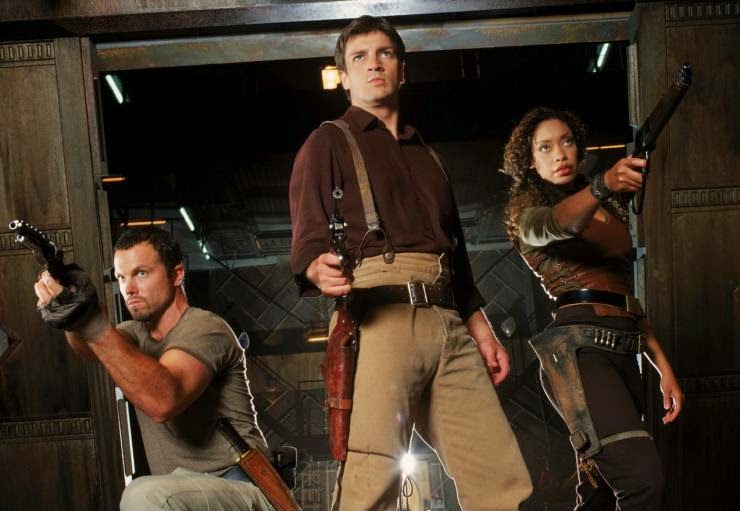
It's cowboys/Civil War veterans IN SPACE! What's not to like???

Almost Human and Terra Nova have their shortcomings, I know. The special effects and the acting aren't perfect. Pacing, characterization and story are sometimes lackluster. Everyone I know at my workplace and on Facebook loves to point out how shoddy, unengaging, static, formulaic, boring, unbelievable or artificial they are, with flat characters, unsatisfying stories and flawed concepts. But as the Guardian's pithy Glaswegian Graeme Virtue points out, the first seasons of these shows are like "the early, rough-and-ready EPs of your favourite band." Yeah, sure, the lyrics are canned and superficial, the garage-band sound is fuzzy and inexpertly mixed, the guitarist's fingers are still bleeding and the drummer hasn't found his rhythm yet, but isn't that the fun of it? Getting in on the ground floor? Liking a band because of that raw, pristine concept, the fundamental sound down deep beneath those shaky riffs and uneasy vocals? Following them while they mature into the next KISS or Zeppelin or Floyd? Watching them find their cadence, their vibe, their niche, and fill it out like a piece of loose clothing they're growing into?

That's been one of the joys of watching Marvel's Agents of S.H.I.E.L.D. Yeah, sure: it was soulless early on. A lot of people tried watching it and quit in disgust. But if they'd had the patience (unlike your average Fox network executive) to stick with it, they'd have discovered a true wonder: a flower blooming, a vine twirling its way around a beanpole, a seaweed-strewn ship emerging from its watery grave where once only the rotting, sun-bleached mastheads were visible. Watching M.A.O.S. get into its stride, establish its characters and its world and then cut loose like a slipshod stallion kicking his way out of a barn has been...well, a real kick. It's probably true that you have to be a fan of the Marvel Universe (or at least Agent Phillip Coulson, or at the very least Clark Gregg) to like the show. And you have to sit through those awkward first few episodes wherein the groundwork is laid. But then the show gets its hooks into you. Firefly and Almost Human did it during their pilot episodes, and Terra Nova managed it in the season finale.

It's just a travesty that these three shows will never have the chance to revel in the worlds they worked so hard and long to build, thanks to the pusillanimous, apple-polishing, money-grubbing swine at Fox.

That, ladies and gentlemen, is called injustice. And it's also the reason that television sucks so hard in this day and age.

Rant over.

Wednesday, October 30, 2013

making a bug-out bag in Korea

Do you know what a bug-out bag is?

If you don't, follow that link and read the article. You'll need some context. I'll wait.

In case you're too lazy to do that, though, let me just give you the skinny: the term "bugging out" means evacuating your home due to fire, earthquake, poison gas leak, alien invasion...or war. A
bug-out bag is an emergency kit, personally assembled by you, a forward-thinking human being, in case you have to be away from your home for 72 hours.

The only natural disasters that face Seoul on a regular basis are monsoons, fires, and maybe the occasional tsunami. (Japan does a pretty good job of soaking up all the typhoons and earthquakes that come this way, though.)

You have to remember, though, what's sitting just 60 kilometers (37 miles) north of this city.

That's right. North Korea.


On Wednesdays I have no class, which means I get to putter around doing whatever I want. Today even more so: I had no choice but to moon around the apartment all day waiting for the deliveryman to arrive with the Coleman waterproof matches I ordered from Gmarket. I bought myself a Stanwell beechwood pipe and some tobacco a month ago, but I've been dogged by the lack of proper lighting materials. You can't use a Zippo to light a pipe, 'cause the butane makes the tobacco taste funny. Moreover, you have to hold the lighter upside-down, and that singes your fingers. Wooden matches, however, neither taint the flavor of your smoke nor char the rim of your pipe. So I had my heart set on matches. After a fruitless search through every grocery mart, convenience store and bar in my area, I found them on Gmarket and ordered them. They were due to arrive today, and the deliveryman wouldn't just leave them at the door; I had to receive them personally. So I couldn't leave.

To pass the time, I watched the 2012 movie Red Dawn.


And suddenly I thought of a much better use for those Coleman waterproof matches.

The movie made me realize just how unprepared Miss H and I were for a disaster
—of any kind. She and I have talked about preparing bug-out bags for months now, ever since we moved into our new place in East Seoul. We did all the usual stay-at-home preparations, like compiling our important documents, files, IDs, bankbooks and passports into one convenient and safe location, buying eight liters of emergency water, acquiring flashlights and lanterns and candles and a fire extinguisher, et cetera. But somehow we never got around to putting together a bug-out bag. Senseless, I know. A 72-hour emergency kit would be invaluable in case we had to leave the apartment (and, say, assemble at Jamsil Stadium for evacuation by the U.S. Army as North Korean troops overrun the DMZ).

So I resolved to fix this inadequacy this very afternoon. After taking delivery of the matches, I stuck six boxes into my Timberland
® 20-liter backpack. (The other six boxes will go into my drawer with my pipe.)

And that was the start of it all. I hunted high and low through the apartment and located some other items to stick in:

  • 2 cans of tuna
  • Nature Valley® granola bars
  • 2 flashlights
  • a deck of cards
  • plastic sporknife (yes, they exist)
  • diarrhea medication
  • multitool
  • first-aid kit
  • sunblock
  • lens wipes
  • 2 liters of water
  • complete change of clothes
  • Colgate® WISP™ toothbrushes
  • lensatic compass
  • Ziploc® bags
  • vitamin tablets
  • cash and coins

Noticing that there were several items on my list that just weren't in the apartment, I hopped the subway across the river to Cheonho and went to E-Mart. There, I acquired the following:

  • Ottogi tuna (2 bundles of 3 cans, ₩3960 apiece)
  • bowls of prepared rice (pack of 3, ₩3450)
  • Diget chocolate biscuits (₩1580)
  • Dr. You granola bars (2 boxes of 4, ₩3980 apiece)
  • kitchen knife (₩2000)
  • small paring knife (₩1000)
  • folding knife (₩5100)
  • hand saw (₩7900)
  • folding trowel (₩7500)
  • packet of quick-start charcoal (₩1360)
  • camping rope (6mm x 10m, ₩2,900)
  • duct tape (10 meters, ₩1350)

The items remaining on my list are:

  • glow sticks (for when flashlights fail)
  • hand-cranked radio
  • ponchos
  • tarp
  • space blankets
  • signal mirror (though I think I'll just use the small shaving mirror in my grooming kit)
  • safety whistle
  • camp axe

I'll have to get these either at Homeplus (which is a subsidiary of Tesco, and generally better stocked than E-Mart) or a camping supply store.

Some of you might scoff at the completeness of this list. "What do you need a hand axe for?" you'll ask. Good question. Hopefully, we'll never need it. But just in case the North Koreans come storming across that border faster than expected (or they bring some Chinese or Russian friends with them), I want to be ready. The worst-case scenario here is Miss H and I hiking through the wild hills of K-Land trying to get back behind friendly lines, or make our way down to Busan to catch a boat for Japan. If we have to rough it for a few days, at least I'll have the tools, ropes, tarps, and matches I need to make our campsites comfortable. Even if the North Koreans never invade (or the zombies never attack, it don't matter to me) we'll at least have a well-stocked supply kit for untoward exigencies.

One more thing.

You'll notice that I entitled this post "making a bug-out bag in Korea."

The emphasis was intentional. There are some items which I would normally include in my bug-out bag, but can't, because I live in Korea. The first one, obviously, is this:


A gun, stupid.

When disaster strikes, people go crazy. Ain't no denying that. I think K (Tommy Lee Jones's character from the Men in Black franchise) said it best:  "A person is smart. People are dumb, panicky, dangerous animals and you know it." So when the crap hits the fan and looters take to the streets, I want to be prepared to defend what's mine: my life, my property and my loved ones. I have to be honest: as an American, I'm a bit uncomfortable living in a country that doesn't allow private gun ownership, especially when there's a militaristic regime lurking on the horizon.

The second item is this:


It's a survival knife, in case you didn't know. An Aitor Jungle King II, to be exact. I haven't really shopped around and chosen the survival knife that best suits me, but this is pretty much what I'm looking for: a straight blade with a saw-edge and a good long grip with a lanyard ring. A splendid knife for cutting branches, skinning game, or personal defense.

Korea has this thing about knives, though. Turns out that any pocketknife with a blade longer than six centimeters (a paltry 2.36 inches) is classified as a "sword" under Korean law, and requires a "sword permit." This means that the 10-inch Bowie knife I have in my footlocker back in California would get me chucked in jail over here. Bollocks. I'm not sure what the laws concerning non-folding or straight-bladed knives are like, but I have a feeling they're similarly restrictive. The three knives I bought today at E-Mart were an attempt to ameliorate this deficiency.

And there you have it! My Korean bug-out bag. Once I acquire those last few vital items (particularly the tarp and ponchos), Miss H and I will be well ahead of any disaster which fickle chance decides to throw at us. With any luck, we'll never need this stuff, but it sure will be nice to have on hand.

And if we want to go camping, we're already packed...