Showing posts with label weird foods. Show all posts

Monday, September 15, 2014

snake wine in Cambodia

First, you should see what it is.

Second, you should see what it looks like.

Third, you should know that I still wanted to try it, even though I understood both of these things in advance. 

I happened to see a souvenir market set up on the broad, palm-shaded grounds of Angkor Wat, so I stopped over to have a look. I had intended to give snake wine a taste in either southern China or Vietnam, where its consumption, I assumed, was more widespread and commonplace. No opportunity presented itself. You may imagine my delight when I saw bottles of snake wine being sold at this Cambodian market, then. I picked a small bottle, talked the saleswoman down from $8 to $5 (though I probably could have gotten it for $4) and took it back to the King Boutique Hotel with me to sample.


Here's the video.


Now, I know what's going through your head. Two thoughts, roughly along the lines of "Eww gross, I wouldn't touch that stuff with a ten-foot pole," and "Why would anyone in their right mind want to drink that?"

Well, there's two things you should know. Number one, I am not in my right mind. I've been eating strange things on this blog for five years now. Number two, snake wine is a thing in Southeast Asia, because...

...well, like so many other weird foods and exotic animal products in the Orient, snake wine is believed to be a cure-all. The Chinese, Vietnamese, Taiwanese, and other-ese loudly insist that the stuff will fix everything from hair loss to farsightedness. Oh, and it increases male sexual performance as well. Holy schla-moly, if I had a nickel for every nostrum that the Asians claim improves male stamina, I wouldn't be sitting here in a hipster café off Gwangnaru Road writing about it. 

Anyway, I just thought you should see me drinking a bottle of bathtub tequila with a dead cobra in it. Don't you feel special?

Wednesday, September 10, 2014

Ho Chi Minh City, day two

As mentioned priorly, Jeff, Jenn, and I had booked tours at a small streetside stall across the road from 23 September Park on Wednesday, July 16. It was one of those charming little tour-booking stands that pop up in the touristy areas of Asian cities. This one did double-duty—it moonlighted as a laundromat. A pair of whirring washing machines stood behind the two clerks as they took our names and our cash and put Jeff and me down for a half-day trip to the Cu Chi tunnels, and Jenn down for a full day. 

After a refreshing night's sleep, the three of us met up at that same streetside stall at half-past dawn on Thursday, July 17, clutching a few limpid banh mi in our hands and looking bleary-eyed and exhausted. We clambered aboard our air-conditioned buses (and Jenn aboard hers) and off we went. I was too fuddled to make much sense of the countryside in between HCMC and the Cu Chi tunnels, but I remember a lot of rice paddies, banana trees, and water buffalo. We made a pit stop along the way—a rather political one, a warehouse-type compound where Vietnam's disabled and handicapped crafted pottery and decorative tiles for tourists to shell out way too much money for. I used the word "shell" intentionally: it was made clear to us that this organization had got started as a way to prevent Vietnamese civilians who'd been injured by U.S. bombs in the war from starving to death in the aftermath. 

Our stop was mercifully brief. We did bump into Jenn, and said hello at her. Then it was off to the tunnels. Our tour guide Mr. Ly wasn't young by any means, but he was short and lean and wiry and there wasn't a grey hair on his head. He had big, calculating eyes, a wide mouth full of white teeth, a baseball cap perched cockily on his head, a grey polo shirt and frayed jeans. His voice was loud and resonant and his accent almost impenetrable. (He pronounced "Cu Chi" like "Goji.") He was a crafty old devil, too. Right from the get-go he set himself to tugging our heartstrings and fostering indignity on behalf of the righteous socialist republic of Vietnam. He claimed to have been born in 1977, a few years after the war's end, in a one-room shack in the countryside with no running water or electricity, and to a maimed mother. Pulled himself up by his bootstraps, he did, moving to Saigon and becoming a tour guide. Well, he'd certainly been at this job a while, and it was evident in the foreigner-aimed jokes he made and the expert showmanship he displayed. Under his supervision, we disembarked from the buses and made our way along neat sidewalks through the jungle to a series of recessed barracks and makeshift bunkers, where we were treated to a propaganda film detailing the V.C.'s use of the tunnels to fight American incursion. 

Then it was time for a little preview. Ly led us to a unremarkable clearing and asked us to hunt for one of the "Goji tunnels." We were unable to locate it. Ly kicked aside some leaves and unveiled a trapdoor the size of your average breakfast tray there in the muddy, silty soil. He knocked the lid off with the toe of his Nike trainers and dared one of us to step forward and insert ourselves into it. The tunnel had been expanded to accommodate our Western...generousness-ness, he assured us. Moreover the tunnel beneath was only twenty yards long and the exit was close at hand, a couple of right turns away from the exit. (He did issue us a dire warning not to head left, or "you be in Cambodia before sunset." 

And then this happened:


And, about 45-60 seconds later, this:


I didn't hear much about how the experience went, as the sap in question was too busy explaining it to his friends in low tones as Ly herded us to the next teaser (a V.C. spike trap). But I did hear him mention bats. Icky. 


And so we made our way through the tamed, trimmed, and somewhat-less-than-virgin Vietnamese jungle, moving from exhibit to exhibit. We saw a lineup of diabolical V.C. spike traps (you can research those if you want; they're a bit too horrific for this blog). We saw a wrecked, gutted American tank, destroyed by the patriotic yahoos from the cover of their tunnels. 


There were also several conspicuously-labeled B-52 bomb craters lying about: 


Then it was time for the kicker, the climax, the reason we'd all come along: a hundred-meter stretch of tunnel (widened for our convenience, but not our comfort) which Ly dared us to brave. Half the tour group took him up on it, including Jeff and me. There we all were, hot, sweaty, greasy, and gritty from the dirt of the floors and walls scraping against us, in a long line, strung out through a hundred meters of four-foot tall, three-foot wide passageway. It took about 10-15 minutes to traverse those hundred meters, especially due to some unexpected dips and ledges that foiled the less adventurous among us. There were escape hatches for the pansies if we got too claustrophobic or came near to asphyxiating, but nobody used them as far as I could tell. The hot jungle air and bright afternoon sun were welcome changes from those stifling tunnels when Jeff and I finally emerged, dirt-smeared and soaked to the bone. 


Ly stood at the exit, hands behind his back, a smug smile on his face, bobbing back and forth on the balls of his feet. As we emerged, coughing and blinking and stretching, he ominously hinted that the tunnels had originally been three feet high, and that V.C. fighters progressed through them at a running squat, which he demonstrated a few moments later at the exit to the park. He openly ridiculed us for our inability to mimic him; everyone who tried to imitate his peculiar Asian squat fell on their backside, save for one female English hipster with dreadlocks.  

Then we took a relaxing bus ride back to HCMC, sucking greedily at our two-liter bottles of water. We got back to our hotels, cleaned up, and met Adam at around 4:30 for a pregame snack of Saigon beef pho and beer along Nguyen Cu Trinh. Then we walked around the corner to a big open-air eatery on Ho Hao Hon and had more beer, plus some curried eel and blackened frog legs. We got slightly drunk and hotly debated whether the United States truly lost the Vietnam War or not. (You can guess which side of that debate I was on.) 

Curried eel and blackened frog legs, Saigon-style. 
I felt so free and easy that I bought a cigar off a street vendor and smoked it as we walked through District 1's narrow, darkened thoroughfares—staggered, really—to meet Jenn at Baba's Kitchen, an Indian restaurant on Bui Vien Street. I'm not big on Indian grub, but that place was astoundingly good. We feasted on three different types of curry (Northern and Southern Indian), kebab, naan bread, long-grain rice, and a host of delicious side dishes. 

We went to a rooftop bar across the road that was supposed to be having a pub quiz, but due to there being some kind of school holiday, half the foreigners in Saigon had bugged out for parts unknown, and the bar was all but deserted. Undaunted, we made up our own pub quiz, sitting and swilling beers and watching the world go by in the streets and alleys below, grilling each other on nebulous topics like "famous figures of the Cold War" and "dinosaurs." 


Jeff and Adam doing their trivia thing. 
The makings of a mighty good pub crawl were in the air, but I was done. Before we slid out of that place and on to another den of venial sin, I begged off. It was past midnight in Saigon but well after two in Seoul, and my body clock was screaming at me to shut down. I lurched straight back to Green Suites and collapsed into bed.

Tomorrow: the last day in Saigon. After that it's on to Cambodia. You coming? 

Friday, September 5, 2014

Ho Chi Minh City, day one

Travel Truth #2: It pays to have friends. 

The light in which you first see a city is important. No unfamiliar metropolis looks attractive under grey, cloudy skies. Maybe some of the towns in Western Europe could pull it off, but definitely not Asia. 

I first saw Ho Chi Minh City (which from hereon I shall interchangeably refer to as either "HCMC" or "Saigon") under the pale pink light of dawn, and it was already bustling. Scooters—even more numerous than they'd been in Hanoi—warred for room on the roads with trucks and cars and taxicabs. Shopkeepers, fruit sellers, noodle-mongers, and other vendors were just opening their doors. The city was stretching and yawning wakefully under the warm, steamy, slanting light of the morning sun, which leaped above the horizon with equatorial swiftness. I observed all this as I rode in a cab from the Saigon Railway Station in District 3 to Cong Quynh Street in District 1 (which, I believe, was named after a popular scholar who lived during the Le-Trinh dynasty). 

It was barely six-thirty. Check-in time wasn't for another nine hours. But my road had been paved ahead of me. A Geordie friend whom I knew from my Geoje days, Adam, knew the morning receptionist at Green Suites. He'd greased a few wheels for me, and she admitted me to the hotel for no extra charge. Pays to have friends, see?

I had to wait a couple of hours for a room to be cleaned and prepared for me, but hey—no extra charge! 

Green Suites was infinitely better than the Asia Star in Hanoi—bigger, brighter, cleaner rooms, an enormous bathroom, a double bed whose mattress eschewed the usual Asian adamance, and more tasteful interior décor. Gratefully I flung my baggage down and took a long shower. I considered a nap, but I was too excited. I hadn't seen Adam, Jeff, or Jenn in something like six months, and now here we were in an entirely new city in an entirely new country and about to go exploring. Hell yeah. Just you try to sit still, mister. 

Adam showed up to get me at half-past noon, and we walked through a crooked series of shade- and sun-drenched alleys to Jeff and Jenn's hotel. They'd had a hell of a time getting to Vietnam from Indonesia; their Tiger Air flight had delivered them safely but their baggage was still stuck in Singapore. To mend their stressed souls we wended our way through the twisting alleys to a nearby café and had us some Vietnamese coffee. 


Now perhaps you haven't heard about Vietnamese iced coffee, or cà phê đá in the local lingo. To quote Wikipedia, it's "coarse-ground Vietnamese-grown dark roast coffee individually brewed with a small metal French drip filter into a cup containing about a quarter to a half as much sweetened condensed milk, stirred and poured over ice." 


And that's about all you need to know, really. Aside from the fact that it's freaking delicious.

And you know what else is freaking delicious? Bacon sandwiches. 


This place was called The Hungry Pig, started by a wet-behind-the-ears English university grad who obeyed the call to "Go east, young man, go east" and, like so many of his British peers, became an entrepreneur in the Orient. This little grub shop at 144 Cong Quynh was the flagship store for what is hoped will be a country- (and perhaps continent-) spanning enterprise someday. If they keep making sandwiches that good, they'll do it just fine. You could order any fixed item on the menu or even customize ingredients to create your own Frankenstein of a sandwich. I had maple bacon and chorizo on whole grain bread with lettuce, tomato, green pepper, and red onion, plus cheddar cheese and HP ("brown") Sauce. And a little Saigon beer, of course. Fantastic.

But who can be satisfied with only one breakfast? This was HCMC and we were all on vacation. We walked down Cong Quynh, crossed Nguyen Cu Trinh, and had some cơm tấm Sài Gòn—Saigon-style broken rice, a signature dish. I got shredded pork on top of my rice and some kind of soft tofu ball with meat inside. We had 333 Beer and some excellent conversation with Stacey, Adam's girlfriend. 

By and by Stacey had to leave to do lesson plans and Adam had to go to work, so that left Jeff, Jenn, and me free to do some exploring. We wandered through District 1's notable areas, including Twenty-Three September Park and Bến Thành Market. 


Bến Thành Market, one of Saigon's oldest buildings, is that building with the clock in the left background. 

There were some pretty cool T-shirts that I wanted to buy, including one with a silhouette of a B-52 and that famous quote by General Curtis LeMay—"They've got to draw in their horns and stop their aggression, or we're going to bomb them back into the Stone Age"—but as usual, nothing fit me properly. Even the XXL shirts fit me like a tailored vest, with my ample stomach sticking out by a mile. So I had to quit on the business. Jeff and I wandered through the vast shopping arcade with its lofty French colonial ceiling, humid air, overworked oscillating fans, its overflowing shopping stalls stuck way too close together, and the stumpy saleswomen who kept plucking at our elbows and sleeves as we walked by. To escape these personal intrusions Jeff and I went across the road and waited for Stacey at the Coffee Bean & Tea Leaf (yes, they have those in Vietnam) to sample what Westernized commercialism has done to indigenous culture. Then we went back to our hotels for a rest.

At 5:45 we met Stacey at a place called L'Usine on Dong Khoi. It was a French-style wine and cheese sort of place, with faux-stucco walls, iron rails, potted plants, and strange realist paintings of geared devices on the walls. ("L'Usine" apparently means "Factory" in French.) We drank wine (house red and house white) and ate baguettes, cheese, figs, quince jam, marinated olives, frites, and calamari. The prices were exorbitant—for Southeast Asia. For foreigners like us it was dirt cheap. Leave it to the Brits to sniff out French wine-and-cheese joints while they're on holiday. I added L'Usine to my mental list of "places to take Miss H later" and enjoyed myself to the fullest. 

Then it was time for another break. Walking around in the hot streets and still, humid air of Southeast Asian megacities really takes it outta ya. 

We met Adam (finally off work) at 10 p.m. near my hotel. Green Suites occupies an alleyway just off the main thoroughfare of Cong Quynh, and said alleyway happens to be full of streetside eateries. One of these, Oc Trang, seats its customers on little blue plastic lawn chairs and stubby metal tables beside a cracked, crumbling, white-plastered cinderblock wall. Then it gives 'em as much phở and Bia Saigon (83 cents a bottle) as they can eat. The four of us sat around, staring out at the brightly-lit street behind us, tucking in our elbows and knees whenever a scooter roared down the alley, enduring the stares of the old women and young boys skulking in corners, watching geckos crawl across the cinderblock wall to eat gnats attracted by the floodlights, while the patrons of Oc Trang ate gaily-colored snails, prawns, and frog legs. I think that's what I'll remember most about my time in southern Vietnam, besides the cheap beer, dirty streets, and hordes of honking scooters—those geckos. They were everywhere in Vietnam and Cambodia and Thailand, sitting under the eaves near light sources and gobbling bugs by the bushel. 

Stop by next time if you want to hear about the Cu Chi tunnels. 

Wednesday, August 20, 2014

first night in Hanoi

Picture, if you will, a pale blue sky crowded with wispy, windblown cumulonimbus clouds, through which the brassy sun glitters down upon the late-afternoon haze below. 

The landscape is flatter than a chessboard. Hemmed in by cracked concrete dikes, the muddy brown Red River and its little children wind their way through an endless series of neon-green rice paddies on their way to join the Thái Binh River and satisfy the Gulf of Tonkin's endless thirst. 

Amid this sea of green are odd sights: clumps of areca palm and banana trees, their broad leaves flapping in the breeze like drowsy birds' wings; French colonial manor houses, their yellow ochre walls and white columns clashing incongruously with the overflowing verdure of the surrounding countryside; and fat water buffalo—their legs, bellies, backs and snouts coated with a slimy veneer of mud, snot, and saliva—wallowing indolently in ponds or slogging through soggy fields.

Running like a seam through this idyllic scene is a broad, straight expanse of ancient asphalt.  Trucks, cars, buses, and an overwhelming plethora of scooters—some crammed with as many as five passengers, including unrestrained infants—zip to and fro along this highway. This, then, was the 34-kilometer stretch of the Bac Thăng Long - Noi Bai expressway between Noi Bai Airport and Hanoi's Old Quarter, which I traveled late in the afternoon on July 13th. 

I got off the plane and made it through immigration. As I'd predicted, I was immediately accosted by a taxi driver. He was a skinny man of unimpressive height and unassuming appearance, with manic eyes and an energetic demeanor, clad in a light blue short-sleeved work shirt, slacks, and sandals with black socks. He called himself Mr. Anh. He quoted me a price of $20 American for a cab ride to the Hanoi Asia Star Hotel in the Old Quarter. I demurred. I was determined not to be suckered during this trip, as I had on so many others. I sat and tried fruitlessly to get the Noi Bai Airport wifi to work on Miss H's iPad while Mr. Anh sat next to me and fidgeted. Eventually he agreed to drop the price to $18. I computed the exchange rate and figured that was about as good as I was going to get. The triumphant Anh and I left the terminal building and weaved our way through the throng of less courageous taxi drivers to Anh's hot-pink conveyance. We got in, and Mr. Anh swung the car onto an unpaved dirt road which led out of the airport and onto the expressway. 

Dirt roads? I wondered silently. 

Anh was a great one for conversation. At first I had difficulty discerning that I was indeed not in Korea. I was asked all the usual questions: where was I from, where I was going, how long would I be in Vietnam, and all that sort of thing. Wherever I roam I'm always delighted by how curious the Asian people are about foreigners, no matter what their governments say about us. I'm afraid I wasn't much of a conversationalist, though. I was too busy fretting that I'd paid too much for the ride, feeling sleepy after my horrendous transfer fiasco in China, and trying to soak up the amazing scenes outside the window.

After 40 minutes we rolled into the northern outskirts of Hanoi. The rice paddies gave way to crumbling, weather-stained concrete buildings
—or the skeletons of buildings—into which people had crammed the meager implements of their lives: steel bowls, wicker baskets, rusty bicycles, plastic chairs and stools, laundry on lines, flowerbeds under windows. Heaps of gravel and piles of rubbish adorned the narrow, dark alleys and uneven gutters. Lean-ribbed stray dogs sniffed among them for sustenance. Shirtless, bony, olive-skinned men lounged in doorways and smoked, while their women washed or cooked or arranged goods in shop windows. Boys—their hair uniformly buzz-cut—ran around kicking beanbags or roughhousing. Wheezing, droning scooters ran hither and thither without rhyme or reason. What few four-wheeled vehicles there were looked swamped and half-drowned, like buffalo in a rain-swollen river. 

Anh—who by this time had learned to keep his mouth shut—turned off the freeway and directed his tiny pink cab into the madness of the Old Quarter. I'd thought some of the older Korean neighborhoods could be narrow and dark, but I hadn't seen anything like this place. The streets were just wide enough for a compact car. People walked in the gutters because the sidewalks were choked with heaps of garbage, shopkeepers' wares, and clumps of parked scooters. Shabby convenience stores, scooter garages, souvenir shops, cafés, and greasy spoons jockeyed for position in each tiny alley, all of which seemed to connect as though this neighborhood had been planned and built by a legion of sentient spiders. They'd trapped a lot of flies, that's for sure: I saw foreigners everywhere. Tall, svelte, blonde-haired European university students (and their dumpy, frumpy parents), tattooed American hipsters, suntanned Australian youths, oily backpackers, fresh-faced and hairless urban adventurers. It made me sick just to look at them. 

I actually only had 15 American dollars. I gave them to Mr. Anh and paid him the rest in Vietnamese dong. Making some later calculations in my room, I discovered that I'd given him approximately $5 US in dong, rounding out his asked-for price of $20 after all. Oh well. He was a nice guy and didn't take any detours. 

I kicked the door to the cab open, slung my ten-ton backpack over my shoulder, and entered the lobby of the Hanoi Asia Star. It amazes me how Asian entrepreneurs manage to cram their sundry shopfronts and boutiques and businesses onto a lot the average American would consider fit for a victory garden. The hotel had about ten or twelve rooms, each of which was about 344 square feet. Nothing too small, but when you consider that they'd stuck the whole place onto a lot that couldn't have been much more than 900 feet square, it becomes quite a feat. 

I got checked in and collapsed in my room. I'd had about a 90 minutes of sleep in the last 36 hours. Darkness was falling fast and I was hungry. To allay both these problems I changed clothes and, despite heat and humidity that resembled a giant warm-blooded amoeba trying to absorb and digest me Blob-style, I strode a few hundred meters west to the night market.


I was bitterly disappointed. Once again I felt like I was back in Korea. I saw nothing but cheap knock-offs of Western products, poorly-made souvenirs, gaudy baubles, hackneyed gift ideas, and fashion disasters. The food pickings were likewise pretty slim. Unlike Korea, however, the hawkers didn't just stand behind their stalls and call out to you: they hired underage boys to jump into your path and shove a laminated menu under your nose. This happened to me twice: prepubescent, crop-haired youths in jeans and tennis shoes leaped out of nowhere with English menus in their hands, flicking them with their fingers in precisely the same way that a fleshmonger on Las Vegas Boulevard would do with his smutty business cards. Free-market capitalism, even with reminders of the country's nominal political stance in the background:


After a bit of wandering I located a street-corner restaurant. I don't know how else to describe it. A wispy shrimp of a woman, her skin brown and covered with a shiny film of sweat and cooking grease, stood at an open-air kitchen, surrounded by billowing steam and the entrancing smell of charcoal. Short metal tables (only two feet off the ground) and the omnipresent blue plastic stools were arranged under an awning up against the wall of an adjoining building, and here were seated a bewildering array of locals and foreigners.  Teenage boys flitted among them, delivering giant bottles of Bia Ha Noi and plates of steaming food. The smells
—and, I'll confess, the sight of other foreigners—drew me in. I found an empty stool next to an attractive and well-dressed young Vietnamese couple and sat there in the sweltering heat, my linen shirt stuck to my back and the blue bandanna on my forehead dripping sweat into my eyes. I ordered the pigeon-heart-and-gizzard pho and an oozing bottle of Bia Ha Noi. 

Now, ladies and gentlemen, I crave your attention. For here, after sweating my balls off all evening and stepping over heaps of garbage and refuse on the way...this was the point at which I started falling in love with Vietnam. 

I got an enormous plate of delicious pigeon-heart-and-gizzard pho with noodles, a mint salad, and a 450-ml bottle of Bia Ha Noi...for less than five dollars. Stuffing yourself with delicious food for next to nothing, ladies and gentlemen, is happiness. I didn't take any pictures...sorry. I set out on this journey with a set of ironclad rules which gradually got looser and looser as the miles went by. One of these rules was "absolutely NO food selfies." I'll tell you the others later. 

As I was waiting for dinner to arrive, the cute Vietnamese couple next to me started talking to me. The young lady introduced herself as Jenny. She was from Ho Chi Minh City, and her boyfriend was from some remote province in the south. They were both up in Hanoi on holiday, sampling the local cuisine. Jenny asked me the same questions Mr. Anh had: name, rank, posting. I, in turn, asked how they'd met and what jobs they did. The boyfriend didn't speak much English, so Jenny did all the talking. She worked in an office and made good money, and her boyfriend was trying to get a job in the city so he could move away from his crappy job in the sticks and they could save up enough to get married. They'd managed to scrape together enough for this trip, though. They were mostly here for the food, for (as I was to be reminded many times during this journey) the culinary differences between North and South Vietnam are many and variegated. 

The pivotal moment came when I asked Jenny what advice she might have for me, a wet-behind-the-ears tourist who'd never been to Vietnam  before. She gave me a mile-wide grin and said "Get out of Hanoi!"  

No problem, I thought. I have a train to catch at 11:00 p.m. tomorrow night.  

Thursday, February 13, 2014

Hokkaido diary: the 65th Sapporo Snow Festival

In one of the many cut-rate sci-fi adventure stories I read as a youth and continue to read to this day (this one was On Earth As It Is In Hell, an officially-licensed Hellboy novel by Brian Hodge), a defeated villain defiantly tells the hero: "Do you know why you'll always lose, in the end? Because what you consider victories are such small things."

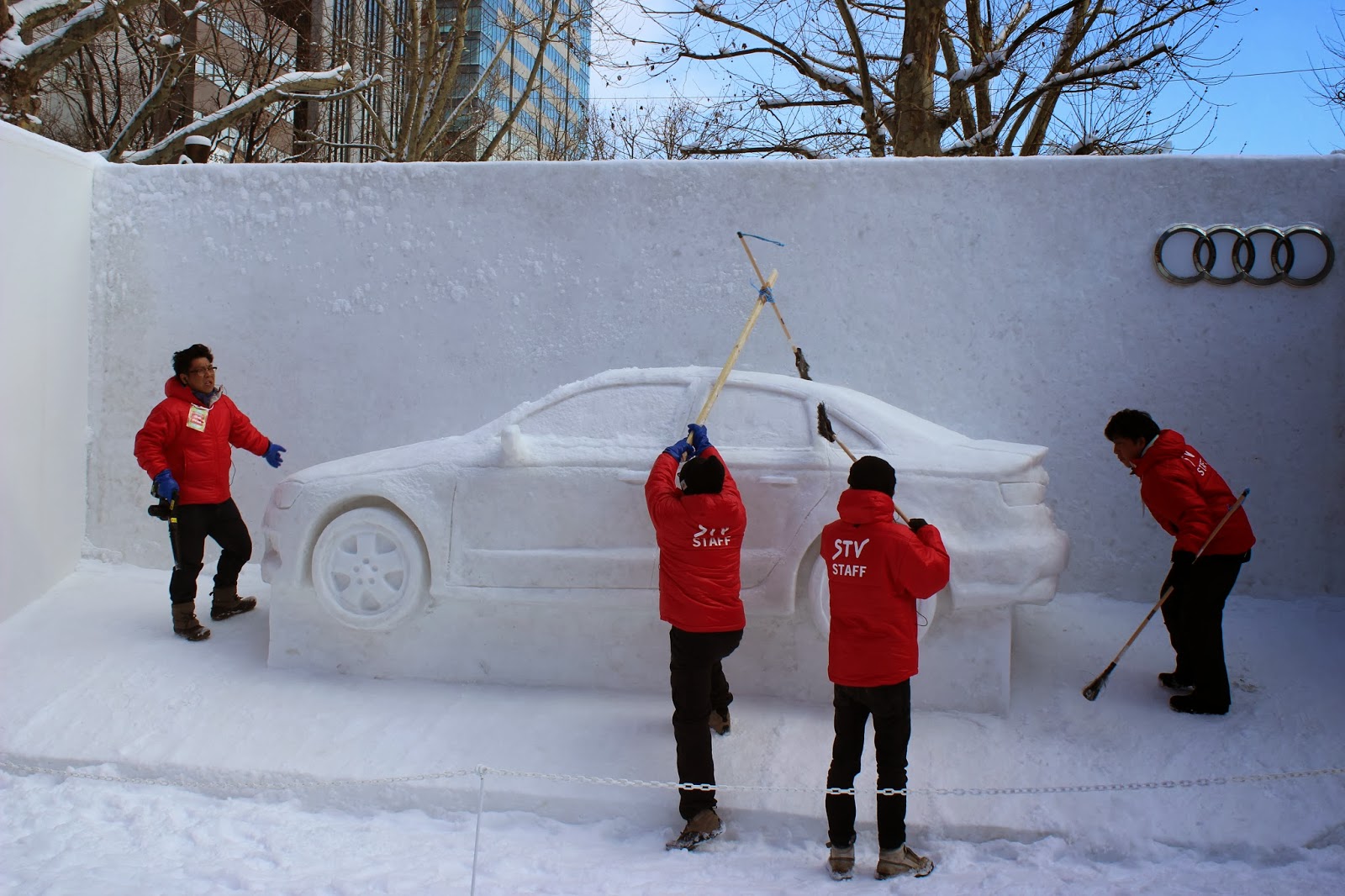
Going to the Sapporo Snow Festival reminded me of that quip, for some reason. It just impressed me how something that started so small—a pack of enterprising Hokkaido University students building modest snow sculptures in Odori Park in central Sapporo—blossomed into an annual world-famous festival that attracts over two million foreign tourists per year.

This year I was one of them. Here's my diary entry for that day: 


2/5:

10:32 a.m. Nice long sleep-in. At Kita-12 jo waiting for the train. Hardly anybody here. Is it because I'm used to Seoul, which is always a zoo, or because of the festival? The 65th Sapporo Snow Festival starts today, and I am heading first to Odori Park and then to Susukino to take in two-thirds of it (the other third is up in Tsudome, near Asaba, way up north, but I'm prioritizing). 

It's STILL snowing. Must have snowed all night. Light snow, heavy snow, light snow again. The only time it hasn't snowed was the bright sunny first morning. Wow. Not sure how easy it'll be trying to wrangle an umbrella AND a camera in this weather, but I'll try.


1:07 p.m. What I was praying for happened. At 11 or so, 30 minutes after I arrived at Odori Park, the sky cleared. The snow stopped.


Hokkaido scallop, ¥500. Good deal. 


Crab soup, also five hundred yen. Three kinds of crab!


I got some great pics and then strolled south to Susukino to see the ice sculptures.


That there may be no speculation...those are real fish.


Now they're just making me hungry...

Now I'm standing outside of Sushizanmai (which looks packed to the gills) and memorizing the menu. I want the Uruoi Sushimori Special, which has herring roe, boiled prawn, salmon roe, red tuna, white stuff that could be squid or flounder, red snapper, and six other things besides. Great place—the waitresses bustle and flit about in blue blouses, white aprons, black stockings and buckled shoes, while the chefs flay away at the fish, egg, and seaweed with their long, thin knives, shouting hearty hellos, goodbyes and thank-yous to the patrons coming and going. The tea is hot and the atmosphere warm in more ways than one.


You could immediately tell the difference between this and any other cut-rate sushi joint—fresh, tender ginger, moist rice and succulent seaweed. Eating the herring roe was an interesting experience—it had the color and texture of an orange slice. The miso soup with prawn heads was a lovely counterpoint. The sea urchin roe had the consistency of apple butter. There was also sardine, sea eel, and albacore tuna, plus shellfish. One of the red fish—either mackerel or red tuna—simply melted in my mouth. A feast. 

3:00 p.m. Sitting in the Hokkaido University Museum. Made a brief but futile stop at the gift shop for souvenirs. Pole Town (an underground mall between Odori and Susukino Stations) was a bust, too. Speaking of busts, I'm going to go see William Clark's now.
"Boys, be ambitious!" 

3:41 p.m. Just sent off the postcard to my folks at Sapporo's big blocky grey post office, east of the station. I'm lucky everything is so close together in this town. I think I'll hit the station on the way back to the hotel in one last-ditch effort to find souvenirs. 

5:32 p.m. Darkness has fallen. My last day in Sapporo is over. I'm ready to be gone, but I am a bit sad. I found no souvenirs—not in the station, nor Tokyu Department Store, nor anywhere else. All that's left is to get some chicken kebabs (yakitori) and beer for dinner, pack my bags and go to bed early. 

7:28 p.m. ADDENDUM. I had a peek in the yakitori place and discovered it was actually an izakaya—and the prices weren't nice. So I stumped a bit further south and found something that wasn't crowded, noisy, or overpriced—Beer & Coffee Venison. The name isn't poetic license—they serve deer meat. So I went on in. The light was low, coming from a line of glass globes over the wooden bar, every other one of which had the names of various Scotch whiskies written on it in multicolored marker. Lots of dark wood and white stucco-like walls, interspersed with tables and chairs with cross-shaped holes in the back (plus fully-antlered deer skulls on the walls and old coffee grinders and tea tins on the shelves) completed the rustic ambience [sic]. Behind the bar were two men: one elderly and thin, severe in demeanor, wearing a tie and black waistcoat and apron, with a beige wool-knit cap which clung to his bald pate like a yarmulke. The other man was likewise in a dark suit (with a fleece jacket flung over it) but was young, handsome, and energetic. He drummed his fingers on the bar in time to the jazz playing on the stereo (Colin Stranahan and Lloyd Miller), and buzzed about snipping labels or sterilizing glasses. The place had a bewildering collection of empty beer bottles in the window and quite a few in the fridge, Negra Modelo, Old Tom, Stone IPA and Löwenbräu among them. The Scotch selection, though extensive, tended to favor Islay and Highlands single malts, I noted. 


I sat down and ordered some venison sausage and a ¥500 glass of Heartland (a European pale lager made by Kirin, with a fine flavor and a delicious creamy head). I nibbled on Hokkaido potato salad and sliced pickles (and later the sausage and some fresh fruit) while the younger barkeep and I attempted a conversation. His name was Kei, and he loved jazz. It was he who manned the Toshiba laptop above the bar and chose tune after syncopated tune. I sensed rather than knew—for he spoke as little English as I did Japanese—that he was a student at Hokkaido University and that this was his part-time job, and that he longed to escape from pulling pints and pouring whiskey and escape to Tokyo (or perhaps even New York) and found a jazz trio. We talked as much as we were able. I sipped beer. The old proprietor washed up or stared into space. I felt the weight of my impending departure weigh heavily upon me. It was an introspective moment—the old man in his wool cap behind the bar, arms folded, staring at the empty room; Kei drumming his fingers, nodding his head and gazing at the computer screen; and me with a cleaned plate and a sweating beer glass in front of me, eyeing the collection of whiskey bottles in their glass cabinets, thinking about getting up at 4 a.m. tomorrow and feeling simultaneously warm and content yet lonely and restless. 

I got up, paid, snapped some photos of the bar and its stewards, bowed low, and left. I bought a crap-ton of food at the convenience store for tomorrow's 18-hour journey—onigiri, bento, salad, coffee, beer, apples, and even something which looked suspiciously like kimchi. All I have to do now is pack my bags and await the dawn.